THeMIS
The West's benchmark battlefield robot — an Estonian tracked "tankette" that swaps payloads to haul cargo, evacuate wounded, scout, defuse bombs or carry a machine gun. The first ground robot in the Lexicon, and the platform that proved the UGV concept across NATO and in Ukraine.
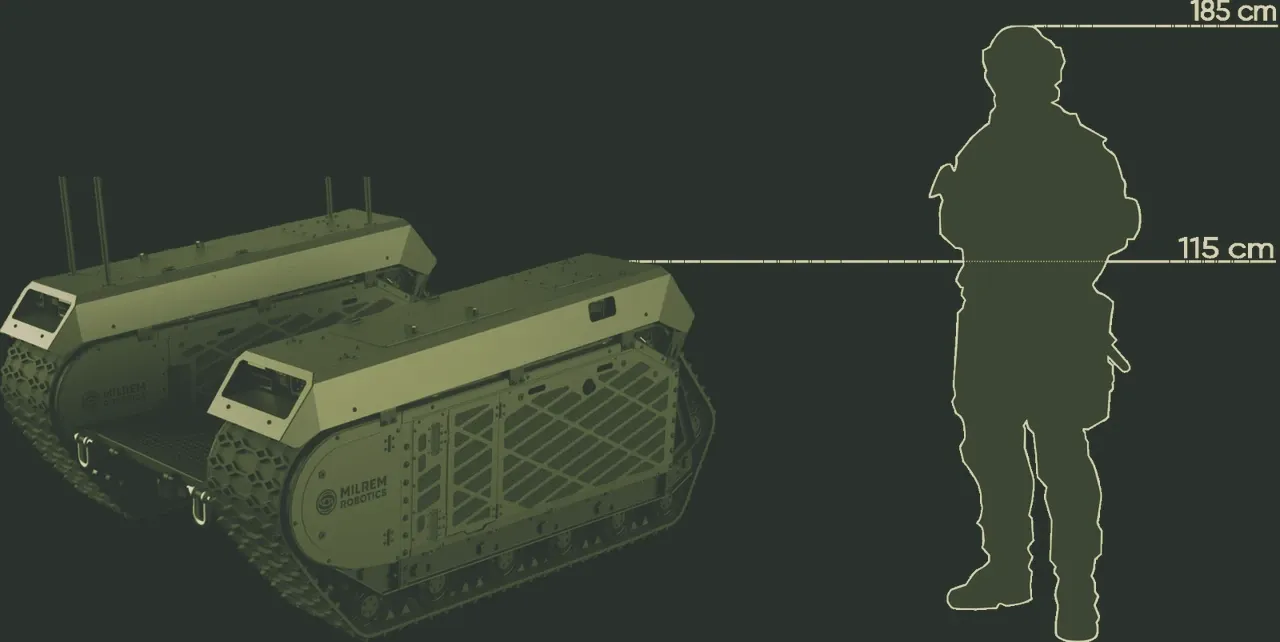
The West's benchmark battlefield robot — an Estonian tracked "tankette" the size of a quad bike that swaps modular payloads to haul supplies, evacuate wounded under fire, scout, clear mines, or carry a remote-controlled machine gun or anti-tank missile. It is the first unmanned ground vehicle (UGV) in the BattlePolicy Lexicon, opening a new category — because the ground robot is doing for the infantry's dirty, dangerous jobs what the FPV drone did for reconnaissance and strike. Built by Milrem Robotics, it has been exported across NATO and fielded in Ukraine.
Overview
THeMIS — Tracked Hybrid Modular Infantry System — is a tracked, hybrid diesel-electric unmanned ground vehicle built by Milrem Robotics of Estonia. Its defining trait is modularity: a common chassis with an open architecture accepts interchangeable mission payloads, so the same robot can be a logistics mule carrying cargo and ammunition, a casualty-evacuation platform fitted with stretchers, an ISR scout bristling with sensors, an EOD bomb-disposal unit, or a combat vehicle mounting a self-stabilizing remote weapon station. Designed to follow or be tele-operated by dismounted infantry, it reduces soldiers' physical load and pushes risk onto a machine. As the Lexicon's first ground robot, it stands in for the broader UGV surge now reshaping ground combat — most dramatically in Ukraine, where ground robots have moved from hauling supplies to leading assaults.
Development
Milrem Robotics began producing THeMIS in 2015 and the system entered service in 2019, per Wikipedia, built from the start as a "tankette" modular body for war robots. Estonia and the Netherlands jointly acquired the first batch in 2020, and Milrem unveiled missile-armed and combat configurations through the late 2010s. The Ukraine war accelerated everything: in September 2022 Milrem delivered casevac- and supply-configured THeMIS to Ukraine, followed in November 2022 by a German Ministry of Defence contract (via Krauss-Maffei Wegmann) for 14 more, and by 2025 the first armed THeMIS bound for the Ukrainian Armed Forces, including a configuration integrating Ukrainian firm Frontline's BURIA remote weapon station with a 40 mm automatic grenade launcher. The system has been exported to a long list of NATO members and partners, and Milrem has since developed the heavier 12-tonne Type-X robotic combat vehicle as its larger sibling.
Design & capabilities
THeMIS weighs about 1,630 kg, measures roughly 2.4 m long, and carries a payload of up to 1,200 kg on a tracked chassis driven by a hybrid diesel-electric powertrain — the "hybrid" allowing near-silent battery-only movement with the diesel generator off, per Wikipedia and Army Technology. Top speed is about 20 km/h with around 60 cm of ground clearance. The open architecture is the point: combat variants mount self-stabilizing remote weapon stations firing light or heavy machine guns, 40 mm grenade launchers, 30 mm autocannon, anti-tank guided missiles, or even loitering-munition launchers, while logistics, casevac, ISR and EOD payloads bolt onto the same body. It is tele-operated by line-of-sight or relay, with growing autonomy for waypoint navigation and obstacle avoidance — though, like all UGVs, it remains tied to a vulnerable control link.
Variants
- THeMIS Transport / Cargo: logistics mule for last-mile resupply.
- THeMIS CASEVAC: stretcher-equipped casualty evacuation (the early Ukraine deliveries).
- THeMIS Combat: self-stabilizing RWS with MG, 40 mm AGL, 30 mm autocannon or ATGM; the Frontline BURIA-integrated version for Ukraine.
- THeMIS Observe / ISR: multi-sensor reconnaissance and surveillance.
- THeMIS EOD: explosive-ordnance disposal and counter-IED.
- Type-X: Milrem's separate, heavier (~12-tonne) robotic combat vehicle — the bigger sibling, not a THeMIS variant.
Combat record / operational use
THeMIS first saw operational use supporting France's Operation Barkhane in Mali, but its highest-profile employment is in Ukraine, where casevac and logistics units have used it to resupply front-line positions and pull wounded out of fire since 2022, with armed variants following in 2025. It has also reportedly appeared in the 2025 Cambodia–Thailand border clashes. Across NATO it is fielded or trialed by Estonia, the Netherlands, Germany, France, the UK, the US, Spain, Sweden, Norway, Australia, India and Denmark, making it the most widely exported Western battlefield UGV. Its Ukraine record sits within a much larger ground-robot wave — alongside cheaper indigenous Ukrainian UGVs like Lyut and TerMIT — that by 2025 had robots not just hauling and evacuating but leading assaults and holding positions.
Advantages
- Modular — one chassis, many missions (logistics, casevac, combat, ISR, EOD) via interchangeable payloads.
- Saves lives — moves cargo and wounded, and delivers fire, without exposing soldiers.
- Hybrid drive — near-silent battery movement for stealthy approaches; diesel for range.
- High payload — up to 1,200 kg on a compact tracked body.
- Proven and exported — combat-used in Mali and Ukraine; fielded across 15+ nations, the Western UGV standard.
Drawbacks / limitations
- Control-link dependent — tele-operation relies on a radio link that EW can jam and that limits range (line-of-sight on the order of a kilometer-plus).
- Slow and short-ranged — ~20 km/h and limited endurance constrain tactical reach.
- Costly versus improvised UGVs — far pricier than the cheap indigenous Ukrainian ground robots now made in bulk.
- Vulnerable — like any ground vehicle, exposed to mines, ATGMs and FPV drones once spotted.
- Limited autonomy — still largely operator-driven; full autonomy remains aspirational.
Counterparts
THeMIS opens the UGV category in the Lexicon and is the Western benchmark against which other ground robots are measured: the Russian Uran-9 combat UGV, and Ukraine's cheaper, mass-produced indigenous systems — the Lyut combat robot and the TerMIT logistics/casevac platform. Its larger sibling is Milrem's Type-X robotic combat vehicle, and its conceptual peers include the US-tested Gladiator/RCV programs and a growing field of NATO UGVs. THeMIS's distinction is maturity and reach: where most UGVs are national or experimental, it is a proven, widely exported, modular product that helped establish the category itself.
Outlook
THeMIS sits at the front of a category that is exploding: ground robots are following aerial drones in transforming combat, taking on the logistics, casevac and increasingly the assault and fire-support roles that cost infantry the most. Its trajectory is toward greater autonomy, multi-robot control, and armed configurations like the BURIA-integrated version for Ukraine. The tension to watch into 2026–2027 is cost and scale: THeMIS is capable and proven but expensive, while Ukraine is fielding thousands of cheap indigenous UGVs — so the question is whether the premium Western product or the mass-produced attritable model defines the future of ground robotics, and how both cope with the EW and drone threats that hunt anything on the battlefield.
Key specifications
| Spec | Value |
|---|---|
| Type | Tracked modular unmanned ground vehicle (UGV) |
| Origin | Estonia — Milrem Robotics |
| In service | 2019 (produced from 2015) |
| Mass / payload | ~1,630 kg / up to 1,200 kg |
| Dimensions | ~2.4 m L × 2.0 m W × 1.15 m H |
| Powertrain | Hybrid diesel-electric; tracked |
| Speed | ~20 km/h |
| Variants | Transport, CASEVAC, Combat (RWS), ISR/Observe, EOD |
| Armament (combat) | LMG/HMG, 40 mm AGL, 30 mm autocannon, ATGM, loitering-munition launcher |
| Operators | Estonia, Ukraine, Netherlands, Germany, France, UK, US, Spain, Sweden, Norway, Australia, India, Denmark |
| Status | In service |
Sources
- THeMIS — Wikipedia
- THeMIS Hybrid Unmanned Ground Vehicle — Army Technology
- THeMIS family — Milrem Robotics
- Milrem Robotics delivers THeMIS UGV to Ukraine — MilitaryLeak
- IAV 2025: Milrem reveals armed UGV to be supplied to Ukraine — Janes
- Milrem Robotics and Frontline integrate THeMIS UGV and BURIA RWS — Milrem Robotics
🔒 The Analyst Section on THeMIS is for BattlePolicy Pro members. Below the line: procurement and contract history, the suppliers and companies behind the system, our head-to-head analyst view of the systems it actually competes with, and the BattlePolicy assessment note. Unlock the full file with BattlePolicy Pro →