The Wire · live GRID-REF 37°47′N 122°25′W
DISPATCH 03/26 · 25 Aug 2026
BattlePolicy
Startup to front line. Strategy to consequence.
Lexicon · Europe

Steyr AUG

The rifle that made the bullpup mainstream — Austria's Steyr AUG packed a full-length barrel into a compact polymer body with an integral optic and quick-change barrels, decades ahead of its time in 1978. Still produced, still serving in ~40 countries, it is Austria's defining weapon.
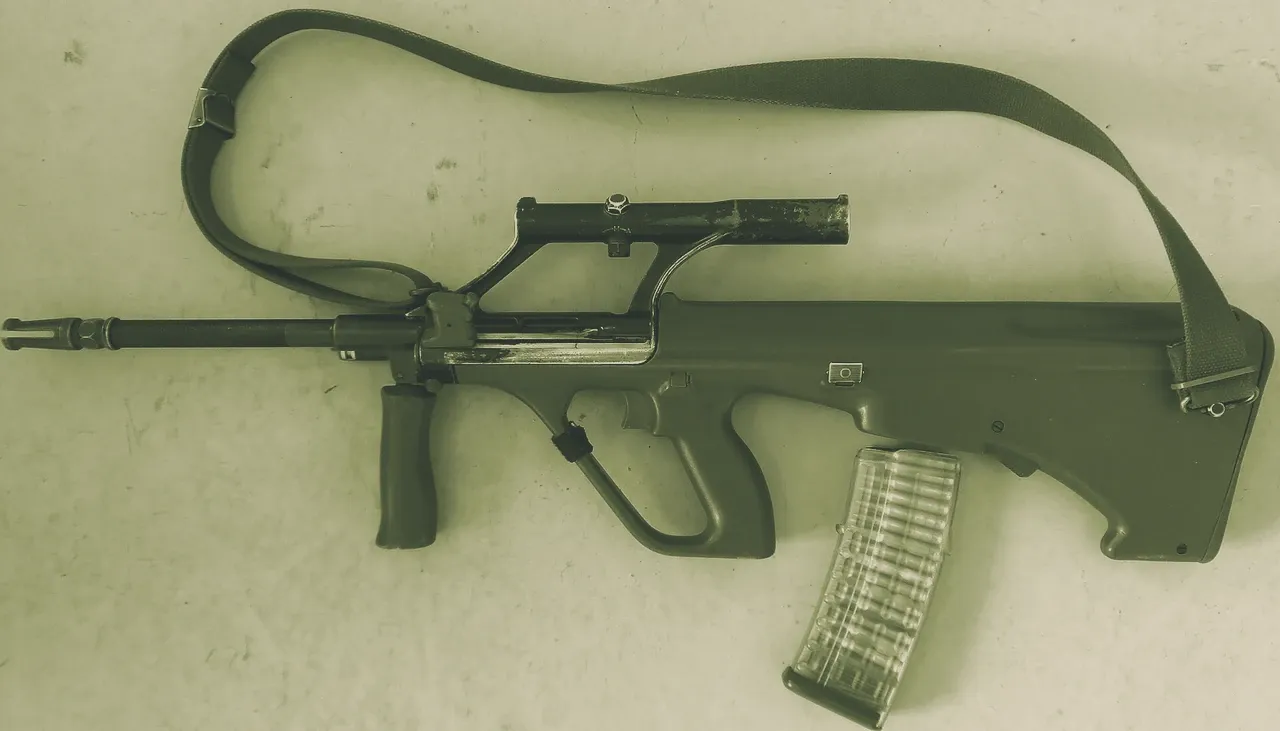
Steyr AUG
FIG.01 · Europe Image - A Steyr AUG bullpup assault rifle. Photo by MoserB, Public domain, via Wikimedia Commons.
The rifle that made the bullpup mainstream — Austria's Steyr AUG (Armee-Universal-Gewehr, "army universal rifle") was a decade or more ahead of its time when it entered service in 1978: a compact, futuristic polymer weapon that put the action behind the trigger to fit a full-length barrel in a short package, with a built-in optical sight and quick-change barrels turning one rifle into a carbine, a marksman's weapon or a light support gun. Nearly half a century on it is still produced and still serving across some 40 countries — Austria's single most influential and recognizable weapon.

Overview

The Steyr AUG is a bullpup 5.56×45mm NATO assault rifle developed by Steyr Mannlicher (now Steyr Arms) of Austria, adopted by the Austrian Armed Forces as the StG 77 in the late 1970s. "Bullpup" means the magazine and action sit behind the trigger group, so the rifle can carry a long barrel for full velocity and accuracy in an overall length far shorter than a conventional rifle. The AUG paired that layout with a then-radical mix of features — an integral optical sight, extensive use of polymer, a modular quick-change barrel system, ambidextrous controls and a progressive trigger (squeeze partway for semi-auto, fully for automatic) — that made it look and work like a weapon from a later decade. It is the design that proved the bullpup concept for Western armies, and it remains, with the Glock pistol, one of Austria's two globally significant small arms.

Development

Steyr developed the AUG in the early-to-mid 1970s as a clean-sheet "universal" weapon system, and Austria adopted it as the StG 77 around 1977–1978, per Wikipedia and standard small-arms references. Its design goals were compactness, modularity, ergonomics and manufacturability, and it achieved them with a distinctive look — the translucent magazine, integral 1.5× optic and forward grip became iconic. The AUG was an early and influential adopter of the bullpup configuration for general-issue infantry rifles, predating and informing later Western bullpups. It has been produced in successive variants (the modular AUG A1/A2/A3 standards, the latter adding Picatinny rails for modern optics and accessories) and remains in production. Crucially, it was widely exported and licence-produced: most notably Australia adopted it as the F88 Austeyr (built by Lithgow), and it was taken up by Ireland, Malaysia, New Zealand (formerly), Saudi Arabia and many others — roughly 40 nations in total.

Design & capabilities

The AUG's core is its bullpup layout: a ~508 mm (20-inch) standard barrel in a rifle only about 790 mm long — a full-power barrel in a carbine-sized package. The receiver and furniture are polymer; the controls are ambidextrous (the rifle can be set up to eject from either side with a bolt swap); and the original trigger is progressive, a clever way to give semi- and full-automatic fire without a separate selector switch (later/variant models offer conventional selectors). The signature feature is modularity: barrels of different lengths (carbine ~407 mm, standard ~508 mm, and a heavy ~621 mm light-support-gun barrel with bipod) swap quickly via a barrel-release catch, and the optic/rail module can be changed, so a single weapon family covers the close-quarters, standard-rifle and squad-automatic roles. The integral 1.5× optical sight (on early models; a Picatinny rail on the A3) gave issued troops optics decades before it became standard elsewhere. The trade-offs are the bullpup's known ones — a rearward balance, the magazine and ejection close to the face, a longer, mushier trigger linkage, and historically awkward left/right reconfiguration — but the AUG's reliability, accuracy and compactness made it a durable success.

Variants

  • AUG A1: the original with integral 1.5× optical sight.
  • AUG A2: revised optic/rail mounting and accessory options.
  • AUG A3: Picatinny rails for modern optics, lights and accessories; the current modular standard.
  • Barrel modules: carbine (~407 mm), standard rifle (~508 mm), and heavy-barrel LSW (~621 mm) configurations.
  • F88 Austeyr: the Australian licence-built family (Lithgow), with national EF88 upgrades.
  • Various national and semi-automatic civilian versions.

Combat record / operational use

The AUG has seen broad service since 1978 across the militaries and police forces of some 40 countries, including extensive operational use by Australian forces (as the F88/EF88) in Iraq, Afghanistan and elsewhere, and by Irish, Austrian and other troops on deployments and peacekeeping missions. As a general-issue rifle it has a long, varied combat history rather than a single defining engagement, and its reliability and accuracy earned it a solid operational reputation. Its modular barrel system has been used to field a single weapon family in multiple roles within a unit. The AUG's significance is its longevity and influence: a 1970s design still in front-line service and production decades later, and the weapon that demonstrated the bullpup layout could work for a modern Western army — paving the way for later bullpups.

Advantages

  • Compact with a full barrel — bullpup layout gives rifle-length performance in a carbine-sized weapon.
  • Modular — quick-change barrels turn one rifle into carbine, standard rifle or light support weapon.
  • Optic-equipped from the start — integral sight (later rails) decades ahead of general-issue norms.
  • Reliable and accurate — a durable, well-regarded combat reputation over ~50 years.
  • Proven and widespread — adopted/licence-built by ~40 nations; still produced (A3).

Drawbacks / limitations

  • Dated by 2020s standards — a 1970s design; not a "new" system despite ongoing production.
  • Bullpup ergonomics — rearward balance, action near the face, longer trigger linkage.
  • Reconfiguration awkwardness — changing ejection side historically required a bolt swap (improved later).
  • Magazine/optics legacy — early proprietary magazines and the integral optic dated faster than modular rails.
  • Superseded in some fleets — several operators have moved to newer rifles or upgraded variants.

Counterparts

The Steyr AUG's closest peer is the British L85 — the two are the defining Western bullpups, the AUG far more successful in export and reputation. It stands against conventional-layout rifles like the M4 carbine, the German G36 and HK416, and Russia's AK-12, and alongside other bullpups such as China's QBZ-95 and France's former FAMAS. Within Austrian small arms it is the rifle counterpart to the Glock 17 pistol — the two products that made a small, neutral country a global small-arms power. The AUG's distinction is historical primacy: it proved the bullpup concept for the West and packed modular, optic-equipped, polymer design into a service rifle long before such features became standard.

Outlook

The Steyr AUG is included here as Austria's defining weapon rather than a new one: a system whose significance is its longevity, influence and continued production and service nearly five decades on. Its trajectory is steady — ongoing A3 production and national upgrade programs (like Australia's EF88) keep it relevant, even as some operators transition to newer rifles. The broader context is a small-arms world that has, in many ways, caught up to and moved past the AUG's once-radical ideas: modularity, optics and polymer construction are now universal, and the bullpup layout has fallen in and out of favour. For a country of Austria's size and neutrality, the AUG (with the Glock) remains a remarkable industrial achievement — a service rifle that shaped infantry-weapon design and still arms soldiers around the world. It is the clearest answer to "what is Austria's notable combat system," even if the honest caveat is that it is a classic rather than a newcomer.

Key specifications

Spec Value
Type Bullpup 5.56×45mm NATO assault rifle (modular)
Designation Steyr AUG (Austrian StG 77)
Origin Austria — Steyr Arms (Steyr Mannlicher)
Adopted 1977–1978 (Austria)
Layout Bullpup; polymer; ambidextrous; progressive trigger (early)
Barrels Carbine ~407 mm / standard ~508 mm / heavy LSW ~621 mm (quick-change)
Optics Integral 1.5× (A1); Picatinny rails (A3)
Overall length ~790 mm (standard barrel)
Variants A1 / A2 / A3; F88/EF88 Austeyr (Australia)
Operators Austria, Australia, Ireland, Malaysia, Saudi Arabia, others (~40 nations)
Status In service / production

Sources

  1. Steyr AUG — Wikipedia
  2. Steyr AUG — Steyr Arms
  3. Steyr AUG assault rifle — Army Recognition
  4. F88 Austeyr — Australian Army / Lithgow
  5. Steyr AUG — Modern Firearms
🔒 The Analyst Section on Steyr AUG is for BattlePolicy Pro members. Below the line: procurement and contract history, the suppliers and companies behind the system, our head-to-head analyst view of the systems it actually competes with, and the BattlePolicy assessment note. Unlock the full file with BattlePolicy Pro →
Related