The Wire · live GRID-REF 37°47′N 122°25′W
DISPATCH 03/26 · 23 Aug 2026
BattlePolicy
Startup to front line. Strategy to consequence.
Lexicon · Europe

Pilatus PC-21

The turboprop that flies like a jet — Switzerland's Pilatus PC-21 trains fast-jet pilots at a fraction of a jet's cost by mimicking jet-like performance and cockpits, "downloading" expensive jet training onto a cheap propeller plane. The most successful Western advanced trainer of its generation.
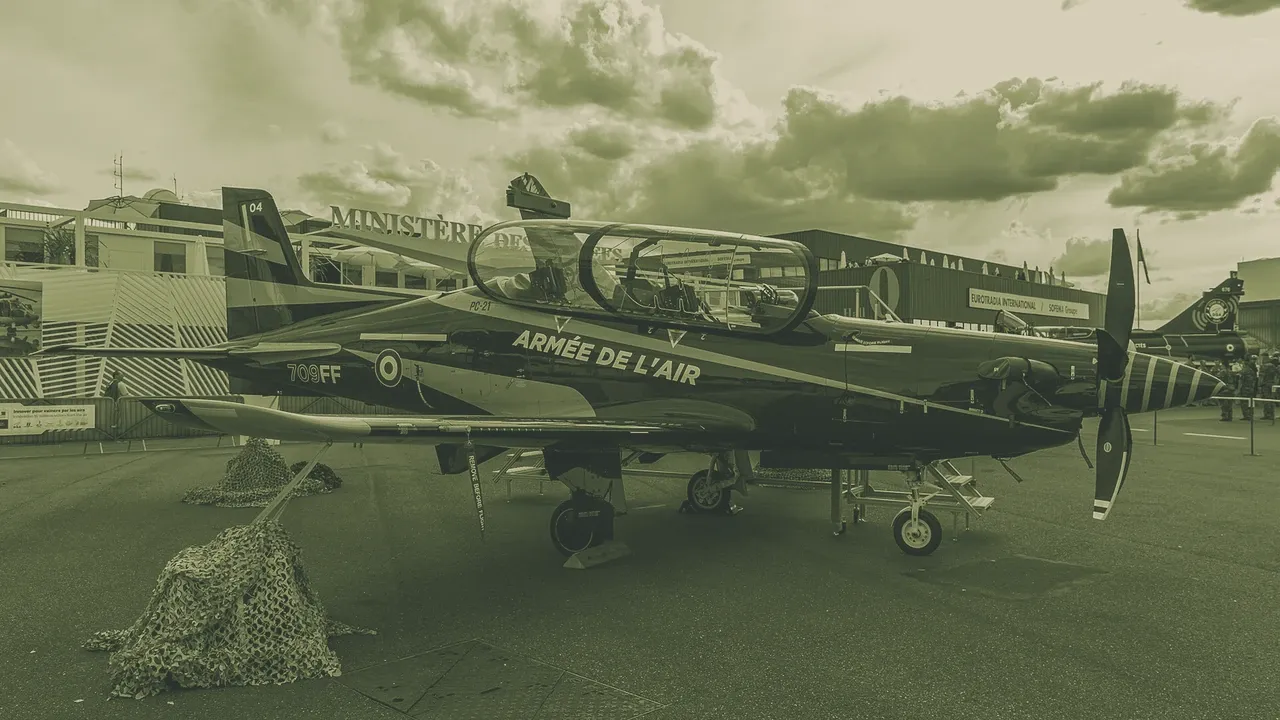
Pilatus PC-21
FIG.01 · Europe Image - A Pilatus PC-21 advanced trainer aircraft. Photo by Matti Blume, CC BY-SA 4.0, via Wikimedia Commons.
The turboprop that flies like a jet — Switzerland's Pilatus PC-21 is built to train fast-jet pilots at a fraction of a jet's cost, mimicking jet-like performance, handling and cockpits so that air forces can "download" most of their expensive jet training onto a cheap, reliable propeller aircraft before students ever climb into a real fighter. With a secondary light-attack capability and operators across Europe, the Gulf and the Pacific, it is the most successful Western advanced trainer of its generation and the flagship military product of Swiss aerospace.

Overview

The PC-21 is a single-engine, tandem-seat advanced trainer manufactured by Pilatus Aircraft of Switzerland. Powered by a 1,600-horsepower Pratt & Whitney Canada turboprop yet engineered for jet-like performance — high speed, high g-limits and a digital, fighter-style cockpit — it is designed to let students complete the bulk of fast-jet training on a turboprop, deferring or reducing time on costly jet trainers and lead-in fighters. The result is dramatically lower training costs per pilot. Beyond training, the PC-21 carries underwing hardpoints for weapons, giving it a secondary light-attack role. It sits at the top of Pilatus's military-trainer line above the PC-7 and PC-9, and has become a global standard for advanced/lead-in fighter training.

Development

The PC-21 first flew on 1 July 2002 and entered service from the mid-2000s, conceived by Pilatus as an "expanded envelope" trainer to bridge basic flying and modern fast jets, per Wikipedia and Airforce Technology. The core idea was economic and pedagogical: modern fighters (and even jet trainers) are extremely expensive to fly, so pushing as much training as possible onto a high-performance turboprop — with simulated sensors, datalink and weapons in the cockpit — saves money and aircraft hours while still teaching jet-relevant skills. The concept proved popular: the PC-21 has been sold to a long list of air forces, with over 235 built and production continuing. Pilatus markets it as a complete training system, not just an airframe — including simulators, ground-based training and courseware — which is central to its commercial success.

Design & capabilities

The PC-21 pairs a Pratt & Whitney Canada PT6A-68B turboprop (about 1,600 hp / 1,200 kW) driving a five-bladed propeller with an airframe cleared for jet-like flight: a maximum speed around 370 knots indicated and a g-envelope of roughly +8 / −4, with a digital "glass" cockpit, hands-on-throttle-and-stick controls and an embedded simulation/training system that can mimic radar, sensors, datalink and weapons for realistic mission training, per Grokipedia and Pilatus. The stepped tandem cockpit replicates a fast-jet layout for both student and instructor. Five external hardpoints allow carriage of training stores or live weapons, supporting a secondary light-attack role (used by some operators) and weapons-training sorties. The aircraft is designed for high sortie rates, low maintenance and long life. Its defining attribute is not raw performance but training value: delivering as much fighter-relevant instruction as possible on a cheap, durable turboprop, reshaping the economics of pilot training.

Variants

The PC-21 is a single principal type rather than a branching family; differences are by national training-system configuration (avionics, embedded-simulation fits and weapons clearances tailored to each customer). It is the advanced member of Pilatus's trainer line, above the PC-7 and PC-9 (and the newer PC-7 MkX), and complements rather than replaces those basic trainers in many fleets.

Combat record / operational use

The PC-21's "operational" record is overwhelmingly in training: it is the advanced/lead-in fighter trainer for numerous air forces, including Switzerland, the United Arab Emirates, Qatar, Saudi Arabia, Australia, France, Spain, Jordan, the UK (Empire Test Pilots' School) and others, with Canada among future operators. France and others use it as the centrepiece of restructured, cost-efficient pilot-training pipelines. In its secondary light-attack role, PC-21s and the related PC-7/PC-9 family have been used for armed light-strike and counter-insurgency by some operators, though the PC-21 is primarily a trainer. Its significance is industrial and systemic rather than combat: it has reshaped how Western and partner air forces train fast-jet pilots, moving the bulk of instruction onto an affordable turboprop and saving enormous sums in jet-trainer and fighter flying hours.

Advantages

  • Jet-like training cheaply — turboprop economics with jet-relevant performance, cockpit and embedded simulation.
  • Cost savings — "downloads" expensive jet/fighter training onto a far cheaper aircraft.
  • Complete training system — sold with simulators, ground training and courseware, not just an airframe.
  • Widely adopted — 235+ built across many air forces; a de facto Western advanced-trainer standard.
  • Secondary light attack — hardpoints allow weapons training and a light-strike role.

Drawbacks / limitations

  • Primarily a trainer — not a combat aircraft; its light-attack role is secondary and limited.
  • Turboprop ceiling — cannot fully replicate the highest-end jet performance regimes.
  • Not survivable in contested airspace — a light-attack PC-21 is vulnerable against modern air defences.
  • Training-pipeline dependence — its value is realized only within a well-designed training system.
  • Limited payload/range — modest weapons load and reach in the light-attack role.

Counterparts

The PC-21 competes in the advanced/lead-in turboprop-trainer market against the US/Beechcraft T-6 Texan II, the Brazilian Embraer Super Tucano (which leans more toward light attack), the Korean KAI KT-1, and jet trainers like the Leonardo M-345/M-346 (the latter for the highest-end lead-in fighter training). It trains pilots who go on to fly fighters such as the Rafale, Eurofighter Typhoon, F-35 and Gripen. The PC-21's distinction is how far up the training ladder it pushes a turboprop — its jet-like envelope and embedded simulation let it absorb training that previously required jets, which is the core of its commercial success and its influence on training doctrine. As Switzerland's flagship military aircraft, it is also the most prominent product of a neutral country's defence-aerospace industry.

Outlook

The PC-21 is the standard-bearer of a structural shift in pilot training: moving instruction off expensive jets and onto a high-performance, simulation-rich turboprop to cut costs without sacrificing fighter-relevant skills. Its trajectory is continued sales and the expansion of its training-system model, as air forces facing rising fighter-flying-hour costs (especially with fifth-generation jets) look to economize. The variables to watch are new orders (Canada and others), the competition from jet trainers for the very top of lead-in fighter training, and how embedded-simulation and synthetic training evolve the trainer's role. For Switzerland, the PC-21 is a rare case of a neutral nation fielding a globally successful military aircraft; for air forces, it is the quiet enabler that makes training the next generation of fighter pilots affordable.

Key specifications

Spec Value
Type Advanced turboprop trainer / light attack
Origin Switzerland — Pilatus Aircraft
First flight 1 July 2002
Engine Pratt & Whitney Canada PT6A-68B turboprop, ~1,600 hp (1,200 kW)
Max speed ~370 knots indicated
g-limit ~+8 / −4
Crew 2 (student + instructor, tandem)
Hardpoints 5 (training stores / light-attack weapons)
Built 235+ (production continuing)
Operators Switzerland, UAE, Qatar, Saudi Arabia, Australia, France, Spain, Jordan, UK (test school), others; Canada (future)
Status In service

Sources

  1. Pilatus PC-21 — Wikipedia
  2. Pilatus PC-21 Turboprop Trainer Aircraft — Airforce Technology
  3. Pilatus PC-21 – Technical Specifications — Pilatus Aircraft
  4. Pilatus PC-21: RCAF's Next-Gen Trainers — Simple Flying
  5. Pilatus PC-21 — Military Factory
🔒 The Analyst Section on Pilatus PC-21 is for BattlePolicy Pro members. Below the line: procurement and contract history, the suppliers and companies behind the system, our head-to-head analyst view of the systems it actually competes with, and the BattlePolicy assessment note. Unlock the full file with BattlePolicy Pro →
Related