A Consumer Developer Board Let a Russian Drone Pick Its Own Target
An Nvidia Jetson Orin gave Russia's mass-produced Molniya autonomous terminal targeting, with no radio control link for Ukrainian electronic warfare to jam.
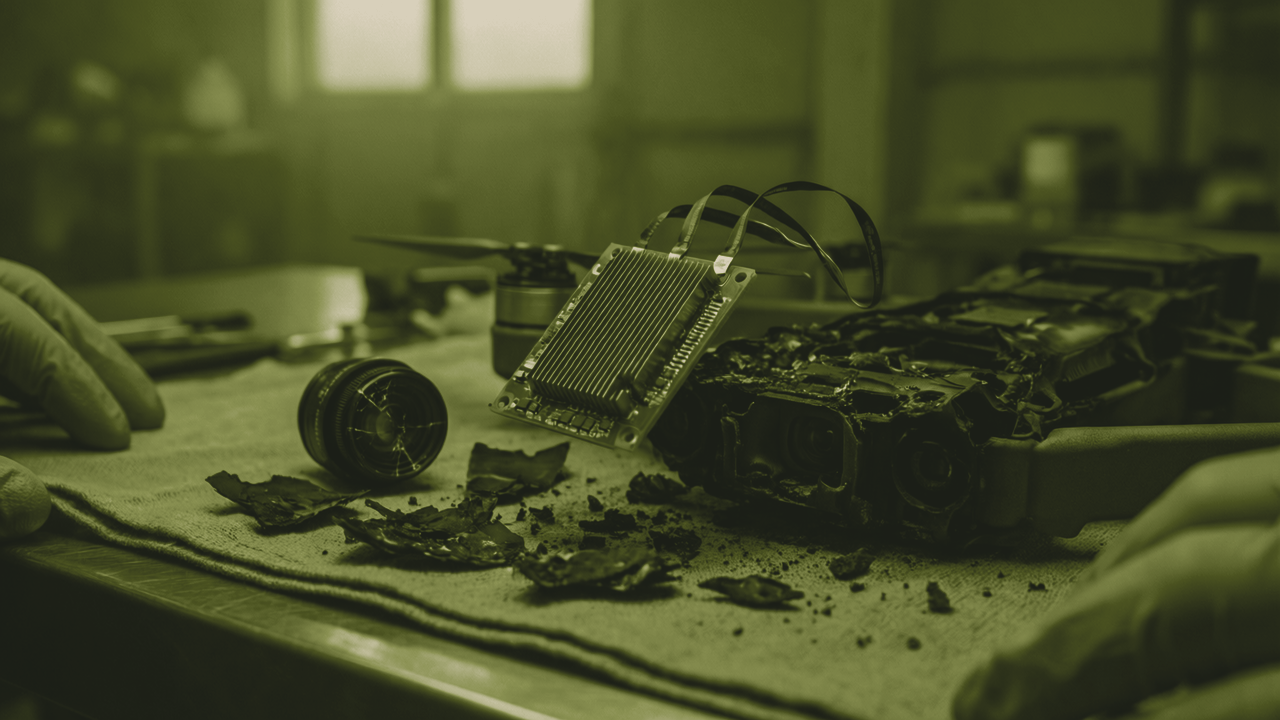
An Nvidia Jetson Orin gave Russia's mass-produced Molniya autonomous terminal targeting, with no radio control link for Ukrainian electronic warfare to jam.
A Russian Molniya attack drone struck near a gas station in Zaporizhzhia on July 6, killing three civilians, The New York Times reported. The victims were Tetiana Bubynets, a 19-year-old accounting student at Zaporizhzhia National University, Oleksiy Svirin, 41, and Roman Karpiy, 48.
Operators sent the fixed-wing drone toward the station. Onboard software then selected the exact aimpoint without human control, most likely propane tanks it had learned to recognize, Ukrainian air-defense commanders and forensic examiners told the Times. The drone failed to clear an apartment building, struck a wall and detonated near people sheltering there.
Frequently Asked Questions
What made the July 6 Zaporizhzhia strike different from other drone attacks?
Operators flew the drone toward the gas station, but onboard software picked the exact aimpoint with no human in the loop, Ukrainian air-defense commanders and forensic examiners told The New York Times. A CSIS analyst tracking the program assessed it as the first documented civilian deaths from a Russian self-targeting drone.
What is the Nvidia Jetson Orin, and how did it end up in a Russian weapon?
It is a consumer-grade edge-computing module sold to students and developers for a few hundred dollars. Nvidia said it does not sell the board in Russia and that it is widely available through resellers. The module is absent from the U.S. export-control list, so a distributor can legally sell it to a reseller in a third country, per DroneXL.
Why does the missing radio antenna matter?
Wreckage held the Jetson modules but no radio antennas, and the drone flew in a wave of roughly six, none transmitting. With no operator link, there is nothing for Ukrainian electronic warfare to sever.
How did investigators establish what the drone was targeting?
The July 6 module was not encrypted, which let Ukrainian officials read the stored terrain imagery and the code specifying which objects to attack. Vadym Kushnikov of the Kharkiv Aviation Institute said the weapon was preprogrammed and trained in simulation to hunt specific objects.
Has the same board turned up in other Russian systems?
The Molniya is the fourth Russian weapon family Ukrainian investigators have tied to the board, after the V2U drone, the Shahed MS001 variant and the S-71M Monochrome cruise missile. Ukraine's HUR database lists the S-71M module as produced in March 2025.
How is Zaporizhzhia defending against these drones?
The defenses are physical. Anti-drone nets now cover about 386 kilometers of roads in and around the city, and gas stations prop angled plastic sheeting around propane tanks to confuse the image classifiers.
AI-generated summary, reviewed by an editor. More on our AI guidelines.
Below this point
5 more sections.
Wreckage from that strike and other Molniya attacks contained Nvidia Jetson Orin minicomputers but no radio antennas. The July 6 module was not encrypted, allowing Ukrainian officials to read stored terrain imagery and code specifying which objects to attack. The drone flew in a wave of roughly six, none transmitting. A CSIS analyst tracking the program assessed that the attack caused the first documented civilian deaths from a Russian self-targeting drone.
The weapon was preprogrammed and trained in simulation to hunt specific objects, Vadym Kushnikov of the Kharkiv Aviation Institute said. Without an antenna, the Molniya has no operator link for Ukrainian electronic warfare to sever. Russia has put that autonomy on a cheap fixed-wing model it already mass-produces, rather than reserving it for a scarce missile.
Nvidia confirmed to the Times that photographs showed a Jetson Orin. The company called it a consumer-grade board sold to students and developers for a few hundred dollars. It said it does not sell the module in Russia, and that the board remains widely available through resellers. The board is absent from the U.S. export-control list, so a distributor can legally sell it to a reseller in a third country, DroneXL found.
The Molniya is the fourth Russian weapon family Ukrainian investigators have tied to the board, after the V2U drone, Shahed MS001 variant and S-71M Monochrome cruise missile. Ukraine's HUR database lists the S-71M module as produced in March 2025.
Zaporizhzhia now has anti-drone nets covering about 386 kilometers of roads. Gas stations are also propping angled plastic sheeting around propane tanks to confuse the image classifiers.

Marcus Schuler
Marcus Schuler edits BattlePolicy, a daily defense-technology brief connecting the companies and capabilities behind modern war to the contest among Europe, the US, Russia, and China.