The Wire · live GRID-REF 37°47′N 122°25′W
DISPATCH 03/26 · 23 Aug 2026
BattlePolicy
Startup to front line. Strategy to consequence.
Lexicon · Ukraine

TerMIT

Ukraine's $12,000 robot mule — a small tracked ground drone that hauls 300 kg of ammo and supplies to the trench, evacuates the wounded, or mounts a machine gun, made by the thousands. The workhorse of Ukraine's 2025 ground-robot surge, now heading into German co-production.
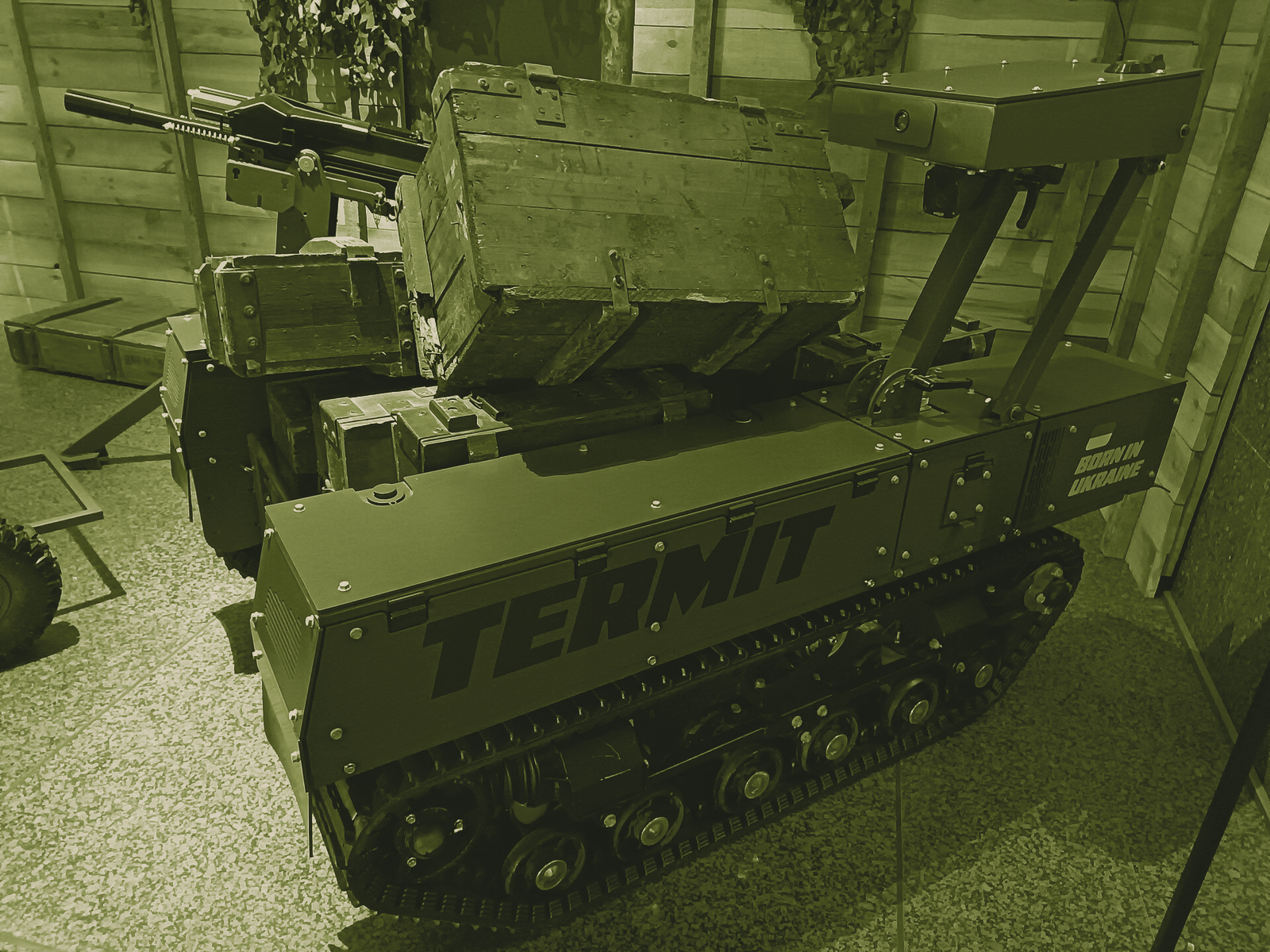
Ukraine's robot mule — a small, cheap tracked ground drone that hauls up to 300 kg of ammunition, water and supplies into the trench, drags the wounded out under fire, or mounts a machine gun, and is being built by the thousands for roughly the price of a used car. Made by the Ukrainian startup Tencore, the TerMIT (Terrain Modular Infantry Transporter) is the workhorse of Ukraine's 2025 ground-robot surge — the cheap-and-many answer to a manpower crisis, now heading into German co-production.

Overview

TerMIT is a tracked, modular unmanned ground vehicle (UGV) developed by the Ukrainian firm Tencore LLC. It is built around one idea: take the most dangerous, manpower-intensive jobs near the front — resupply, casualty evacuation, surveillance — and hand them to a cheap, attritable robot. A low-profile tracked chassis carries a 300 kg payload across mud, trenches and broken ground, and the platform is modular: the same body can be a logistics carrier, a stretcher-equipped casevac unit, a surveillance scout, or a combat vehicle mounting a Browning machine gun, an Mk 19 grenade launcher, or a remote weapon station. At around $12,000 a unit, it embodies Ukraine's strategy of substituting cheap mass-produced machines for scarce, irreplaceable infantry — the ground equivalent of the FPV-drone revolution.

Development

TerMIT is the product of Ukraine's wartime defense-tech boom, accelerated by the Brave1 technology cluster that vets and codifies new systems for procurement. Earlier versions of the platform were already in front-line use for logistics and surveillance, and Tencore's improved model — explicitly designed around feedback from those deployments — was codified and approved by Ukraine's Ministry of Defence in mid-2025, per Forbes and Defense Express. The name expands to Terrain Modular Infantry Transporter. Tencore raised funding to scale production toward 2,000 units, and in June 2026 announced Quantum Tencore Industries (QTI), a joint venture with Germany's drone-maker Quantum Systems to build 2,000 TerMITs in Germany for Ukraine — a notable step from improvised wartime startup to internationalized production.

Design & capabilities

The TerMIT is a compact, low-slung tracked robot whose design priorities are payload, terrain-crossing and cost. It carries up to 300 kg, navigates trenches and rough ground thanks to its low profile and tracked drive, and is tele-operated by an operator who stays in cover — taking the human out of the kill zone for logistics and evacuation runs that historically cost lives. Modularity is central: per TechUkraine, the platform swaps between a logistics bed, a dedicated evacuation module, and combat fits including a Browning machine gun or Mk 19 grenade launcher. It has been integrated with Ukrainian firm Frontline's Burya remote weapon station — a 47 kg turret that can be targeted by drones or the Kropyva fire-control system — turning the logistics mule into a remote-controlled gun platform. Like all UGVs it depends on a tele-operation link vulnerable to jamming and limited in range, and it is exposed to mines and FPV drones once spotted.

Variants

TerMIT is an evolving modular family rather than a fixed model: successive generations have improved payload, weight distribution and terrain handling, and the platform reconfigures by role — logistics (cargo/ammunition resupply), casevac (a dedicated evacuation module added in 2026), surveillance/ISR, and combat (machine gun, Mk 19, or the Burya remote weapon station). The QTI joint venture introduces German co-production of the platform.

Combat record / operational use

TerMIT has been in front-line service since 2024 and is one of the most widely fielded Ukrainian UGVs, concentrated in the highest-intensity sectors — Pokrovsk, Avdiivka and Kupiansk — where, per 423 Grifony, ground robots are credited with cutting logistics and evacuation casualties by 50–70%. It is a standard asset in elite Ukrainian units, including the 3rd Assault, 47th Mechanized and K-2 battalions, and featured among the named systems in Ukraine's milestone 2025–2026 operations in which UGVs and drones captured Russian positions and held ground with little or no infantry exposure. As a cheap, codified, mass-produced platform, its significance is less any single engagement than its scale: it is a building block of the "first ground-drone battalion" and the Ministry of Defence's push to field tens of thousands of ground robots.

Advantages

  • Cheap and attritable — roughly $12,000, made in the thousands; losing one is affordable.
  • Saves lives — pulls logistics and casualty-evacuation runs out of the human kill zone.
  • High payload for its size — up to 300 kg on a compact tracked body.
  • Modular — reconfigures between logistics, casevac, ISR and combat (incl. the Burya RWS).
  • Codified and scaling — MoD-approved with 2,000-unit orders and German co-production via QTI.

Drawbacks / limitations

  • Control-link/EW vulnerability — tele-operation can be jammed; range is limited.
  • Exposed when spotted — vulnerable to mines, ATGMs and FPV drones like any ground vehicle.
  • Limited autonomy — largely operator-driven; full autonomy is still maturing.
  • Modest speed/range — a short-legged last-mile machine, not a deep-penetration platform.
  • Young, iterating design — rapid generational change brings reliability and standardization growing pains.

Counterparts

TerMIT is the Ukrainian logistics/casevac counterpart to the Western THeMIS — similar modular intent, but an order of magnitude cheaper and built for mass attrition rather than durability. Within Ukraine's own fleet it sits alongside the combat-focused Lyut and a crowded field of indigenous UGVs (Ratel H, ARK-1, Moroz, D-21), and opposite Russia's heavy Uran-9 robot tank. Its Burya-armed configuration ties into the same fire-control ecosystem as Kropyva. TerMIT's distinction is the economics: it proves a battle-winning logistics-and-evacuation capability can be fielded for the price of a cheap car, the ground-robot expression of Ukraine's cost-asymmetry doctrine.

Outlook

TerMIT sits at the center of the most important ground-warfare shift since the FPV drone: the move to substitute cheap robots for scarce infantry in the most lethal tasks. Its trajectory — MoD codification, 2,000-unit orders, a German co-production JV — shows a wartime startup industrializing fast, and its casevac and combat modules point to ever-broader roles. The variables to watch into 2026–2027 are autonomy (reducing the operator burden and EW exposure), production scale and standardization across Ukraine's fragmented UGV market, and how the cheap-attritable model represented by TerMIT competes with premium Western UGVs like THeMIS for the future of ground robotics. On current evidence, the mass-and-cheap approach is winning the ground-robot war.

Key specifications

Spec Value
Type Tracked modular unmanned ground vehicle (UGV)
Origin Ukraine — Tencore LLC
Name TerMIT (Terrain Modular Infantry Transporter)
In service 2024– (earlier versions); MoD-codified 2025
Payload up to 300 kg
Drive Tracked, low-profile
Roles Logistics, casevac, ISR, combat (Browning MG, Mk 19, Burya RWS)
Control Tele-operated (operator in cover)
Unit cost ~$12,000 (₴510,000)
Production 2,000-unit orders; German co-production (Quantum Tencore Industries)
Operators Ukraine
Status In service

Sources

  1. Meet TERMIT: The Modular, All-Terrain UGV Greenlit for Ukraine's Armed Forces — TechUkraine
  2. Ukraine's New TERMIT Robot Rolls Into War — Defense Express
  3. Tencore to produce 2,000 TerMIT UGVs with new cash injection — Calibre Defence
  4. Money Is The Secret Weapon In Ukraine's Battlefield Robot Surge — Forbes
  5. Quantum Systems and Tencore launch QTI to build 2,000 TerMIT ground robots in Germany — Grosswald
  6. Burya RWS and TerMIT tracked platform combined into a single combat system — Militarnyi
  7. Special project: Ukraine creates the world's first ground drone battalion — NV
🔒 The Analyst Section on TerMIT is for BattlePolicy Pro members. Below the line: procurement and contract history, the suppliers and companies behind the system, our head-to-head analyst view of the systems it actually competes with, and the BattlePolicy assessment note. Unlock the full file with BattlePolicy Pro →
Related