Kropyva
"Nettle" — the volunteer-built Ukrainian app that turns a $150 Android tablet into an artillery fire-control computer, replacing 15-minute Soviet hand-calculation with a coordinate, a tap and rounds on target in seconds. Built by the NGO Army SOS.
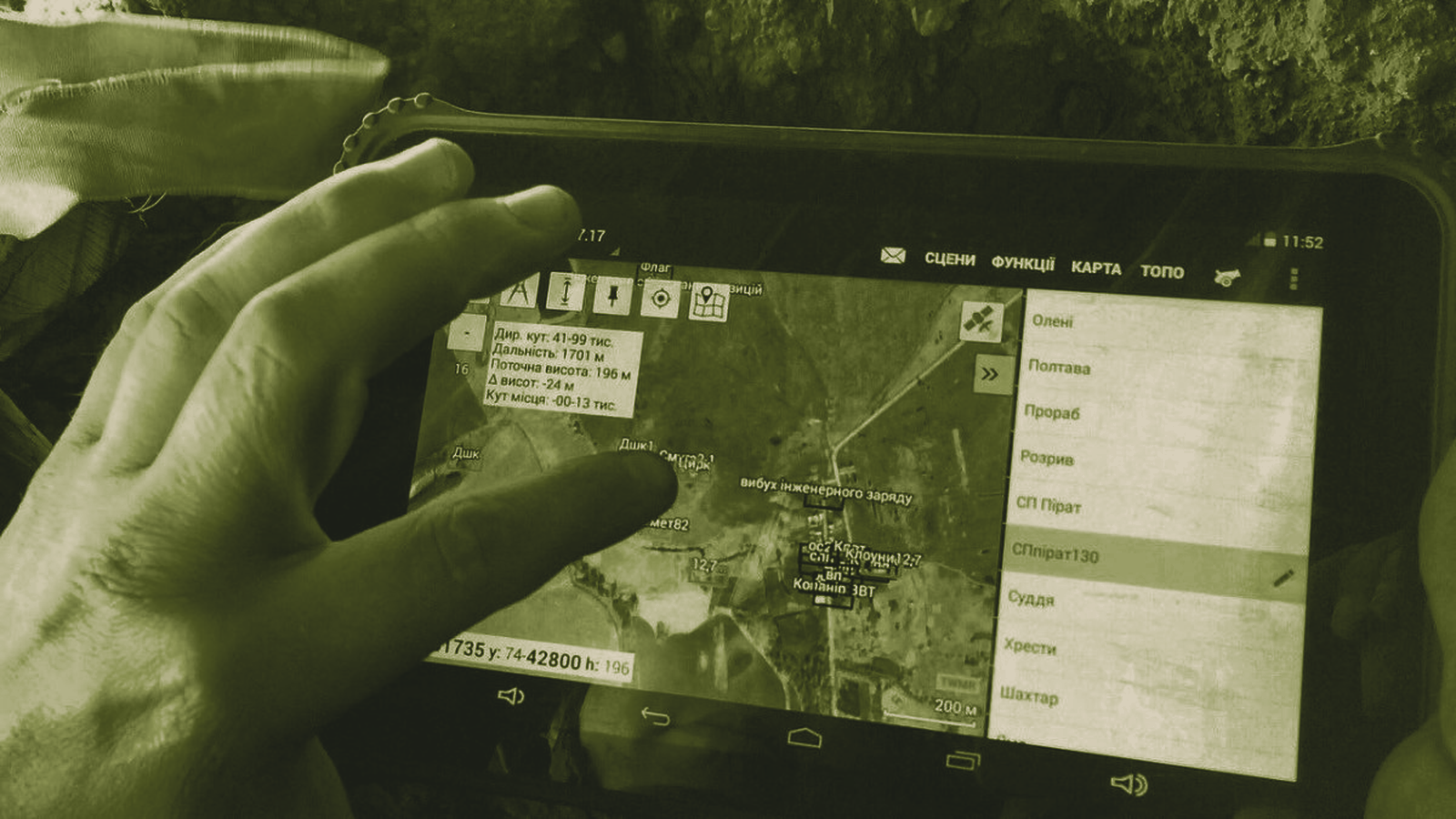
"Nettle" — the volunteer-built Ukrainian software that turns an ordinary $150 Android tablet into an artillery fire-control computer, a live battlefield map and a unit-to-unit command tool. Where the Soviet method took up to fifteen minutes of hand calculation with paper firing tables, Kropyva takes a coordinate from a soldier, drone or radar, runs the ballistics, and pushes a firing solution in seconds. Built not by a defense ministry but by a volunteer charity, Army SOS, it is — with GIS Arta and Delta — one of the homegrown apps that let an outgunned army out-shoot a larger one.
Overview
Kropyva (Кропива, "nettle"; also transliterated Kropiva / Krapiva) is field software that installs on a commercial Android tablet and converts it, in the words of Al Jazeera, into "a basic unit of an automated precision guidance system." The tablet displays accurate modern maps, lets the user measure distances and drop target coordinates, ingests positions from drones, radar or forward observers, and computes a firing solution for whichever Ukrainian artillery type is being used — factoring wind speed and direction, temperature, humidity and even the curvature of the Earth. The result is transmitted within seconds over web or, where there is no connection, portable radio. Beyond gunnery it is a command-and-control and mapping tool: it tracks friendly and enemy positions, maps minefields and safe medevac routes, and logs the location of the fallen for later recovery. It is frequently mentioned in the same breath as GIS Arta, but the two are distinct — Kropyva is the tablet-resident fire-control/mapping app; GIS Arta is the network that matches a target to the best-placed gun.
Development
Kropyva is a product of Ukraine's volunteer movement, not its procurement system. Its maker, Army SOS, was founded in 2014 by activists from the Maidan protests — among them Oleksiy Savchenko and Artem Palyutin — initially to buy body armor and supplies for under-equipped volunteer fighters, per Al Jazeera and UNITED24 Media. When front-line troops asked for usable maps to replace 1980s Soviet sheets, Army SOS instead loaded satellite maps and military data onto tablets, then — at soldiers' request — added distance measurement, coordinate entry and artillery-fire calculation. That bottom-up feature accretion, from roughly 2014–2015, became Kropyva. Army SOS handed the source code to the Ukrainian military free of charge in 2018. By 2024 UNITED24 reported nearly 200,000 installations across the Armed Forces. The organization is unusual in operating independently of government oversight and shielding the identities of its developers and users.
Design & capabilities
Kropyva runs on any Android tablet costing roughly $150 or more — a deliberate choice that makes the capability cheap, replaceable and mass-distributable. As an artillery tool it embeds ballistic calculators and meteorological inputs to convert a target coordinate into azimuth, range and fuse data for each gun type, with CSIS noting that entered coordinates are "automatically translated to the nearest available artillery battery along with precalculated aiming trajectories." As a C2 tool it shares enemy and friendly locations, passes intelligence and relays orders in real time; Army SOS describes an air-defense function that takes incoming-threat data, computes speed and environmental factors, and outputs firing coordinates for interception. Security is built around compartmentalization: each tablet is a "worker bee" holding only its user's local picture, locked behind a per-user login, and remotely wipeable — "rendered digitally dead from a server" if captured, per Al Jazeera. A captured tablet is, in the words of one Russian military outlet quoted by Al Jazeera, "free cheese... in a mouse trap." Army SOS says newer versions are being enhanced with AI to recognize Russian vehicle types.
Variants
Kropyva is a single, continuously updated application rather than a family of variants. Its evolution runs from a digital-map viewer (2014) to a full fire-control, mapping and C2 suite, with later additions in air defense, minefield mapping and AI-assisted recognition. Functionally it scales from a single infantry tablet up to battery- and brigade-level use, and it is designed to interoperate with the wider Ukrainian software stack.
Combat record / operational use
Kropyva has been in combat use since the 2014–2015 Donbas fighting and became near-ubiquitous after Russia's 2022 full-scale invasion, with installations in the hundreds of thousands. Ukrainian crews have used it to wring precision out of antiquated Soviet equipment — Defense Express recounts tank crews firing indirect missions with Kropyva tablets — and on donated Western guns where crews strip the electronics and run fire control off the tablet instead. Beyond gunnery, the software has guided troops out of minefields alive, mapped medevac routes and located the dead for recovery. Army SOS's Palyutin told UNITED24 he was "very proud" that Kropyva contributed to the air-defense intercept of a Russian Kinzhal — a participant's claim, not an independently confirmed engagement. The system is also a constant cyber target: Palyutin acknowledged Russian forces have at times pulled Kropyva data, "and it's a problem," in an ongoing two-way hacking fight.
Advantages
- Cheap and mass-producible — runs on a $150 commercial tablet; capability is replaceable and distributable at scale.
- Speed — collapses the Soviet 15-minute hand-calculation into seconds.
- Force multiplier on old kit — lets Soviet-era and stripped-down Western guns fire fast, accurate indirect missions.
- More than gunnery — mapping, blue/red tracking, minefield and medevac routing, casualty location, air-defense calculation.
- Hardened by compartmentalization — local-only data, per-user logins, remote wipe on capture.
Drawbacks / limitations
- Connectivity/EW exposure — depends on data or radio links that jamming and outages degrade; radio fallback has limits.
- Cyber target — a high-value system Russia actively attacks; data has been compromised in places.
- Capture risk — though mitigated by wipe and compartmentalization, physical loss of tablets is constant.
- Unverified standout claims — headline events such as a Kinzhal intercept rest on participant testimony.
- Volunteer dependency — funded and maintained largely by an NGO reliant on donations, outside formal procurement.
Counterparts
Kropyva sits alongside Ukraine's other homegrown battlefield apps and is most often paired with GIS Arta and Delta: Kropyva is the tablet-level fire-control and mapping app, GIS Arta the network that optimizes target-to-gun assignment, and Delta the theatre-wide common operating picture. Its Western analogues are artillery fire-control systems (the US AFATDS, Germany's ESG Adler) and the soldier-level situational-awareness kit ATAK/TAK, while the broader battle-management tier is held by Maven Smart System, Anduril Lattice and SitaWare. On the Russian side the nearest equivalents are the Strelets reconnaissance-fire system and the ESU-TZ program. Kropyva's distinction is its origin and price point — a volunteer charity's app on a consumer tablet, which the Jamestown Foundation's Pavel Luzin told Al Jazeera is "barely possible" inside Russia's clumsier military-industrial complex.
Outlook
Kropyva is the grassroots end of the "software is a weapon" story: not a state program but a charity's app that put a fire-control computer in every Ukrainian gun crew's hands for the price of a cheap tablet. Its trajectory mirrors the rest of Ukraine's digital stack — deeper integration with GIS Arta and Delta, AI-assisted target recognition, and an unending cyber/EW contest over the data it carries. The strategic lesson Western militaries keep drawing from it is less about the code than the model: a fast, donation-funded, soldier-feedback development loop that fielded and iterated a battle-winning capability in months. The open questions into 2026–2027 are whether that volunteer model can be sustained and formalized without losing its speed, and how well Kropyva's compartmentalized security holds as Russian cyber and EW pressure grows.
Key specifications
| Spec | Value |
|---|---|
| Type | Tablet artillery fire-control, mapping & C2 software |
| Developer / origin | Ukraine — Army SOS (volunteer NGO); code donated to the AFU in 2018 |
| First fielded | 2014–2015 (Donbas); ~200,000 installs by 2024 |
| Platform | Commercial Android tablet (~$150+); radio fallback when offline |
| Fire-control inputs | Target coords from user/drone/radar; wind, temperature, humidity, Earth curvature |
| Output | Azimuth/range/fuse firing solution to nearest available battery, in seconds |
| Other functions | Mapping, blue/red tracking, minefield & medevac routing, casualty location, air-defense calculation |
| Security | Local-only data per tablet, per-user logins, remote wipe ("digitally dead") on capture |
| Operators | Armed Forces of Ukraine |
| Status | In service; being enhanced with AI vehicle recognition |
Sources
- How Ukraine turns cheap tablets into lethal weapons — Al Jazeera
- Ukraine's secret weapon: Kropyva software — UNITED24 Media
- Understanding the Military AI Ecosystem of Ukraine — CSIS
- How the "Kropyva" Combat Control System Helps in the Most Difficult Situations — Defense Express
- Kropyva: Ukrainian Artillery Application — Tom Cooper / Medium
- Situational Awareness Systems — Boryviter
- Army SOS — official site
🔒 The Analyst Section on Kropyva is for BattlePolicy Pro members. Below the line: procurement and contract history, the suppliers and companies behind the system, our head-to-head analyst view of the systems it actually competes with, and the BattlePolicy assessment note. Unlock the full file with BattlePolicy Pro →