Ukraine Says 70-Plus AI Systems Help Its Drones Strike Through Russian Jamming
Ukraine's Defence Ministry says more than 70 AI and computer-vision systems already strike targets and that every frontline drone should carry machine vision, with terminal guidance that holds a target after Russian jamming cuts the link.
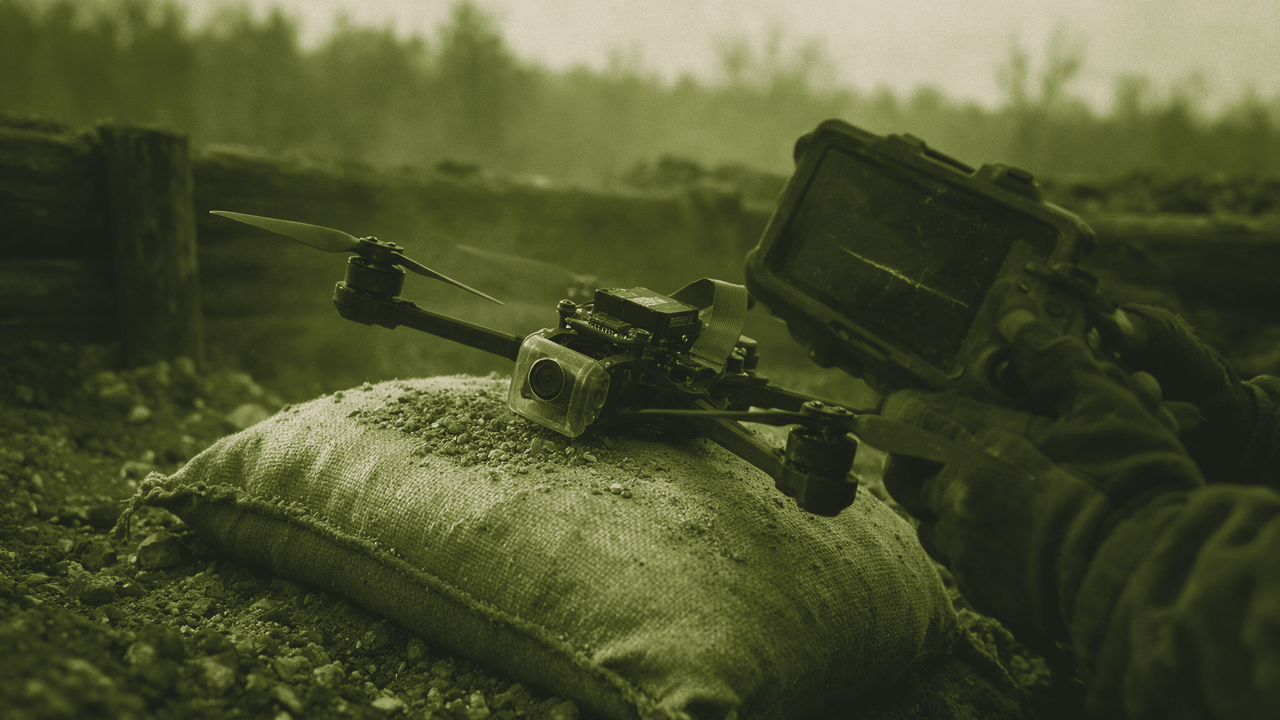
Kyiv is scaling terminal guidance that keeps a drone on target after electronic warfare cuts the operator's link, and it wants machine vision on every frontline drone.
Ukraine's Defence Forces already use more than 70 AI and computer-vision systems to strike enemy targets, Ukraine's Ministry of Defence said Aug. 18. The ministry wants computer vision and AI aboard every drone on the front line, making machine guidance standard equipment rather than a specialist addition.
Frequently Asked Questions
How many AI systems does Ukraine say it is using on the battlefield?
More than 70 different systems powered by AI and computer vision are already used to strike enemy targets, according to Ukraine's Ministry of Defence on Aug. 18, 2026.
What does the AI actually do on a strike drone?
Per the ministry, computer vision navigates without GPS by matching terrain to uploaded maps, neural networks recognize equipment and personnel, and on the final approach the drone locks onto the target and continues autonomously after electronic warfare cuts the operator link.
Is a human still deciding what to hit?
Yes, per the ministry: the final decision on target selection and engagement is made by a human operator. United24 Media reported that current rules prohibit fully autonomous operation and that a policy on AI-driven autonomous weapons is still being drafted.
How big is Ukraine's AI-drone industry?
More than 200 Ukrainian companies produce AI-enabled drones, and Brave1 Market lists 46 AI solutions, according to the Ministry of Defence. More than 100 companies have access to Brave1 Dataroom for training models.
What is Avengers Labs?
A ministry platform with 5 million annotated battlefield frames, mostly from the DELTA combat system, used to train AI models; the ministry says it detects 70% of enemy equipment in Vezha video streams at 2.2 seconds per item.
What is the ministry's stated goal?
That 100% of drones on the front line carry computer vision and AI, per the Aug. 18 statement.
AI-generated summary, reviewed by an editor. More on our AI guidelines.
Below this point
4 more sections.
Computer vision lets a drone navigate without satellite signals by matching terrain and landmarks against uploaded maps, the ministry explains. Neural networks detect equipment and personnel in visual data. On the attack run, the drone locks onto a target and continues its approach autonomously after Russian electronic warfare severs the operator link. The ministry says AI now supports the kill chain from detection and identification through engagement and damage assessment.
More than 200 Ukrainian companies produce AI-enabled drones, the ministry said. Brave1 Market, the state defense-tech marketplace, offers 46 target-recognition, optical-stabilization and automatic terminal-guidance solutions. More than 100 companies can train models through Brave1 Dataroom, which holds visual and thermal datasets collected across different weather conditions and times of day. Avengers Labs adds 5 million annotated battlefield frames, mostly from the DELTA combat system. According to the ministry, Avengers detects 70% of enemy equipment in Vezha video streams and takes 2.2 seconds to identify one item; The Defense Post put that at more than 100,000 drone video streams a month.
A human operator makes the final decision on target selection and engagement, the ministry states. Current rules prohibit fully autonomous operation and require human verification in the final stage, and Ukraine has no official policy framework yet for AI-driven autonomous weapons, United24 Media wrote Aug. 19. Mykhailo Markevych, head of AI at the ministry's Main Directorate of Information Technology, told United24 that officials are drafting rules to bridge traditional autonomous weapons and advanced AI.
The 70-plus systems are the fielded layer of a larger state pipeline. Shared combat data trains the models, Brave1 distributes the modules, and a 200-company sector builds drones that can finish an attack when the link dies. The next measures are whether Ukraine publishes the autonomy policy Markevych described, and how quickly the ministry moves toward its 100% target.

Marcus Schuler
Marcus Schuler edits BattlePolicy, a daily defense-technology brief connecting the companies and capabilities behind modern war to the contest among Europe, the US, Russia, and China.