AWS names Anduril its preferred edge provider, putting cloud compute in a shipping container at the front
Amazon Web Services named Anduril its preferred edge provider and packed AWS Outposts into Anduril's Menace-I data center, pushing cloud compute to the contested front.
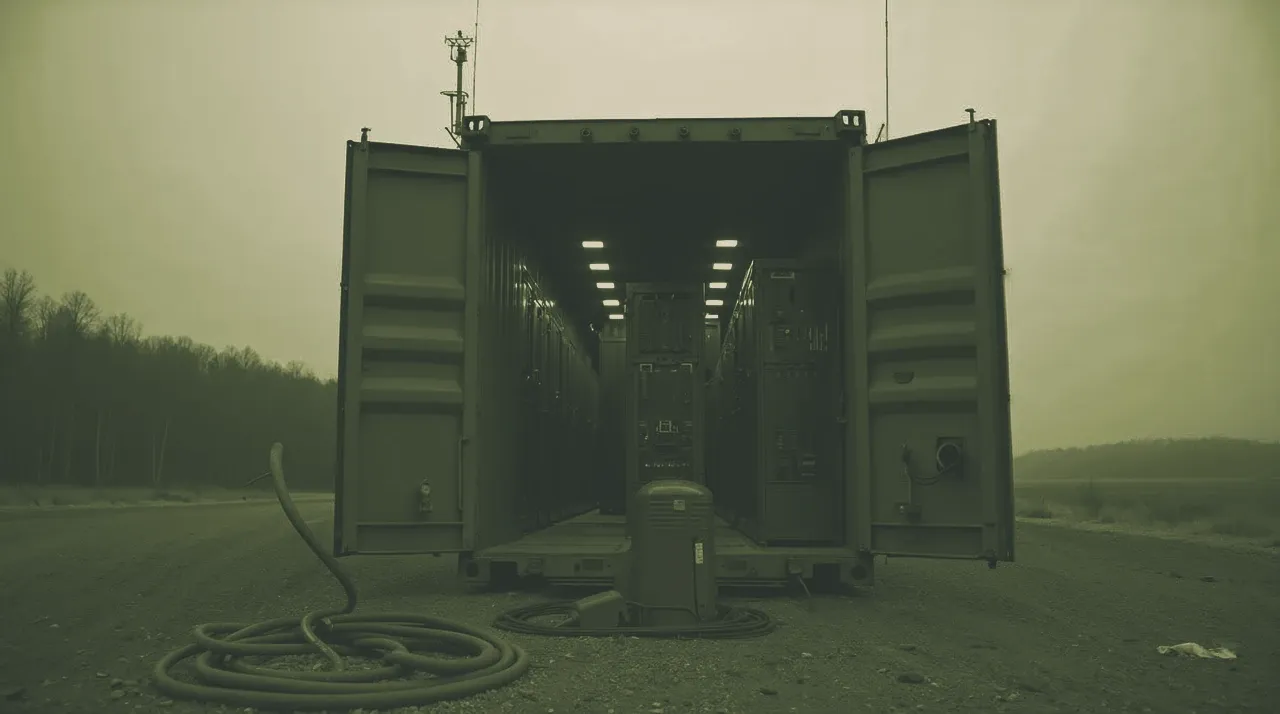
Amazon Web Services named Anduril its preferred edge provider and packed AWS Outposts into Anduril's Menace-I data center, pushing cloud compute to the contested front.
Amazon Web Services has named Anduril its "preferred edge provider" for national security and defense, and fitted its Outposts cloud racks into Anduril's containerized Menace-I data center, Defense One reported Tuesday. The pairing puts hyperscaler compute inside a shipping container that moves with the mission.
Two people can stand the system up in under 10 minutes, and it moves by truck, rail, airlift, or helicopter sling load, the companies said in a joint announcement. Menace-I ships in three variants, Core, Command, and Enhanced, holding 40 to 42 servers in the smaller units and up to 168 in the largest, per Air & Space Forces Magazine, which cited a person familiar with the hardware. Outposts run what AWS calls Ultra Low Latency Racks.
The point is latency. Backhauling sensor data to a secure data center thousands of miles away burns time a targeting cycle does not have, Anduril engineering chief Tom Keane told reporters. A complex F-35 mission that once took eight operators nearly two days to plan can run on two people in about two hours with edge compute alongside, Keane said, per Air & Space Forces Magazine.
Menace-I has logged more than 50,000 field hours over three years and is deployed across the Army, Air Force, Marines, and Navy, an Anduril executive told an AWS panel, adding it was used in Operation Epic Fury against Iran. The two firms also ran a joint field test under AWS's Project MAVERICK, steering a drone swarm by spoken command in a comms-denied environment on Menace-T hardware running Anduril's Lattice, AWS said.
The battlefield and the startup story — free in your inbox every week. No paywall.
Subscribe Free →The wedge is who steps forward. AWS, the Pentagon's dominant cloud vendor, is reaching past the fortified data center to the container at the edge, and it is doing so through a prime rather than in its own name. Survivability is the open question. Defense One noted six Army reservists were killed when a concrete-walled operations center was hit during Epic Fury, which is why Keane framed the pitch around distributing many nodes rather than hardening one.
Frequently Asked Questions
What did AWS and Anduril announce?
Amazon Web Services named Anduril a "preferred edge provider" for national security and defense and integrated its Outposts cloud racks into Anduril's Menace-I mobile data center, per Defense One and Air & Space Forces Magazine. The goal is to run cloud compute close to the battlefield.
What is Menace-I?
Menace-I is Anduril's containerized command-and-data-center platform. According to Anduril, it comes in Core, Command, and Enhanced variants, two people can set it up in under 10 minutes, and it moves by truck, rail, airlift, or helicopter sling load.
Why does edge computing matter at the front?
Sending sensor data back to a distant data center adds latency that can cost a target, Anduril's Tom Keane told reporters, per Air & Space Forces Magazine. Running compute at the edge also keeps systems working when communications are degraded or denied.
Has the system been used in combat?
An Anduril executive told an AWS panel that Menace-I has logged more than 50,000 field hours and was used in Operation Epic Fury against Iran, according to Defense One and Air & Space Forces Magazine. AWS Outposts had also been deployed in the region, but in protected structures.
What was Project MAVERICK?
Project MAVERICK is an AWS mobile field-testing platform. AWS said a joint exercise with Anduril and startup Gambit steered a drone swarm by natural-language command in a disconnected environment, using Menace-T hardware running Anduril's Lattice software.
AI-generated summary, reviewed by an editor. More on our AI guidelines.

Marcus Schuler
Marcus Schuler edits BattlePolicy, a daily defense-technology brief connecting the companies and capabilities behind modern war to the contest among Europe, the US, Russia, and China.