OA-1K Skyraider II
The OA-1K Skyraider II is the armed crop-duster that beat the A-29 Super Tucano for the US Armed Overwatch contract — an Air Tractor AT-802 turned into an L3Harris gunship with 10 hardpoints, Hellfires and a WESCAM sensor ball. It won the US buy the A-29 dominates the world without.
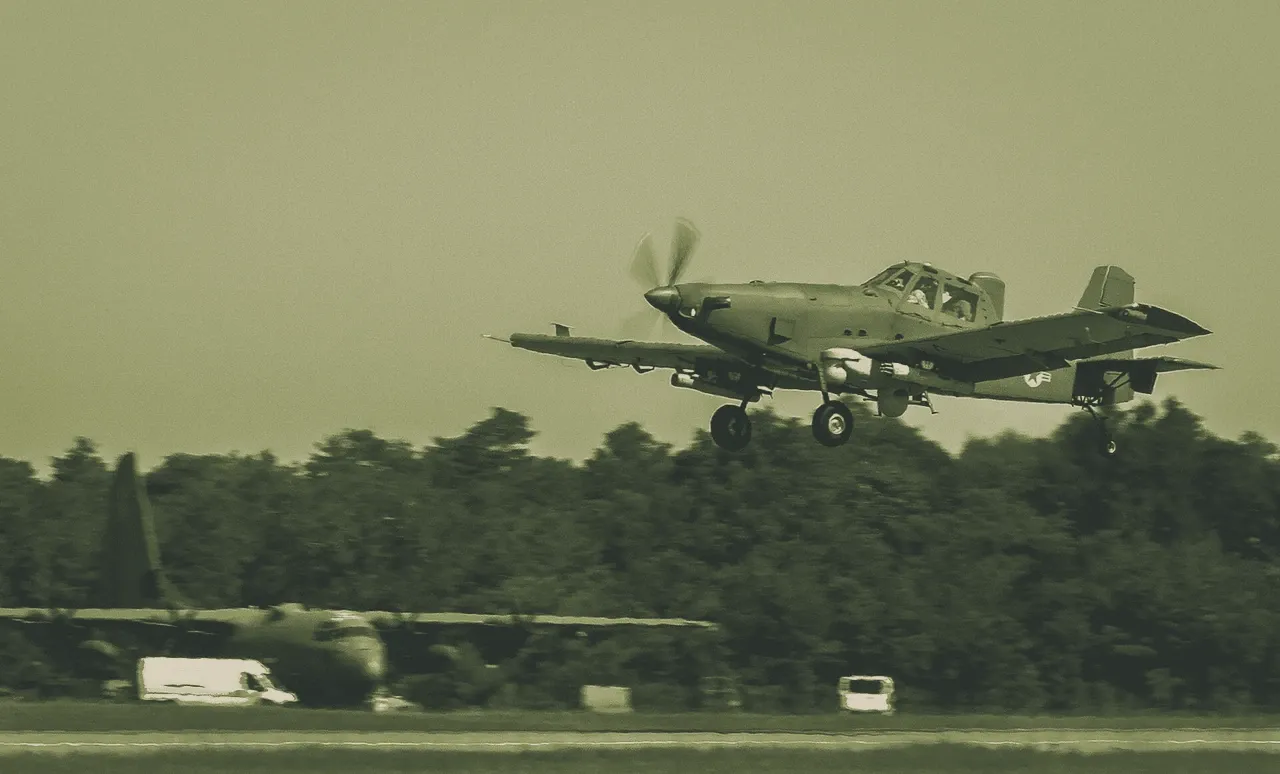
The armed crop-duster that beat the Super Tucano — the OA-1K Skyraider II is what happens when you bolt armor, Hellfires and a surveillance ball onto an Air Tractor agricultural plane and hand it to Air Force special operations. It won the US Armed Overwatch contract in 2022 over the A-29 Super Tucano, and the two aircraft are perfect mirror images: the OA-1K has the American buy and no export customers, while the A-29 it beat has twenty-plus operators and no US order of consequence. Named for the legendary A-1 Skyraider, it is a cheap, austere-strip gunship for the counter-insurgency wars — arriving just as the Pentagon pivots to China and questions whether it still needs one.
Overview
The OA-1K Skyraider II (company name AT-802U Sky Warden) is a US light-attack and armed-ISR turboprop built by L3Harris on an Air Tractor AT-802 agricultural airframe — the militarized crop-duster that won US Special Operations Command's Armed Overwatch program in August 2022, beating the A-29 Super Tucano, the AT-6 Wolverine and the PZL M28. Designated OA-1K and named for the Douglas A-1 Skyraider AFSOC's forebears flew, it is a taildragger with a ballistic-armored "bathtub" cockpit, 10 hardpoints, and a mission kit — Hellfire and APKWS-guided rockets, Paveway bombs, gun pods, and WESCAM MX-15/MX-20 EO/IR turrets — that turns a $2 million farm plane into a special-operations gunship costing about $2,500 per flight hour, a tenth of an F-16. Its pitch is cheap, persistent, austere-strip close air support and armed overwatch for irregular warfare, with rapid disassembly to fit inside a C-17. But the OA-1K arrived at an awkward moment: with the Pentagon pivoting to high-end conflict with China, its buy has been repeatedly cut — from 75 aircraft toward roughly 45–53 — and its survivability against a peer questioned, even as 18 have been delivered by mid-2026 and initial operational capability is targeted for the end of the fiscal year. It has no combat record yet, one hull lost to a training accident, and, unlike the A-29, no export customers — a US program of record hunting for a mission as the wars it was built for recede.
Development
SOCOM selected the L3Harris/Air Tractor Sky Warden for Armed Overwatch on 1 August 2022 — a $3 billion IDIQ ceiling, an initial $170 million award, up to 75 aircraft — to replace AFSOC's unarmed U-28A Draco ISR fleet, per Breaking Defense. It was designated OA-1K late that year. Almost immediately the program drew scrutiny: a December 2023 GAO report urged SOCOM to slow it until the fleet size was justified, and the buy was cut from 75 to 62 in the FY2025 budget. Training AT-802s arrived at Hurlburt Field in mid-2024, and AFSOC accepted its first missionized Block-1 OA-1K on 3 April 2025 (the aircraft had originally been due in 2023 — the program ran late), per The War Zone. AFSOC named it "Skyraider II" in February 2025. The cuts continued — SOCOM halved the FY2026 buy from 12 to 6 in July 2025 (after a FY2025 cut of 15 to 12), citing resource constraints and the pivot to high-end conflict, leaving roughly 45 aircraft on contract by 2028 — even as L3Harris opened a new Waco production hangar to accelerate deliveries, per Air & Space Forces Magazine. By May 2026, 18 had been delivered, the program was transitioning to operational testing, a rapid-deploy (C-17 disassembly) demonstration was planned, and IOC was targeted for the end of FY2026, per TWZ. The type suffered its first hull loss on 23 October 2025 — a trainee inadvertently shut off the main fuel valve on takeoff from Oklahoma, forcing a crash landing (both crew unharmed, the ~$18 million aircraft written off), per the June 2026 accident report. Amid US budget uncertainty, L3Harris ramped an international sales pitch at SOF Week 2026 — the export orders the aircraft still lacks.
Design & capabilities
The OA-1K's design inherits from its unlikely origin: an Air Tractor AT-802 built for crop-dusting and, in armed form, coca-eradication — which is why it comes with a ballistic-armored "bathtub" around engine and cockpit, a steel-tube roll cage, self-sealing fuel tanks and a flat armored windshield, but no ejection seats (the airframe was never designed for them). A single Pratt & Whitney PT6A-67F turboprop (~1,600 hp, five-bladed prop) gives it long endurance at low cost — a patrol cruise around 180 knots, roughly 2,400 km range, and a ~$2,500-per-flight-hour operating cost that is the aircraft's central argument. It is a taildragger for austere, unimproved strips, and disassembles in hours to fit inside a C-17 or C-5 — the mobility pitch for dispersed Pacific operations. Armament is generous for the class: 10 hardpoints and up to ~8,000 lb of payload carrying AGM-114 Hellfire, AGR-20 APKWS laser-guided rockets, GBU-12 Paveway bombs and .50-cal/20 mm gun pods, with the L3Harris Red Wolf miniature cruise missile eyed to add standoff strike. Sensors are the ISR half of "armed overwatch" — WESCAM MX-15 and MX-20 EO/IR turrets, missile-warning and countermeasures, and Ku-band SATCOM for beyond-line-of-sight datalinks. The design is deliberately modular for block upgrades. What it is not is survivable against a peer: a low, slow turboprop is a superb counter-insurgency tool and a questionable one against Chinese air defenses — the tension that has driven the budget cuts, and that AFSOC answers with dispersal and low cost rather than stealth.
Variants
- AT-802U Sky Warden: the L3Harris/Air Tractor company and export-marketing designation.
- OA-1K Skyraider II Block 1: the first missionized US configuration (accepted April 2025); modular for future weapon/sensor blocks.
- Lineage: earlier armed AT-802 variants — the AT-802L Longsword and IOMAX Archangel — flew combat with foreign operators, a heritage TWZ notes should have eased weapons integration.
- Displaced types (not variants): succeeds AFSOC's U-28A Draco and MC-12W Liberty ISR fleet, though AFSOC frames it as a purpose-built new capability, not a straight replacement.
Combat record / operational use
None yet — as of mid-2026 the OA-1K is in operational testing, with a first deployment expected in the coming years. Its only notable event is its first mishap: on 23 October 2025, an OA-1K of the 492nd Special Operations Wing crash-landed shortly after takeoff from Will Rogers, Oklahoma, striking power poles and starting a small grass fire; both crew walked away, but the ~$18 million aircraft was written off — the type's first hull loss. The accident board found pilot error: a trainee on an initial qualification flight inadvertently activated the main fuel shutoff valve instead of the tank selector and did not immediately tell the instructor, with task saturation and crew-coordination shortfalls as contributing factors. AFSOC frames the aircraft's remit broadly — a "Swiss Army knife" for counter-terrorism, crisis response, competition and "even aspects of full-on conflict" — but the honest status is a program still proving itself, delivering into a shrinking order, and searching for its place in a force reorienting toward China. That search is the operational story: the OA-1K was conceived for the permissive-airspace counter-insurgency wars of the 2010s, and it is entering service as those wars wind down and the Pentagon asks whether a light turboprop earns its place against a peer adversary.
Advantages
- Cheap to fly — ~$2,500 per flight hour, roughly a tenth of a fast jet, for persistent overwatch and strike.
- Austere and mobile — taildragger for unimproved strips, disassembles into a C-17 for rapid dispersed basing.
- Heavily armed for the class — 10 hardpoints, ~8,000 lb payload, Hellfire/APKWS/Paveway/gun pods, with standoff Red Wolf eyed.
- Armored and survivable to small-arms — ballistic bathtub, roll cage, self-sealing tanks inherited from its coca-eradication heritage.
- Modern ISR and comms — WESCAM MX-15/MX-20 turrets and Ku-band SATCOM for joint-force integration.
Drawbacks / limitations
- No peer survivability — a low, slow turboprop is built for permissive airspace, not contested skies against China's air defenses.
- Shrinking, contested buy — cut from 75 toward ~45–53; GAO-questioned; the Pentagon's high-end pivot works against it.
- No combat record and one hull already lost — still in operational test, with a $18M training write-off on the books.
- No exports — unlike the A-29 it beat, zero foreign orders; L3Harris is only now pitching internationally.
- No ejection seats — the crop-duster airframe cannot take them, a real limit for a combat aircraft.
Counterparts
The OA-1K's defining relationship is with the A-29 Super Tucano — the Armed Overwatch loser and its perfect market mirror. The OA-1K won the US contract on SOCOM-specific criteria (payload flexibility, US industrial preference); the A-29 lost it but dominates the export world with twenty-plus operators and 290-plus ordered. Between them they split the light-attack market cleanly: the American plane has the American buy and no exports, the Brazilian plane has the exports and no American buy. The AT-6 Wolverine is the third Armed Overwatch competitor, which lost to both, and the Pilatus PC-21 is the trainer-class cousin in this lexicon. Within AFSOC it succeeds the U-28A Draco and MC-12W ISR fleet. The comparison that gives the OA-1K its meaning is the one with the A-29: they are near-equivalent capabilities that the market and the Pentagon judged by opposite standards, and the OA-1K's story — winning the US buy while the wars that justify it recede, and lacking the export base that keeps the A-29 in production — is a case study in how a light-attack aircraft can win the contract and still struggle to find its future. It is the rare weapon whose central rival beat it everywhere except the one competition that counted, and lost everywhere else.
Outlook
The OA-1K's future is a question of relevance more than performance. The buy keeps shrinking — 75 to 62 to a planned ~45–53, with FY26 halved to six — and the trend line, plus the GAO's skepticism and the Pentagon's China pivot, makes the program's final size the central uncertainty; it is not cancelled, but it is contested. The survivability debate is unresolved: AFSOC's answer to "what good is a slow turboprop against a peer?" is cheap dispersal, austere basing and a Pacific mobility demo, and whether that argument holds will shape the fleet's ceiling. IOC (targeted end of FY2026) and the first operational deployment are the near-term milestones that turn deliveries into capability. The standoff-weapon path (Red Wolf) is the aspirational hedge — giving the OA-1K reach it can use from outside a threat ring — but it is unfunded. And the export pitch is the commercial lifeline: with US numbers falling, L3Harris needs the foreign orders the A-29 already has, reframing the Sky Warden as a counter-drone hunter and maritime-patrol platform. For BattlePolicy readers the OA-1K is the light-attack class's American paradox: the aircraft that won the US competition just as the US lost interest in the mission, mirror to the A-29 that lost the competition and won the world. Its trajectory — deliveries up, orders down, mission contested — is the clearest sign that the counter-insurgency-era light-attack idea is colliding with the return of great-power war, and the OA-1K is the plane caught in that collision.
Key specifications
AT-802U/Air Tractor figures; some values (payload, fleet size) vary by source and are attributed.
| Spec | Value |
|---|---|
| Type | Light-attack / armed-ISR turboprop (taildragger) |
| Powerplant | 1 × Pratt & Whitney PT6A-67F (~1,600 hp), 5-blade prop |
| Length / wingspan | ~11.4 m / ~18.1 m |
| Max speed / cruise | ~394 km/h; patrol cruise ~180 kn |
| Range | ~2,400 km (full fuel) |
| Hardpoints / payload | 10 stations; up to ~8,000 lb (Air Tractor figure) |
| Weapons | Hellfire, APKWS, GBU-12 Paveway, gun pods; Red Wolf (eyed) |
| Sensors | WESCAM MX-15/MX-20 EO/IR; MAWS + countermeasures; Ku-band SATCOM |
| Crew protection | Ballistic bathtub, roll cage, self-sealing tanks; no ejection seats |
| Cost | ~$18M per aircraft; ~$2,500/flight hour |
| Procurement | SOCOM Armed Overwatch (Aug 2022); 18 delivered by mid-2026; ~45–53 planned (cut from 75) |
| Operator | US AFSOC only; no exports |
Sources
- L3Harris OA-1K Skyraider II — Wikipedia
- L3Harris Sky Warden wins SOCOM's Armed Overwatch program — Breaking Defense
- US SOCOM chooses L3Harris Sky Warden for Armed Overwatch — Defense News
- Sky Warden team selected for USSOCOM Armed Overwatch contract — Air Tractor
- Slow down Armed Overwatch until SOCOM justifies fleet, GAO says — Air & Space Forces Magazine
- SOCOM cuts Armed Overwatch buy from 75 to 62 aircraft — Air & Space Forces Magazine
- First OA-1K handed over to AFSOC — TWZ
- AFSOC reveals name for OA-1K: Skyraider II — AFSOC
- SOCOM halves OA-1K buy for 2026 — Air & Space Forces Magazine
- L3Harris expands OA-1K production in Waco — The Aviationist
- Plan to test OA-1K rapid deployability (18 delivered; 53 planned; APKWS/Red Wolf) — TWZ
- L3Harris increases OA-1K international pitch amid US uncertainty — Aviation Week
- Investigation finds trainer pilot error caused first OA-1K crash — Aviation Week
- Air Force Skyraider II crash caused by pilot error — Stars & Stripes
- AFSOC putting Skyraider through its paces — National Defense Magazine
🔒 The Analyst Section on OA-1K Skyraider II is for BattlePolicy Pro members. Below the line: procurement and contract history, the suppliers and companies behind the system, our head-to-head analyst view of the systems it actually competes with, and the BattlePolicy assessment note. Unlock the full file with BattlePolicy Pro →