Ukraine Arrives at Eurosatory as a Seller, Not a Buyer
The largest land-warfare show in history opened in Paris on June 15 with the Ukraine war's lessons, cheap mass, autonomy and counter-drone, as the organizing logic of the floor. The clearest signal is who is now selling.
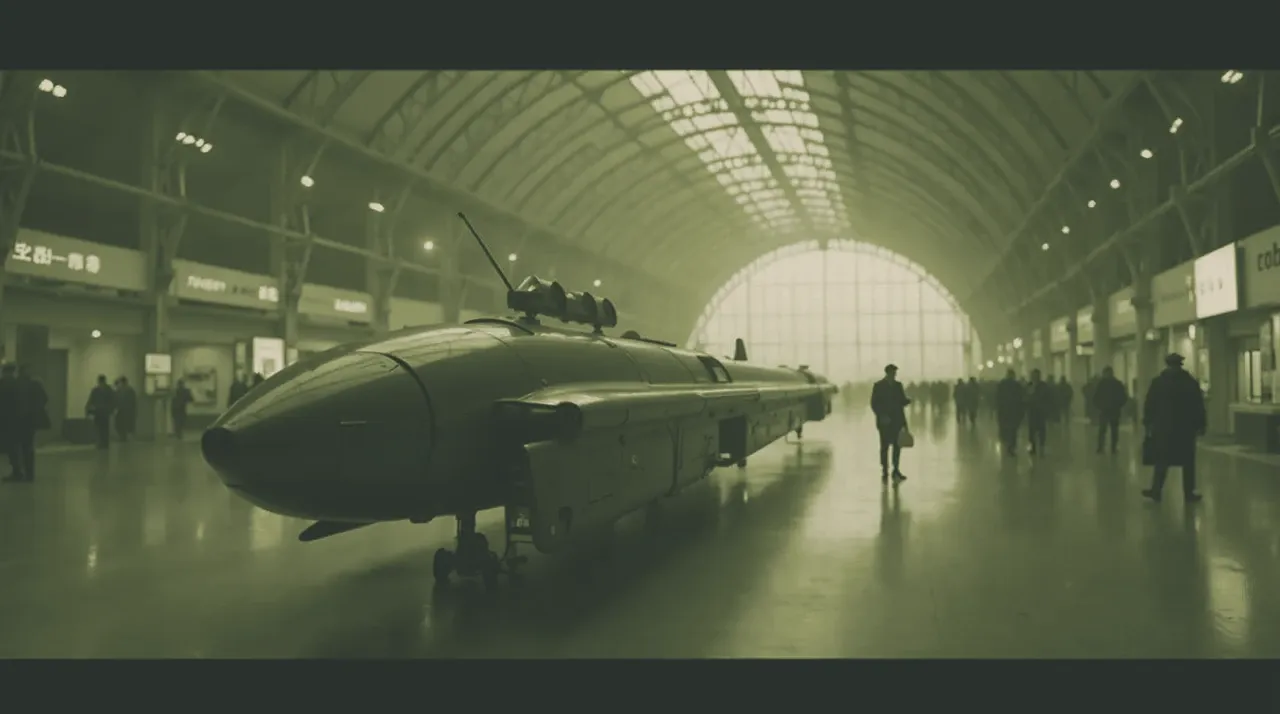
The largest land-warfare show in history opened in Paris on June 15 with the Ukraine war's lessons, cheap mass, autonomy and counter-drone, as the organizing logic of the floor. The clearest signal is who is now selling.
Ukraine came to international arms shows three years ago to ask Western governments for hardware. At Eurosatory 2026, the land-warfare exhibition that opened outside Paris on June 15, its companies arrived selling their own, including a heavy autonomous underwater drone built to carry a one-ton payload over 2,000 nautical miles. Ukrainian firms now share the floor with the Western primes they once lobbied for aid.
Eurosatory opened its gates at the Paris-Nord Villepinte exhibition centre as the biggest edition in the event's 59-year history, TechTimes reported, drawing exhibitors from 68 countries. The number of companies on the floor rose 30% to more than 2,600, according to Defense News, citing the organizer, with about 80% of the defense firms from European NATO members. The show runs through June 19. One exhibitor told Defense News this could be the last edition before a wider war, and the Washington Times reported that delegations came to weigh how fast the West can rearm for a major conflict.
Counter-drone is the fastest-growing line
Europe is moving to mobilize roughly 800 billion euros in defense investment through 2029 under the ReArm framework announced in March 2025, per TechTimes, and the show added a dedicated defense finance cluster this year to court that capital. Where the money is going showed on the floor, concentrated in autonomous systems and counter-drone defenses.
The market for counter-unmanned systems reached about $5.12 billion in 2025 and is projected to nearly double to $8.5 billion in 2026, TechTimes reported, with much of the spending aimed at a problem the war has exposed, detecting fiber-optic-guided drones that emit no radio signal to jam. New hardware on display included a TDoA-based counter-drone sensor and drive-by-wire drivetrains for uncrewed ground vehicles.
The wider drone segment leaned further into autonomy this year, with more uncrewed aerial and maritime systems and longer-range, heavier-payload strike drones on offer, alongside new ground-launched long-range missiles, Defense News reported. Those are the attributes the war has rewarded, where range and payload decide which targets a cheap drone can reach.
The clearest signal came from an older platform. The French army displayed a Leclerc main battle tank fitted with a roof-mounted anti-drone cage, the improvised armor that crews on both sides of the front welded on after top-attack drones began hitting turret roofs, Defense News reported. What Russian and Ukrainian units field-modified under fire is now a factory option from a NATO prime.
Autonomy ran through the aerial displays. Shield AI brought its X-BAT, a vertical-takeoff jet the company says exceeds 3,700 kilometers in range with a full mission payload and needs no runway, Defence Blog reported. The pitch follows from deep-strike campaigns that have made fixed airbases easier to target, a vulnerability the same war has demonstrated against Russian and Ukrainian airfields alike.
The week's strikes matched the catalog
The systems in Paris answer demand signals that arrived from the war the same week the show opened.
In the 48 hours before the opening, Russia fired 611 drones and dozens of missiles at Ukraine in a single overnight barrage, striking Kyiv and damaging the Assumption Cathedral of the Kyiv-Pechersk Lavra, according to the Kyiv Independent. Ukrainian air defenses shot down 582 of the incoming drones, and the Kyiv strikes killed five people and injured 35, the Kyiv Independent reported. Ukrainian special forces struck deep inside Russia over the same period, hitting the "Temp" state fuel reserve and the "Azot" chemical plant, strikes President Volodymyr Zelensky confirmed, the Kyiv Post reported. The campaign reached beyond those two sites, with operators also hitting a Rosrezerv fuel storage facility and a railway depot near Smolensk over the same days, per the Kyiv Post. The mass drone raid and the long-range industrial strikes map onto the two product categories drawing the most attention in Villepinte, layered drone defense and cheap precision at range.
The battlefield and the startup story — free in your inbox every week. No paywall.
Subscribe Free →Ukraine brings 60 firms and a one-ton underwater drone
More than 60 Ukrainian companies are exhibiting in Paris, showing systems built under wartime production and coordinated through an association of more than 280 private Ukrainian defense manufacturers, UNN reported. Their main reveal is Sea Trident, a heavy autonomous underwater drone for strike, logistics and counter-submersible missions. Militarnyi put its range at 2,000 nautical miles and its weight at 10,000 kilograms, with a payload of up to 1,000 kilograms, and listed the vehicle at 10 meters long, 2 meters wide and 1.5 meters tall; the Kyiv Post reported the same one-ton payload and roughly 2,000-mile reach, with the vehicle running autonomously below the surface.
The missile maker Fire Point is showing its FP-series, the FP-1, FP-2, FP-5, FP-7 and FP-9, including the FP-5 better known as the Flamingo, with company chief Iryna Terekh telling UNN the stand carries actual missiles stripped of their navigation and warheads. Ukraine also brought ground robots for demining and casualty evacuation, electronic warfare gear, and the Brave1 platform that channels EU grant money to its developers.
Wartime demand has built a Ukrainian defense base fast enough that European and US buyers now treat Kyiv as a supplier of current combat systems, not only a recipient of aid. That redirects where European money flows and gives Ukraine an export base that outlasts any single aid package.
The Western primes Ukraine would compete against are exhibiting in the same halls. UNN noted that Rheinmetall and Lockheed Martin are among the manufacturers present, companies whose flagship platforms run to tens of millions of dollars per unit and years per delivery. Ukraine is not contesting heavy armor or crewed aircraft; it is underselling on the systems the war consumes in volume, the strike drones, naval drones and loitering munitions expended by the thousand. Kyiv added a second naval system, Triton, a surface drone built to fire missiles and launch smaller UAVs, which United24 Media put at a range of 600 nautical miles and a top speed of 40 knots. Ukrainian one-way attack drones reach buyers at a fraction of a Western equivalent's price, with a combat record behind them.
France walls off the Israeli booths
France allowed Israeli firms to attend but restricted them to defensive systems, air defense and anti-ballistic missiles, and barred offensive weapons and a national pavilion. Organizers erected temporary walls overnight around the booths of several Israeli companies, including Smartshooter, and Israel's defense ministry accused the show of discrimination, Breaking Defense reported. France imposed similar restrictions on Israeli exhibitors at earlier editions, an indication that access to the European market now turns on government policy as much as on price.
US Army air defenders from the 10th Army Air and Missile Defense Command used the show to promote the Eastern Flank Deterrence Initiative, putting Washington's deterrence message on the floor where Europe is deciding how to spend its 800 billion euros, Army.mil reported. For the buyers in that room, the choice of supplier carries an alliance commitment alongside the hardware.
Exhibitors came from 68 countries, with India among the larger national showings, the Times of India reported. The new finance cluster gave private investors a formal place on a floor that has historically belonged to state buyers and national primes, a measure of how much private capital is moving into European defense.
What to watch
The open question is conversion. No Ukrainian system had turned show interest into a signed European procurement contract when the halls opened, and that is the number to track first. The counter-drone budget heading toward $8.5 billion this year also has to deliver sensors that catch fiber-optic drones, which TechTimes reported current systems largely miss. Deliveries are the harder test, because the urgency in the order books still has to beat procurement cycles the front has already outpaced.
Eurosatory runs through June 19, and the contracts signed after it closes will show whether the urgency on the floor produced orders.
Illustration. Generated key image, not a photo of the event.
What is Eurosatory 2026 and why does this edition matter?
Eurosatory is the world's leading land and air-land defense exhibition, held at Paris-Nord Villepinte from June 15 to 19, 2026. TechTimes reported it is the largest edition in the show's 59-year history, with exhibitors from 68 countries; Defense News, citing the organizer, said the number of companies rose 30% to more than 2,600, about 80% of them from European NATO states.
What is Ukraine's Sea Trident drone?
Sea Trident is a heavy autonomous underwater drone Ukraine unveiled in Paris, built for strike, logistics and counter-submersible missions. Militarnyi reported a maximum range of 2,000 nautical miles, a total weight of 10,000 kilograms and a payload capacity of up to 1,000 kilograms; the Kyiv Post reported the same one-ton payload and roughly 2,000-mile reach.
Why is it significant that Ukraine is exhibiting as a vendor?
Ukraine came to past arms shows mainly to request hardware. This year more than 60 Ukrainian companies are selling combat-developed systems, organized through an association of over 280 private manufacturers, per UNN. That shift means European and US buyers increasingly treat Kyiv as a supplier of current systems, which redirects where defense money flows.
How big is the counter-drone market?
TechTimes reported the counter-unmanned-systems market reached about $5.12 billion in 2025 and is projected to nearly double to $8.5 billion in 2026, driven largely by the unsolved problem of detecting fiber-optic-guided drones that emit no jammable radio signal.
Why were Israeli companies' booths walled off?
France allowed Israeli firms to attend but restricted them to defensive systems and barred offensive weapons and a national pavilion. Breaking Defense reported organizers erected temporary walls around several Israeli booths, including Smartshooter's, overnight, prompting Israel's defense ministry to accuse the show of discrimination.
What battlefield events framed the show's opening?
In the days before the show, Russia launched 611 drones and dozens of missiles at Ukraine in one overnight barrage, damaging the Kyiv-Pechersk Lavra, per the Kyiv Independent, while Ukrainian forces struck the "Temp" fuel reserve and "Azot" chemical plant deep inside Russia, which President Zelensky confirmed, the Kyiv Post reported.

Marcus Schuler
Marcus Schuler edits BattlePolicy, a daily defense-technology brief connecting the companies and capabilities behind modern war to the contest among Europe, the US, Russia, and China.