Tesseract's NOMAD container advances in DIU's two-crew drone fleet project
A Kansas City-launched firm cleared a gate in the Pentagon's search for a container that launches, recovers and refits drone fleets with a crew of two, the bottleneck sitting between the Army's million-drone plan and the air.
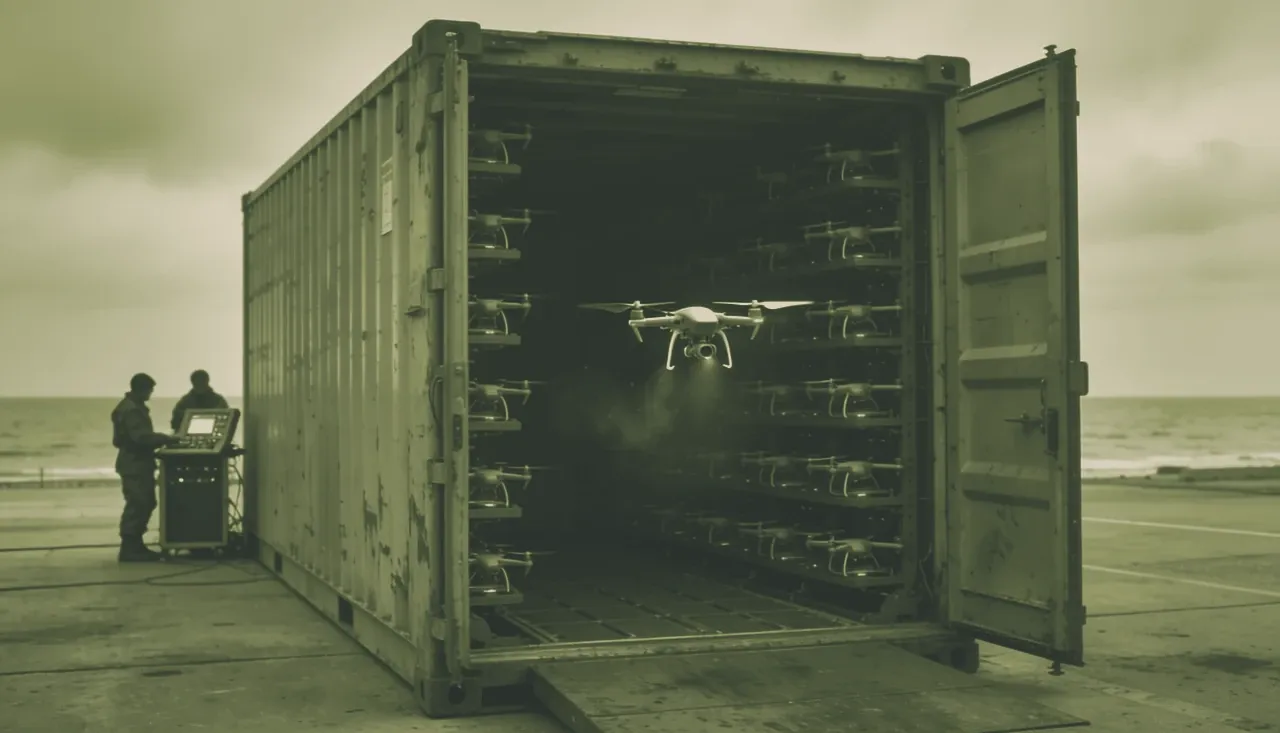
A Kansas City-launched firm cleared a gate in the Pentagon's search for a container that launches, recovers and refits drone fleets with a crew of two, the bottleneck sitting between the Army's million-drone plan and the air.
Tesseract Ventures will advance in the Defense Innovation Unit's Containerized Autonomous Drone Delivery System prototype project, the company said in a July 14 release. No award value was disclosed. The selection buys a demonstration slot, not a production line.
Tesseract is competing with NOMAD, a mobile containerized platform that deploys and manages large drone fleets across air, land and sea using onboard intelligence and secure real-time data sharing, per the release. John Boucard, the CEO and founder, called it a milestone for a company selling scalable autonomy to the U.S. military.
DIU published the CADDS solicitation in February. The notice names its target plainly: the Department of War "faces a robotic mass challenge," and the "1:1 operator-to-aircraft model limits deployment speed and scale while exposing operators to unnecessary risks," The War Zone reported. A CADDS container has to hold drones dormant, then launch, recover and refit them on command, from land or ship, in daylight or darkness and in bad weather, with setup measured in minutes. "Ideally, the system should require a crew of no more than 2 personnel," per the notice. It must also take homogeneous and heterogeneous mixes of government-directed drones, which rules out building the box around one airframe.
That combination is the hard part. Rheinmetall's 126-cell UVision launcher, Mitsubishi Heavy Industries' 48-drone truck container and Northrop Grumman's Modular Payload System launch and stop there, DroneXL noted. Recovery and refit are handled separately, if at all.
Tesseract is not the only vendor through the gate. DIU also tapped Valinor's Dispatch, a modular docking and charging station built to cycle drones without a human swapping batteries, for CADDS, Tectonic Defense reported.
The battlefield and the startup story — free in your inbox every week. No paywall.
Subscribe Free →Army Secretary Daniel Driscoll has said the service plans to buy at least a million drones in two to three years. Airframes are the easy half of that order: a soldier still unboxes, calibrates, launches and recovers each one. Tesseract, which made its Tampa headquarters official this week, holds Air Force and Space Force SBIR work and no drone-container production line. Under the Commercial Solutions Opening, a prototype that performs can go to production without another competition. The demonstrations decide who converts.
Frequently Asked Questions
What did Tesseract Ventures actually win?
A place in the next phase of a prototype project, not a production contract. The company's July 14 release says it will take part in demonstrations to validate operational performance, and no dollar value was disclosed. Under the Defense Innovation Unit's Commercial Solutions Opening process, prototypes that perform may become eligible for follow-on production without further competition.
What is CADDS trying to fix?
The ratio of operators to aircraft. The solicitation says the Department of War "faces a robotic mass challenge" because launching, recovering and refitting each drone takes direct human handling, a 1:1 model that caps deployment speed and exposes operators, according to The War Zone and DroneXL. CADDS asks industry for a container that does those jobs itself.
What are the container's requirements?
Per the DIU notice quoted by The War Zone, it must store drones in a dormant state and then launch, recover and refit them on command, work from land and maritime platforms in day, night and inclement weather, set up and break down in minutes, and support "homogeneous and heterogeneous mixes of Government-directed UAS." The notice adds that "ideally, the system should require a crew of no more than 2 personnel."
How is this different from containerized launchers already on the market?
Most of them only launch. DroneXL and The War Zone note that Rheinmetall's UVision-partnered 126-cell launcher, Mitsubishi Heavy Industries' 48-drone truck container and Northrop Grumman's Modular Payload System handle the outbound leg, while recovery and refit are done separately or not at all. CADDS requires launch, recovery and refit inside one container.
Is Tesseract the only company in the project?
No. Tectonic Defense reported that DIU also selected Dispatch, a modular drone docking and charging station from the defense holding company Valinor, for CADDS, with Dispatch supplying the charging and sustainment side of multi-drone operations.
Where is Tesseract Ventures based?
Tampa. The company was launched in the Kansas City area, and its 2022 announcements carried an Overland Park, Kansas dateline; Startland News and Interesting Engineering still describe it as Kansas City-launched. The July 14 release datelined Tampa, and the Tampa Bay Business Journal reported this week that the headquarters relocation is now official.
AI-generated summary, reviewed by an editor. More on our AI guidelines.

Marcus Schuler
Marcus Schuler edits BattlePolicy, a daily defense-technology brief connecting the companies and capabilities behind modern war to the contest among Europe, the US, Russia, and China.