Taiwan's engineers now fly Shield AI's autonomy themselves
An expanded contract gives NCSIST the ability to build AI pilots locally for drones that can keep operating when electronic warfare breaks the operator link.
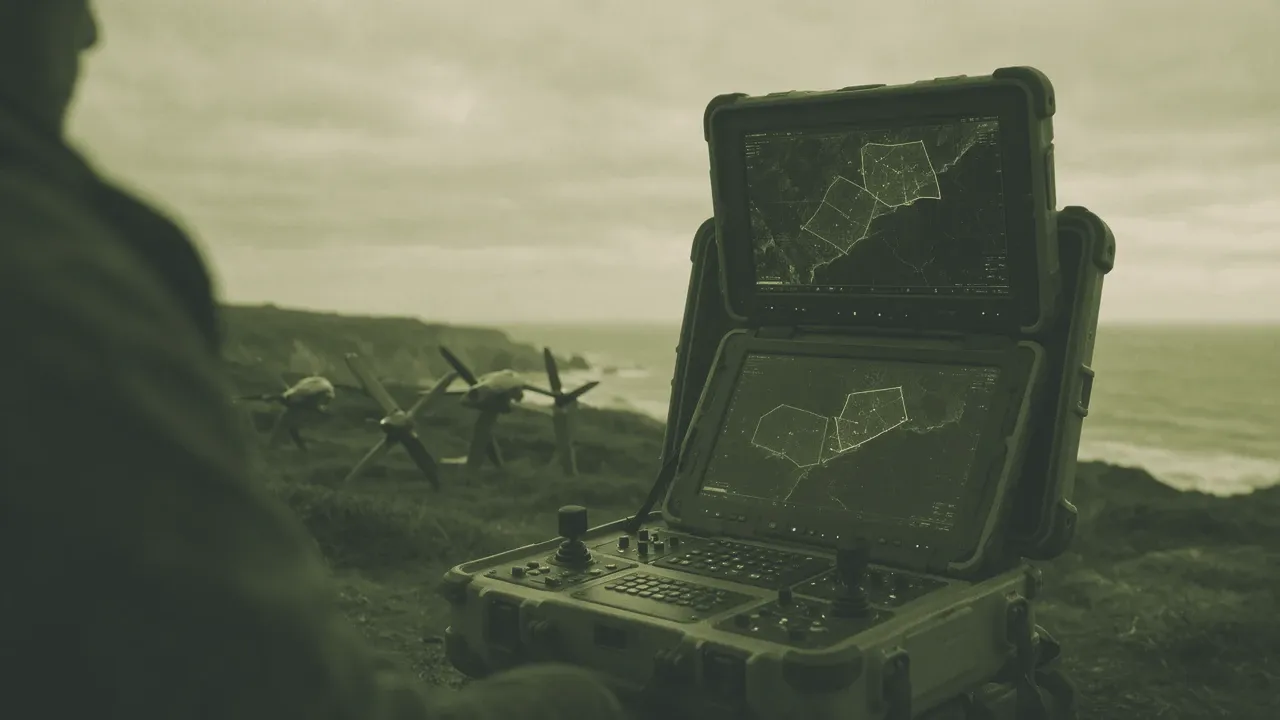
An expanded contract gives NCSIST the ability to build AI pilots locally for drones that can keep operating when electronic warfare breaks the operator link.
Shield AI and Taiwan's National Chung-Shan Institute of Science and Technology completed a field demonstration Aug. 6 in which Hivemind launched, coordinated and landed three NCSIST-built Mighty Hornet III drones, the partners announced. No human flew an individual aircraft.
Each drone searched an assigned area while communicating with the other two. One routed around a partial no-fly zone inside its sector without human redirection. Hivemind then landed all three.
The demonstration completed the original contract Shield AI signed with NCSIST earlier this year and produced what the partners called a significant expansion. The new agreement extends Hivemind across the institute's drone programs rather than one aircraft type. Its value was not disclosed.
NCSIST engineers built the AI pilots and installed them on the aircraft in under three months. Shield AI embedded staff at the institute to provide hands-on training and mentorship. NCSIST President Li Shih-chiang said that support gave Taiwanese engineers the confidence to integrate and use Hivemind themselves.
That transfer is the product. Taiwan is acquiring the ability to develop and field autonomous systems without relying on American technicians to operate them.
Mighty Hornet III is NCSIST's Group 2 anti-armor attack drone and Taiwan's first X-wing high-agility UAV. NCSIST describes a 3D-printed modular airframe that combines vertical takeoff and landing with fixed-wing cruise. It requires no launch or recovery equipment, allowing units to operate away from runways.
Shield AI says Hivemind has flown more than 30 platform types, including F-16s, helicopters, uncrewed boats and ground vehicles. "You can build ten million drones, but you can't train ten million drone pilots," Shield AI President Brandon Tseng said.
This was Shield AI's second Taiwan demonstration in eight days. On July 29, two Thunder Tiger SeaShark vessels running Hivemind detected an intruding vessel off Dapeng Bay and escorted it from the search zone.
Both sides in Ukraine routinely jam the radio link between drones and their operators, Taipei Times reported. Aircraft that fly, search and land without that connection remove this route of attack. Taiwan can now build that autonomy in-country. The next marker is which NCSIST programs receive Hivemind.
Frequently Asked Questions
What exactly did the drones do on their own?
Hivemind launched three Mighty Hornet III aircraft, assigned each its own search area, kept them in communication with one another and landed all three, the partners said. One drone routed around a partial no-fly zone inside its sector without a human redirecting it.
Why does it matter that Taiwanese engineers built the AI pilots?
NCSIST engineers developed and installed the AI pilots in under three months with Shield AI staff embedded at the institute. NCSIST President Li Shih-chiang said the training gave Taiwanese engineers the confidence to integrate and use Hivemind on their own, which means Taiwan does not need American technicians to run the systems.
What is the Mighty Hornet III?
NCSIST describes it as Taiwan's first X-wing high-agility UAV, a Group 2 anti-armor attack drone with a 3D-printed modular airframe. It combines vertical takeoff and landing with fixed-wing cruise and needs no launch or recovery equipment, so units can operate it away from runways.
How does autonomy help against electronic warfare?
Jamming attacks the radio link between a drone and its operator, a tactic both sides use in Ukraine, per Taipei Times. An aircraft that flies, searches and lands without that link is not exposed to that particular attack.
What did the contract expansion cover?
The demonstration closed out the original agreement and produced what both sides called a significant expansion, widening Hivemind's use across NCSIST's drone programs rather than a single aircraft type. Neither party disclosed the value.
Has Shield AI worked with other Taiwanese partners?
Yes. On July 29, two Thunder Tiger SeaShark uncrewed surface vessels running Hivemind detected an intruding vessel off Dapeng Bay in Pingtung County and escorted it out of the search area.
AI-generated summary, reviewed by an editor. More on our AI guidelines.

Marcus Schuler
Marcus Schuler edits BattlePolicy, a daily defense-technology brief connecting the companies and capabilities behind modern war to the contest among Europe, the US, Russia, and China.