Slava-class
The Soviet-built Slava-class guided-missile cruiser — a Cold War "carrier-killer" anchored around 16 deck-mounted P-1000 Vulkan anti-ship missiles and an S-300F area air-defence system, now reduced to two active hulls after the sinking of the Black Sea flagship Moskva.
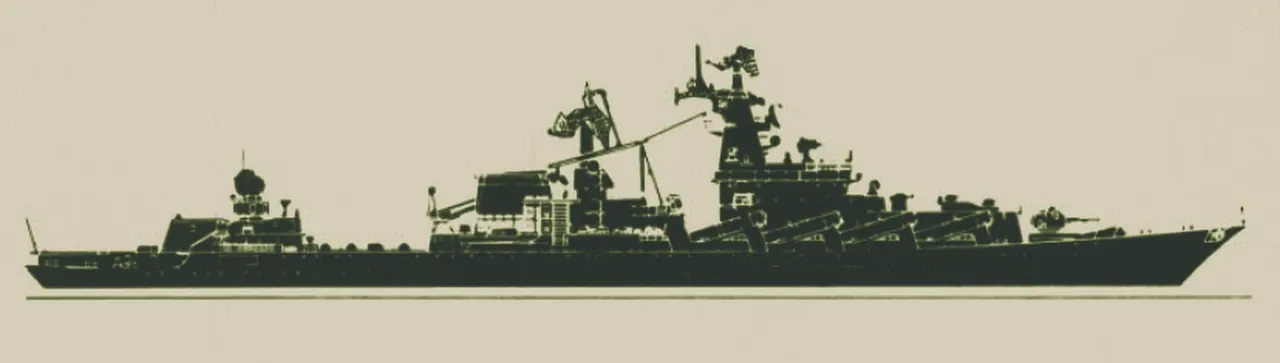
Cold War “carrier-killer” cruiser — a heavy surface combatant that packs sixteen deck-mounted P-1000 Vulkan anti-ship missiles and an S-300F area air-defence system, now reduced to a two-ship force after the flagship Moskva sank in 2022.
Overview
The Slava-class, known officially as Project 1164 Atlant, is a Soviet-designed, gas-turbine-powered guided-missile cruiser built for the Soviet Navy and inherited by the Russian Federation. The class was intended to hunt NATO carrier strike groups by saturating them with long-range heavy anti-ship missiles, while also providing fleet air defence with an S-300F Fort (SA-N-6) surface-to-air system. Three hulls were completed at the 61 Communards Shipyard in Mykolaiv (now Ukraine) during the 1980s; a fourth was left unfinished. After the lead ship, Moskva, was sunk by Ukrainian anti-ship missiles on 14 April 2022, only Marshal Ustinov (Northern Fleet) and Varyag (Pacific Fleet) remain in active service.
Development
Design work on a follow-on to the Kresta-II-class cruisers began in the late 1960s, culminating in the Project 1164 specification approved in the mid-1970s Naval Technology. The lead unit, then named Slava, was laid down in 1976 and commissioned in January 1983 Wikipedia. Two sister ships followed — Marshal Ustinov (formerly Admiral Flota Lobov) in 1986, and Chervona Ukrayina (later renamed Varyag) in October 1989 RussianShips.info. All construction ceased at Mykolaik after the dissolution of the USSR, leaving a fourth hull, Ukrayina, incomplete. Post-Cold War budget pressures kept the class largely pier-side until the 2010s, when the two surviving cruisers underwent extensive overhauls and received the upgraded P-1000 Vulkan missile set.
Design & capabilities
The Slava class displaces roughly 11,200–12,500 tonnes at full load, making it the largest Russian surface combatant in commission apart from the Kirov-class nuclear battlecruiser Naval Technology. The propulsion arrangement — a COGOG (combined gas or gas) plant with four M8KF turbines delivering about 120,000 shaft horsepower — gives the ship a top speed of around 32 knots and a range of up to 7,500 nautical miles RussianShips.info.
The profile is dominated by eight outward-angled twin launchers for the P-500 Bazalt (SS-N-12 Sandbox), later replaced by the longer-ranged P-1000 Vulkan on the in-service ships. These are deck-mounted trainable launchers, not vertical launch systems, and give the cruiser its “carrier-killer” nickname. For air defence, the forward deck houses eight rotary VLS modules of the S-300F Fort (SA-N-6 Grumble) system, providing 64 long-range surface-to-air missiles. Point defence is layered with Osa-M (SA-N-4 Gecko) missiles and six AK-630 30 mm close-in weapon systems. The main gun battery consists of a twin AK-130 130 mm mount, and the ASW suite includes 533 mm torpedo tubes and RBU-6000 rocket launchers. A single Ka-27 helicopter is embarked for antisubmarine warfare and over-the-horizon targeting.
Sensor wise, the class carries the Top Pair (MR-800) 3D air-search radar, the Top Dome (3R41 Volna) fire-control for the S-300F, and the Front Door (Titanit) anti-ship guidance set, paired with a hull-mounted sonar Wikipedia.
Combat record / operational use
The most consequential engagement involving the class occurred on 13-14 April 2022, when the Black Sea Fleet flagship Moskva was struck by two Ukrainian-built R-360 Neptune anti-ship missiles. The cruiser suffered a major magazine explosion and sank the following day while under tow, making it the largest warship lost in combat since the Second World War Legion Magazine. Ukraine’s success against Moskva — and the heavy attrition of the Black Sea Fleet that followed — demonstrated the vulnerability of large, legacy surface combatants to shore-based anti-access weapons and spurred a wider Russian withdrawal from the north-western Black Sea Carnegie Endowment.
The two surviving ships have seen more routine service: Marshal Ustinov has deployed with the Northern Fleet battle group and conducted exercises in the Atlantic and Mediterranean, while Varyag serves as the flagship of the Pacific Fleet and regularly participates in Russian-Chinese naval drills. Neither has fired its primary anti-ship missiles in anger.
Advantages
- Extremely heavy anti-ship punch — sixteen P-1000 Vulkan missiles, each with a 1,000 kg warhead and a range in excess of 500 km.
- Layered air defence with long-range S-300F, point-defence Osa-M, and CIWS, providing a credible area shield for a task force.
- High sustained speed (~32 kts) enables the cruiser to keep pace with carrier strike groups.
- Flagship-level command and communications suite, suitable for leading a surface action group.
- Over-the-horizon targeting capability via organic helicopter and satellite links.
Drawbacks / limitations
- Deck-mounted anti-ship launchers are large radar reflectors and preclude any attempt at stealth; the class is highly visible to modern sensors.
- No vertical launch capability for the main anti-ship battery — the ships cannot fire anti-ship or land-attack cruise missiles from universal cells, limiting adaptability.
- The S-300F Fort and Osa-M systems are 1980s technology and cannot engage modern low-RCS threats as effectively as contemporary naval SAMs.
- Only two hulls remain; the loss of any single ship would eliminate a significant portion of Russia’s blue-water AAW-capable platforms.
- Sustained high-end sortie rates are questionable given the age of the gas turbines and the lack of a domestic supply chain for key components originally produced in Ukraine.
Counterparts
- Arleigh Burke-class (USA) — the standard Western multi-role Aegis destroyer with 96 VLS cells.
- Type 055 Renhai (China) — a similarly sized modern cruiser/destroyer with 112 universal VLS cells and a dual-band AESA radar.
Outlook
Marshal Ustinov and Varyag are expected to serve for another decade or more, but the Slava class is a declining asset in the Russian order of battle. Russia’s modern surface-combatant programs (Project 22350 Gorshkov-class frigates and the upgraded Kirov-class Admiral Nakhimov) point toward much smaller or heavily rebuilt platforms that abandon the deck-mounted heavy-missile concept. The Moskva loss accelerated a doctrinal shift in the Black Sea, where the surviving fleet now relies on small missile corvettes and land-based batteries, a pattern likely to shape how Russia fields the remaining Slava cruisers — kept further from harm, used as flagships of safety, not spearheads.
Key specifications
| Spec | Value |
|---|---|
| Type | Guided-missile cruiser (Project 1164 Atlant) |
| Full-load displacement | ~11,200–12,500 t (est.) |
| Length / beam / draft | 186.4 m / 20.8 m / ~8.4 m |
| Propulsion | COGOG — 4 × M8KF gas turbines (~120,000 shp), 2 shafts |
| Max speed (kts) | ~32 kts |
| Range / endurance | ~6,000–7,500 nm (est.) |
| Complement | ~480–530 |
| Armament | 16 × P-1000 Vulkan (deck-mounted twin launchers); 64 × S-300F Fort (8 rotary VLS); Osa-M point-defence SAM; 1 × twin AK-130 130 mm gun; 6 × AK-630 CIWS; 533 mm torpedoes; 2 × RBU-6000 |
| Sensors / combat system | Top Pair (MR-800) / Top Steer 3D radar; Top Dome (3R41) fire control; Front Door anti-ship guidance; hull sonar |
| Aviation facilities | Flight deck and hangar for 1 × Ka-27 helicopter |
Sources
- Naval Technology — “Slava Class Guided Missile Cruiser” — https://www.naval-technology.com/projects/slavaclassguidedmiss/
- RussianShips.info — “Guided Missile Cruisers – Project 1164” — https://russianships.info/eng/warships/project_1164.htm
- Wikipedia — “Slava-class cruiser” — https://en.wikipedia.org/wiki/Slava-class_cruiser
- Legion Magazine — “Russia's Black Sea fleet falls back amid staggering losses” — https://legionmagazine.com/russias-black-sea-fleet-falls-back-amid-staggering-losses/
- Carnegie Endowment for International Peace — “The Changing Military Balance in the Black Sea: A Ukrainian Perspective” — https://carnegieendowment.org/russia-eurasia/research/2026/04/the-changing-military-balance-in-the-black-sea-a-ukrainian-perspective