The Wire · live GRID-REF 37°47′N 122°25′W
DISPATCH 03/26 · 23 Aug 2026
BattlePolicy
Startup to front line. Strategy to consequence.
Lexicon · Sea

Mogami-class Frigate

Japan's stealth frigate — and its first big arms export — the Mogami-class packs firepower, mine warfare and unmanned systems into a low-signature hull run by a small, automated crew. In 2025 Australia picked the upgraded version over Germany's — Japan's first major overseas defence contract.
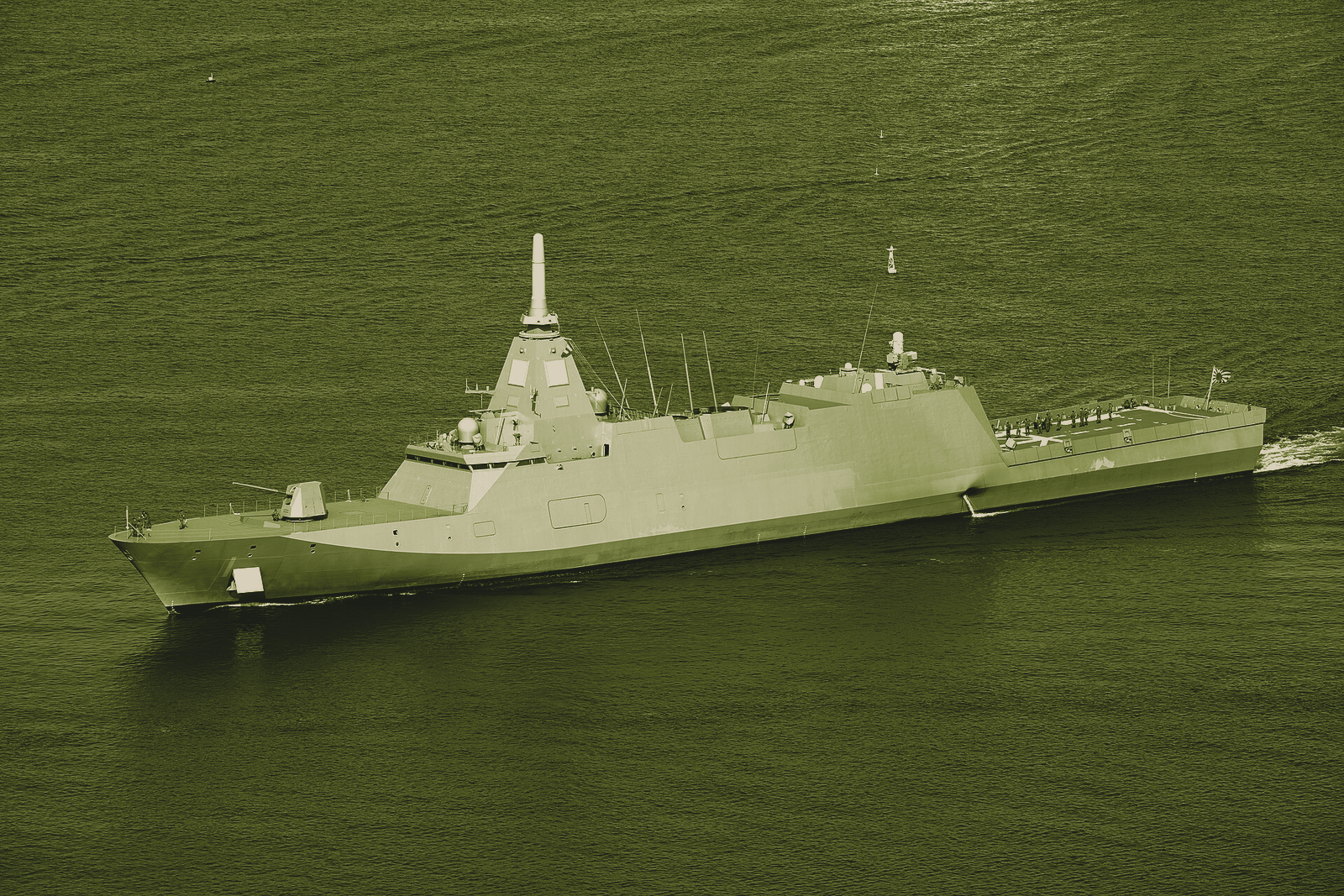
Japan's stealth frigate — and its first big arms export — the Mogami-class (30FFM) is a compact, low-signature multi-mission warship that does the work of larger ships with a remarkably small, highly-automated crew. It folds anti-submarine, anti-air and surface combat together with mine warfare and unmanned systems on one stealthy hull. And in 2025 it became a landmark of Japanese rearmament and export policy: Australia chose the Upgraded Mogami over a German rival for its future frigate fleet — Tokyo's first major overseas defence contract in the postwar era.

Overview

The Mogami-class (designated 30FFM, also 30DX) is a multi-mission stealth frigate built by Mitsubishi Heavy Industries for the Japan Maritime Self-Defense Force (JMSDF). Its design goals were capability density, stealth and efficiency: a low-radar-cross-section hull (with reduced infrared and acoustic signatures) packing area air defence, anti-submarine and anti-surface weapons, mine-countermeasures capability, and the ability to deploy unmanned surface and underwater vehicles, all operated by a small, heavily-automated crew (around 90, far fewer than comparable warships) using a futuristic combat-information centre with panoramic and augmented-reality displays. At roughly 133 m and ~5,500 tonnes it is a true multi-role frigate built in numbers to expand the JMSDF's fleet affordably. An evolved "Upgraded Mogami" (with a larger hull, expanded sensors and a bigger missile battery) was selected by Australia in 2025 — making the class the centrepiece of Japan's emergence as a defence exporter.

Development

Japan conceived the 30FFM in the mid-2010s as a "compact multi-functional destroyer," with Mitsubishi Heavy Industries as builder, to grow the fleet with cheaper, smaller-crewed multi-mission ships, per Wikipedia and Army Recognition. The lead ship commissioned in 2022, and Japan is building 12 of the original class plus 12 more "New FFM" (06FFM) evolved ships — the latter larger, with a 32-cell strike-length VLS. The class's breakthrough came in 2025 in Australia: Canberra's competition for a new general-purpose frigate came down to MHI's Upgraded Mogami versus Germany's ThyssenKrupp MEKO A-200, and in August 2025 Australia selected the Upgraded Mogami as its preferred platform, per the Australian Department of Defence and Naval News. Australia plans up to 11 ships (the first built in Japan, later ones in Australia), and a contract for the first three was signed in 2026 — Japan's first major overseas defence-equipment contract, a milestone for a country that only recently loosened its arms-export rules.

Design & capabilities

The Mogami's signatures are stealth, automation and multi-mission versatility. The hull is shaped for low radar cross-section with an integrated mast and reduced IR and acoustic signatures. Armament on the base 30FFM includes a 127mm (5-inch) main gun, a 16-cell Mk41 VLS (the New FFM and Upgraded Mogami expand this to 32 cells, strike-length), Japanese Type 17 anti-ship missiles, a SeaRAM point-defence system, torpedoes, and a helicopter — plus a notable mine-countermeasures capability (the class can deploy and control mine-hunting unmanned systems) and broader USV/UUV operation, reflecting a deliberate emphasis on unmanned teaming. The defining efficiency is crewing: advanced automation lets the ship operate with roughly 90 sailors, a fraction of comparable frigates, easing Japan's (and customers') personnel constraints. The combat system feeds a strikingly modern CIC with panoramic and augmented-reality displays. The Upgraded Mogami for Australia is larger, with expanded radar/sensors and the 32-cell VLS for more firepower and interoperability with allied fleets. The trade-offs of a compact frigate (less absolute capacity than a large destroyer) are offset by numbers, stealth, automation and flexibility — a balance that won a hard-fought export competition.

Variants

  • 30FFM (Mogami-class): the original 12 ships for the JMSDF (16-cell VLS, mine-warfare, USV/UUV).
  • New FFM / 06FFM: 12 evolved ships — larger, with a 32-cell strike-length VLS.
  • Upgraded Mogami: the export configuration selected by Australia — larger hull, expanded sensors, 32-cell VLS.
  • Specialized fits (e.g. anti-air-warfare-focused configurations) within the family.

Combat record / operational use

The Mogami-class has no combat record — it serves the JMSDF (in service since 2022) on patrol, presence and multi-mission duties in a tense Indo-Pacific, and is now being acquired by Australia. Its operational significance is twofold. Operationally, it gives Japan a growing fleet of stealthy, automation-efficient multi-mission frigates — including a real mine-warfare and unmanned-systems capability — to expand naval mass amid Chinese maritime pressure. Strategically and industrially, the Australian selection is historic: Japan's first major arms export, a deepening of Japan-Australia (and US-allied) defence-industrial ties, and a sign of Tokyo's shift toward an active export policy. As a new class, its wartime performance is unproven, but its design and the export win mark it as one of the more significant frigate programs of the era.

Advantages

  • Stealthy — low radar, infrared and acoustic signatures with an integrated mast.
  • Highly automated — multi-mission capability with a very small (~90) crew.
  • Multi-role — air defence, ASW, anti-surface, mine warfare and unmanned-systems operation.
  • Scalable firepower — 16-cell VLS growing to 32 (New FFM / Upgraded Mogami).
  • Export breakthrough — chosen by Australia; Japan's first major overseas defence contract.

Drawbacks / limitations

  • Compact-frigate limits — less absolute capacity than a large destroyer (offset by numbers/automation).
  • No combat record — capability is projective; unproven in war.
  • Small-crew risk — heavy automation can strain damage control and sustained operations.
  • Export-program complexity — Australian build, support and interoperability are demanding firsts for Japan.
  • Cost growth — the larger Upgraded Mogami is a ~$1 billion-class ship.

Counterparts

The Mogami competes in the modern multi-mission frigate class with Britain's Type 31, France's FDI, Spain's F-110, Italy's PPA and Germany's MEKO A-200 (the rival it beat in Australia) — and, as an export, it broke into a market long dominated by European and American yards. Its distinctions are its stealth-plus-automation efficiency (multi-mission capability with an exceptionally small crew), its built-in mine-warfare and unmanned-systems focus, and the strategic weight of being Japan's first major arms export. Within the JMSDF it complements larger Aegis destroyers as the affordable, numerous multi-role workhorse. The Australian win, over a capable German competitor, is the clearest verdict on its competitiveness.

Outlook

The Mogami-class is both a pillar of Japan's naval expansion and the breakthrough of its new arms-export policy. Its trajectory is the continued build-out of the JMSDF fleet (the 12 original plus 12 larger New FFM), and the landmark Australian program (up to 11 Upgraded Mogamis, transitioning to Australian construction) — a deep, multi-decade Japan-Australia industrial partnership. The variables to watch are the Australian build and support arrangements (firsts for Japanese industry), the class's interoperability within the US-allied Indo-Pacific network, and how its stealth-and-automation model performs operationally. For Japan, the Mogami is a strategic and symbolic milestone — proof it can compete as a defence exporter and a deepening of its alignment with Australia and the US; for the Indo-Pacific, it is a sign of allied navies converging around shared platforms to balance China's growing fleet.

Key specifications

Spec Value
Type Multi-mission stealth frigate
Class Mogami-class (30FFM); New FFM (06FFM); Upgraded Mogami (Australia)
Origin Japan — Mitsubishi Heavy Industries
Lead ship commissioned 2022
Length / displacement ~133 m / ~5,500 tonnes
Crew ~90 (highly automated)
VLS 16-cell Mk41 (30FFM) → 32-cell (New FFM / Upgraded Mogami)
Main gun / missiles 127mm gun; Type 17 anti-ship missiles; SeaRAM
Special Mine-countermeasures; USV/UUV operation; stealth hull
Operators Japan; Australia (Upgraded Mogami, selected 2025)
Status In service / building

Sources

  1. Mogami-class frigate — Wikipedia
  2. Mogami-class frigate selected for Australia's new general-purpose frigates — Australian Dept of Defence
  3. Japan Promotes Mogami-Class Frigate in Australia — Army Recognition
  4. Australia Signs Contract With Japan For Three Upgraded Mogami — Naval News
  5. New FFM — Wikipedia
  6. General purpose frigate — Royal Australian Navy
🔒 The Analyst Section on Mogami-class Frigate is for BattlePolicy Pro members. Below the line: procurement and contract history, the suppliers and companies behind the system, our head-to-head analyst view of the systems it actually competes with, and the BattlePolicy assessment note. Unlock the full file with BattlePolicy Pro →
Related
Sea · submarine · sskPro

MILDEN

MILDEN is Turkey's first indigenously designed submarine — the ~2,700-tonne Atılay class, in block construction at Gölcük since January 2025 with a methanol-reformer AIP and Turkish weapons. Delivery is promised for the early 2030s; nothing is yet in the water.

USA · Sea · ssbnPro

Columbia class

The Columbia class is the US Navy's next ballistic-missile submarine — 12 boats replacing 14 Ohios, with electric drive, an X-stern and a life-of-ship reactor. The $126B+ program is the Navy's top priority, running ~a year late with lead-boat delivery now targeted for 2028.

Sea · lhd · amphibious-assault-shipPro

TCG Anadolu

TCG Anadolu is Turkey's flagship — a Juan Carlos I-derived LHD reinvented as the "world's first drone carrier" after the F-35B expulsion. Bayraktar TB3 drones fly from its ski-jump deck, struck sea targets in NATO's Baltic exercise in 2026, and Kizilelma is meant to follow.