GRID-REF 37°47′N 122°25′W
DISPATCH 02/26 · 9 Jun 2026
BATTLEPOLICY
Startup to front line. Strategy to consequence.
Lexicon · USA

AIM-120 AMRAAM

The AIM-120 AMRAAM is the West's standard active-radar beyond-visual-range air-to-air missile, fielded on 14 fighter types and 42 nations, with a combat record stretching from 1992 to the ongoing war in Ukraine.
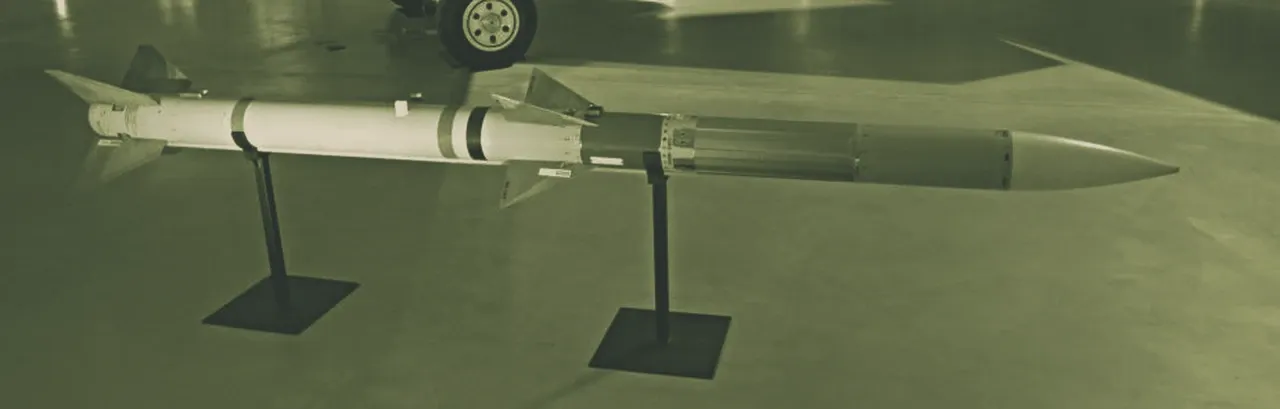
AIM-120 AMRAAM
FIG.01 · USA Image - AIM-120 AMRAAM. Photo by G. Edward Johnson, CC BY-SA 3.0, via Wikimedia Commons.
The West’s primary beyond-visual-range air-to-air missile — an active-radar fire-and-forget weapon that replaced the semi-active Sparrow, arming 14 fighter types across 42 nations and doubling as the interceptor for the ground-based NASAMS.

Overview

The AIM-120 Advanced Medium-Range Air-to-Air Missile (AMRAAM), colloquially “Slammer,” is a beyond-visual-range (BVR) air-to-air missile produced by Raytheon (RTX). It entered service in 1991 as the successor to the AIM-7 Sparrow and became NATO’s standard BVR weapon. The missile combines inertial navigation, a two-way datalink, and an active radar terminal seeker to give pilots a fire-and-forget capability. It has been adapted for surface launch as the interceptor in the National Advanced Surface-to-Air Missile System (NASAMS), giving it a dual air-defense role. More than 25,000 rounds have been produced, and the missile remains in full-rate production with the AIM-120D-3 as the latest variant.

Development

Development began in the late 1970s under the Advanced Medium-Range Air-to-Air Missile program, a joint US Air Force–Navy effort to field an active-radar missile that would overcome the limitations of the Sparrow’s continuous-wave semi-active guidance. Raytheon received the full-scale development contract in 1981, and the first test firings followed in 1984. The AMRAAM achieved initial operational capability in September 1991 with the US Air Force, as detailed by the US Air Force fact sheet. Early production variants (A and B) were rapidly superseded by the AIM-120C with clipped wings for internal carriage on the F-22, and later by the extended-range AIM-120D.

Design & capabilities

The AMRAAM is a solid-rocket-powered missile with an active radar seeker, an inertial navigation system (INS), and a two-way datalink. At launch the missile flies toward a predicted intercept point using INS and mid-course updates from the firing aircraft; in the terminal phase its own active radar takes over, allowing the launch platform to break away (“fire-and-forget”). A home-on-jam mode enables the seeker to guide on a target’s electronic-countermeasure emissions. The AIM-120D added a GPS-enhanced INS for improved navigation and a longer no-escape envelope, according to Army Recognition. The missile is also integrated into NASAMS, where a containerized launcher fires the same round from the ground — a role widely exercised in Ukraine since 2022 against Russian cruise missiles and drones, as noted by NAVAIR.

Variants

  • AIM-120A/B — Baseline variants. Range ~75 km. A was the original; B introduced a reprogrammable signal processor.
  • AIM-120C — Clipped wings for internal carriage (F-22, F-35). Range ~90 km. C-5 through C-7 added improved fuze, guidance improvements, and production enhancements.
  • AIM-120D — Extended range (~160 km) via GPS-enhanced INS, improved datalink, and a new high-off-boresight capability.
  • AIM-120D-3 — Current production standard, replacing legacy guidance section hardware with form-fit-function modules; sustains the line through the 2020s.

Combat record / operational use

The AMRAAM scored its first BVR kill on 27 December 1992 when a US Air Force F-16 shot down an Iraqi MiG-25 over the southern no-fly zone, as recorded by the US Air Force fact sheet. It has since seen action in the Balkans, Iraq, Afghanistan, and Syria, achieving a high probability of kill when fired within its envelope. The missile’s most sustained operational use has been in Ukraine, where NASAMS batteries equipped with AMRAAM have intercepted hundreds of Russian cruise missiles and one-way attack drones, according to NAVAIR’s program profile. The system’s performance in this high-density air-defense environment has validated its effectiveness against small, low-flying targets.

Advantages

  • True fire-and-forget with an active radar seeker; launch aircraft does not need to illuminate the target.
  • Two-way datalink allows mid-course retargeting and cooperates with offboard sensors.
  • Home-on-jam mode counters electronic jamming threats.
  • NATO-wide integration across 14 fighter types, giving it unmatched coalition interoperability.
  • Dual-role as a surface-launched interceptor (NASAMS) with proven cruise-missile and drone-kill performance.

Drawbacks / limitations

  • The solid-rocket motor gives a smaller no-escape zone than a ramjet-powered missile such as the MBDA Meteor.
  • Range is variant-dependent and the maximum figures are achievable only under ideal conditions (high-altitude, head-on supersonic launch).
  • High unit cost (~$1.2–1.8M per round in recent production lots) pressures inventory size.
  • Heavier and larger than short-range IR missiles, limiting the number that can be carried internally on the F-35 and F-22.

Counterparts

Outlook

Raytheon continues to deliver the AIM-120D-3 under an ongoing production contract, while the US Air Force and Navy push toward the future AIM-260 Joint Advanced Tactical Missile (JATM), designed to out-range the Chinese PL-15. The AMRAAM will remain in frontline service well into the 2030s, sustained by the D-3 upgrade and its embedded role in NASAMS for both the US Army and multiple NATO partners.

Key specifications

Spec Value
Type Beyond-visual-range air-to-air missile
Range A/B: ~75 km; C: ~90 km; D: ~160 km (variant-dependent)
Speed (Mach / km·s⁻) ~Mach 4
Warhead (type & weight) ~20 kg blast-fragmentation (proximity/contact fuzing)
Guidance INS + two-way datalink + active-radar terminal (D adds GPS-enhanced INS); home-on-jam
Accuracy (CEP) Not publicly established
Launch platform(s) F-15, F-16, F/A-18, F-22, F-35, Typhoon, Gripen, Tornado, NASAMS surface launcher
Propulsion Solid rocket
Length / diameter / launch weight 3.66 m / 178 mm / ~152–162 kg

Sources

  1. US Air Force — AIM-120 AMRAAM fact sheet — https://www.af.mil/About-Us/Fact-Sheets/Display/Article/104576/aim-120-amraam/
  2. NAVAIR — AMRAAM program overview — https://www.navair.navy.mil/product/AMRAAM
  3. Wikipedia — AIM-120 AMRAAM — https://en.wikipedia.org/wiki/AIM-120_AMRAAM
  4. Sandboxx — SPECS: AIM-120 Advanced Medium-Range Air-to-Air Missile (AMRAAM) — https://www.sandboxx.us/news/references/weapon-systems/specs-aim-120-advanced-medium-range-air-to-air-missile-amraam/
  5. Army Recognition — AMRAAM AIM-120 air-to-air missile — https://www.armyrecognition.com/military-products/army/missiles/tactical-missiles/amraam-aim-120-air-to-air-missile
FIELD DISPATCH · WEEKLY

BattlePolicy Weekly — free.

Defense tech, startups, and security — weekly. No paywall.

Related
Ukraine · USA · Funding · Swarmer · drones · defense tech · venture capital · Pentagon

Ukraine turned its drone war into an industry. Now Wall Street is pricing it.

Swarmer's Nasdaq debut, a wave of Western venture money and a Pentagon FPV contract show Ukrainian defense tech crossing from battlefield to balance sheet, at a valuation that has outrun the revenue.

Ukraine · USA · Funding · Swarmer · drones · defense tech · venture capital · Pentagon
USA · Autonomy · Shifters · Ace Capital Partners

Shifters raises $10.2M to put robots first into tunnels and rubble

The US-Israeli startup raised a $10.2 million seed led by Ace Capital Partners to scale ground robots that enter tunnels and rubble before troops.

USA · Autonomy · Shifters · Ace Capital Partners
USA · Policy · AI · Anthropic · autonomous weapons · Pentagon

Trump orders faster military AI and bars vendors from switching off fielded models

A new national security memo tells the Pentagon to onboard frontier commercial AI at speed, strips vendors of the power to shut it down mid-mission, and resets the rules for autonomous weapons within 90 days.

USA · Policy · AI · Anthropic · autonomous weapons · Pentagon