Anduril Fury
The YFQ-44A Fury is America's jet-powered semi-autonomous fighter drone — a collaborative combat aircraft designed to team with crewed fighters, carry air-to-air missiles, and provide affordable mass for the US Air Force's next-generation airpower.
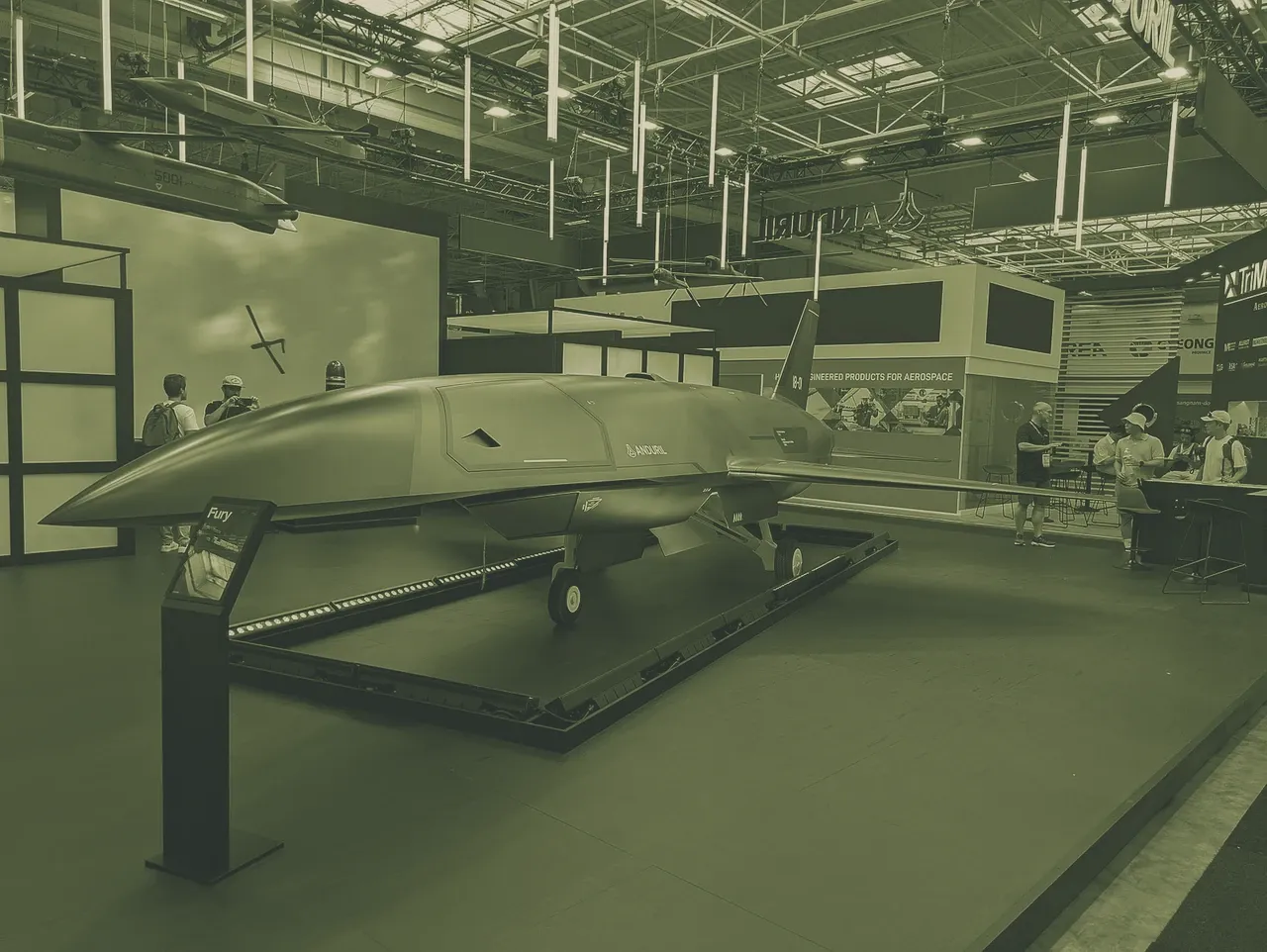
America's jet-powered semi-autonomous fighter drone — a collaborative combat aircraft designed to team with crewed fighters, carry air-to-air missiles, and provide affordable mass for the US Air Force's next-generation airpower.
Overview
The Anduril Fury, formally designated YFQ-44A by the US Air Force, is a jet-powered, semi-autonomous unmanned combat aerial vehicle developed under the Collaborative Combat Aircraft (CCA) Increment 1 program. Intended to fly alongside crewed fighters such as the F-22, F-35 and F-15EX, the aircraft functions as a “fighter drone” that carries air-to-air missiles, extends sensor reach, and absorbs tactical risk through affordable mass. Fury traces its airframe lineage to a high-performance aggressor concept by Blue Force Technologies, which Anduril acquired in 2023 and evolved into a clean-sheet combat system that achieved first flight just 556 days after contract award, an unusually rapid timeline for a fighter-class platform Anduril.
Development
Fury originated in the late 2010s at North Carolina startup Blue Force Technologies as “Grackle”/“REDmedium” — an aggressor drone meant to simulate adversary fighters during training. After The War Zone reported Anduril’s acquisition of the company in September 2023, the design was pitched into the USAF’s CCA program and won one of two Increment 1 contracts in April 2024 alongside General Atomics. The Air Force assigned the YFQ-44A designation — the first “unmanned fighter” in the F-for-fighter series — in March 2025, and ground testing of both Increment 1 prototypes began that spring, covering propulsion, avionics, autonomy integration and ground control DefenseScoop. The first flight, announced on 31 October 2025, took place at the Southern California Logistics Airport in Victorville with two L-29 chase planes; the Air Force noted the type went “from concept to flight in less than two years.”
Design & capabilities
Fury is a compact, high-subsonic jet built around a single Williams FJ44-4M commercial turbofan — an off-the-shelf business-jet engine — with an estimated maximum speed around Mach 0.95 and a ceiling of roughly 15 000 m Wikipedia. The airframe uses predominantly aluminum and commercially available components; Anduril states that 94 % of the parts list is drawn from the commercial supply chain, a deliberate choice to enable fast, affordable production. Two external underwing hardpoints carry weapons; the current test configuration mounts two AIM-120 AMRAAMs, and a future AIM-260 JATM integration is expected. The aircraft has no internal weapons bay, a trade that simplifies manufacturing at the expense of stealth with stores. Sensor and mission payloads are housed in a modular nose section that can be tailored for RF, infrared, or other packages according to the company’s product page Anduril Fury. Flight control is fully semi-autonomous: an operator monitors the mission rather than flying the aircraft, tasking it through a ruggedized laptop running Anduril’s Lattice-based autonomy software — no stick-and-throttle piloting is required.
Combat record / operational use
The YFQ-44A has not been used in combat and remains in developmental testing. Its test campaign, however, has progressed rapidly. After ground testing in mid-2025, the aircraft made its public flight debut on 31 October 2025. In February 2026 the Air Force released imagery of Fury flying with an inert AIM-120 AMRAAM, opening the weapons-integration and captive-carry phase, with a live missile shot planned for later that year The War Zone. In April 2026, the USAF Experimental Operations Unit conducted multiple sorties at Edwards AFB using front-line maintainers — not contractor crews — who launched, recovered, and turned the aircraft between flights using only a ruggedized laptop, demonstrating the squadron-level autonomy and logistics concept Defense News. Anduril’s stated 2026 objectives include a first live weapon shot, multi-ship autonomous operations, teaming flights with crewed fighters, and operations away from established test ranges.
Advantages
- Unprecedented development speed: clean-sheet design to semi-autonomous flight in 556 days, the fastest US fighter-class program in recent memory Anduril.
- Autonomy-first architecture: every taxi and test flight has been semi-autonomous; the operator supervises rather than pilots, taking the hardest technical risk head-on.
- Manufacturability by design: ~94 % commercial parts, a business-jet engine, and a production line engineered without fixed monuments — sized for 50 aircraft per year initially, scaling to ~150 on three shifts Air & Space Forces.
- Squadron-level footprint: the Experimental Operations Unit demonstrated laptop-based mission upload and rapid maintenance turnarounds without fixed-base infrastructure, aligning with expeditionary operations.
- Fighter-class envelope: subsonic-up-to-Mach-0.95 performance and fielded-fighter turn rates enable escort and maneuvering combat roles.
Drawbacks / limitations
- No production order yet: the USAF’s competitive Increment 1 decision between the YFQ-44A and General Atomics’ YFQ-42A is pending in fiscal 2026; Anduril’s ~$1 B Arsenal-1 factory depends on it.
- Externally curated performance data: range, endurance, sensor fit and full radar-cross-section remain unpublished, making independent assessment impossible.
- Limited armament: only two external hardpoints and no internal bay — magazine depth is shallow and weapon carriage compromises stealth.
- Weapons integration unproven: only inert captive-carry flights completed so far; a first live missile shot is still ahead, leaving lethality unvalidated.
- Program uncertainty: total buy numbers remain opaque; USAF references 100–150 Increment 1 aircraft against a long-term ambition of ~1 000 CCAs, but quantities under contract are undisclosed.
Counterparts
- MQ-9 Reaper (USA) — a long-endurance, multi-role uncrewed aircraft, though fundamentally different in role and performance class.
- Bayraktar Akinci (Turkey) — a turboprop-powered armed drone capable of air-to-ground and air-to-air missions, closer in concept but distinct in propulsion and operational context.
Outlook
The YFQ-44A stands at the center of the USAF’s upcoming competitive CCA Increment 1 production decision, expected before the end of fiscal 2026. The service could select Fury, the rival YFQ-42A, or a mixed fleet for an initial tranche of 100–150 aircraft, with fielding targeted before 2030. A crash and six-week stand-down of the General Atomics prototype in April 2026 gave Anduril an uncontested window in which operator-experimentation flights continued, strengthening its position. Meanwhile, Anduril has already begun serial prototype production at Arsenal-1 in Ohio — a 5-million-square-foot plant designed to produce not only Fury but also Roadrunner, Barracuda and a classified system. The CCA award will determine whether the “hyperscale” factory model lives up to its promise, and whether Fury becomes the affordable-mass anchor for the Next-Generation Air Dominance enterprise. Increment 2, with foreign interest already expressed by the Netherlands, represents a follow-on horizon.
Key specifications
| Spec | Value |
|---|---|
| Type | Jet-powered semi-autonomous collaborative combat aircraft (UCAV) |
| Endurance | Not publicly established |
| Range | Not publicly established |
| Cruise / max speed | ~Mach 0.95 (est.) |
| Payload | 2 external weapons stations (AIM-120 AMRAAM); payload mass not publicly established |
| Datalink / control | Operator-on-the-loop semi-autonomy via Anduril Lattice; ruggedized laptop interface |
| Autonomy level | Semi-autonomous — mission plan execution under human supervision; no stick-and-throttle piloting |
| Dimensions / MTOW | ~6.1 m length, ~5.2 m wingspan, ~2 268 kg MTOW (est.) |
| Launch & recovery | Conventional runway takeoff and landing; autonomous taxi, launch and recovery demonstrated |
Sources
- Anduril Industries — Anduril’s YFQ-44A Begins Flight Testing for the Collaborative Combat Aircraft Program. https://www.anduril.com/news/anduril-yfq-44a-begins-flight-testing-for-the-collaborative-combat-aircraft-program
- The War Zone — Anduril’s YFQ-44 Fury ‘Fighter’ Drone Has Flown. https://www.twz.com/air/andurils-yfq-44-fury-fighter-drone-has-flown
- DefenseScoop — Air Force kicks off ground testing for CCA drones while preparing for first flight. https://defensescoop.com/2025/05/01/air-force-cca-drones-ground-testing-general-atomics-anduril/
- Wikipedia — Anduril YFQ-44. https://en.wikipedia.org/wiki/Anduril_YFQ-44
- Anduril Industries — Fury product page. https://www.anduril.com/fury
- The War Zone — Anduril’s Fury Collaborative Combat Aircraft Is Now Flying With AIM-120 AMRAAM. https://www.twz.com/air/yfq-44a-fury-now-flying-with-aim-120-amraam-missile
- Defense News — Air Force unit executes test of Anduril’s semiautonomous combat drone. https://www.defensenews.com/industry/techwatch/2026/04/17/air-force-unit-executes-test-of-andurils-semiautonomous-combat-drone/
- Air & Space Forces Magazine — Look Inside Anduril’s New Factory as Collaborative Combat Aircraft Production Begins. https://www.airandspaceforces.com/look-anduril-new-factory-cca-production/