GRID-REF 37°47′N 122°25′W
DISPATCH 02/26 · 15 Jun 2026
BATTLEPOLICY
Startup to front line. Strategy to consequence.
Lexicon · Russia

Burevestnik

Russia's experimental nuclear-powered, nuclear-armed cruise missile of claimed unlimited range — designed to evade missile defenses through circuitous low-altitude flight, plagued by a troubled test record and not yet in service.
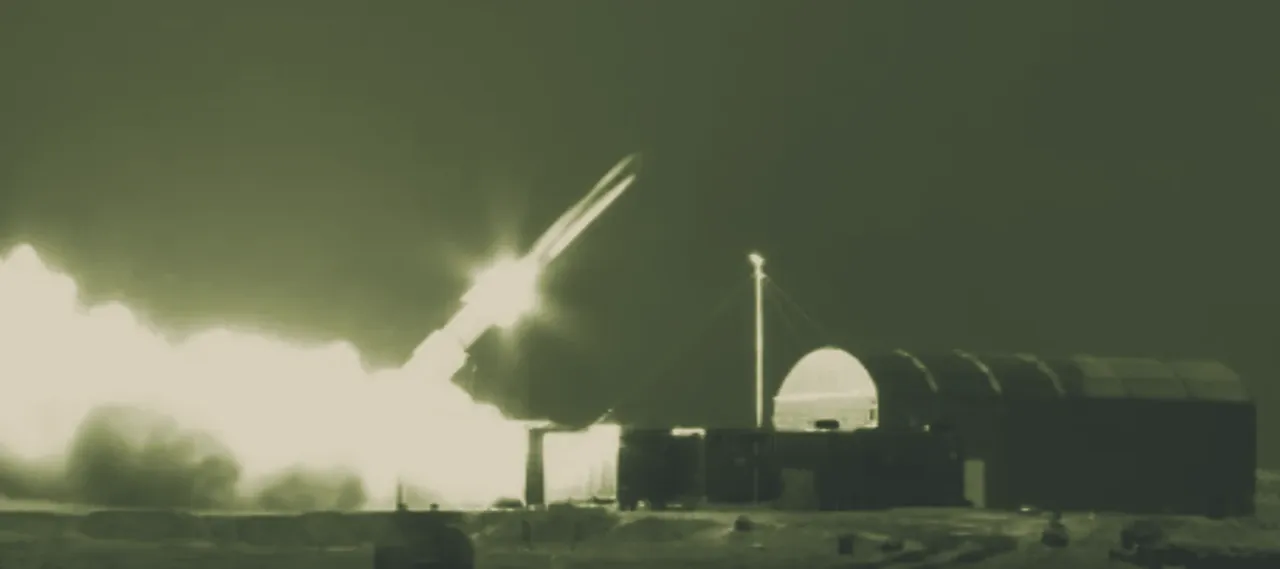
Burevestnik
FIG.01 · Russia Image - Launch of a 9M730 Burevestnik nuclear-powered cruise missile. Photo by Ministry of Defence of the Russian Federation, CC BY 4.0, via Wikimedia Commons.
Russia's experimental nuclear-powered, nuclear-armed cruise missile of claimed effectively unlimited range, designed to evade missile defenses through low-altitude, circuitous flight — not yet in service and plagued by a troubled test record.

Overview

The 9M730 Burevestnik ("Storm Petrel"), assigned the NATO reporting name SSC-X-9 Skyfall, is a Russian experimental intercontinental-range cruise missile propelled by a miniature nuclear reactor and armed with a nuclear warhead. It is the only known weapon of its kind — a concept the United States itself proved and abandoned with Project Pluto (1957–1964) over radiological and safety concerns. Publicly unveiled by Vladimir Putin on 1 March 2018 as one of six "super weapons" positioned explicitly as a counter to U.S. missile defense, the Burevestnik has since become one of the most intensely scrutinized — and controversial — strategic systems under development, widely nicknamed the "flying Chernobyl" by critics, according to Wikipedia. It has never entered service and has never been used in combat.

Development

Russia reportedly began work on an intercontinental nuclear-powered cruise missile in December 2001, following the U.S. withdrawal from the Anti-Ballistic Missile Treaty, reviving a Soviet-era concept, according to an analysis by CSIS. Development is attributed by Russian press to the All-Russian Scientific Research Institute of Experimental Physics (VNIIEF) in Sarov, with manufacture linked to NPO Novator in Yekaterinburg, though neither designation has been officially confirmed. Flight testing began around 2016 from a dedicated rail-ramp launch complex at Pan'kovo on Novaya Zemlya, with the first known flight in November 2017 covering approximately 35 km in two minutes before crashing into the Barents Sea — assessed by the U.S. intelligence community as the only moderately successful early shot, per Wikipedia. A missile lost at sea in 2017 required a recovery effort, and on 8 August 2019 a failed "isotope power source" test at Nyonoksa killed five Rosatom scientists and caused a radiation spike in nearby Severodvinsk — an accident widely linked by open-source analysts and U.S. officials to recovery work on a sunken Burevestnik reactor. Testing visibly resumed at Pan'kovo in August 2021, when satellite imagery analyzed by the Middlebury Institute's Jeffrey Lewis and CNS showed an erected environmental shelter and launcher activity, as documented by Arms Control Wonk. On 5 October 2023, Putin claimed a successful test, though no independent confirmation followed. The program's landmark event came on 21 October 2025, when Chief of the General Staff Valery Gerasimov reported to Putin that the missile had flown 14,000 km in roughly 15 hours with "vertical and horizontal maneuvers," a claim relayed by the Arms Control Association. In May 2026 Putin stated the missile was in its "final stages" of development, and Russian press has pointed to adoption no sooner than 2027 — all deployment-timing claims remain Russian-side and unverified, according to Al Jazeera.

Design & capabilities

The Burevestnik is a ground-launched, two-stage weapon: a solid-fuel rocket booster propels the missile off an inclined rail ramp, after which a miniature nuclear reactor sustains subsonic cruise flight over intercontinental distances, according to CSIS. The exact engine cycle remains unconfirmed in open sources — ramjet, turbojet, and nuclear-thermal interpretations all circulate — but Norwegian intelligence and Western reporting describe a partly open-air-cooled highly enriched uranium core that contaminates the exhaust airflow, a design assessed by The Barents Observer as carrying an inherent risk of radiological release in flight. Guidance is not publicly established but is assessed to combine inertial navigation with a two-way datalink for in-flight retasking; analyst Decker Eveleth, cited by the EurAsian Times, notes that inertial drift over multi-hour flights poses a fundamental accuracy challenge. Moscow claims the missile can fly terrain-hugging profiles as low as roughly 50 meters to stay beneath radar horizons, compressing a defender's reaction time to approximately two minutes for a typical surface radar, while Gerasimov asserts "guaranteed accuracy against highly protected targets at any distance" — a claim with no independent corroboration. The 21 October 2025 test's claimed 14,000 km in 15 hours works out to an average speed of approximately 930 km/h, or roughly 75 percent of the speed of sound. Dimensions are estimated at about 12 meters at launch and roughly 9 meters in cruise configuration, with an elliptical nose cross-section of approximately 1 by 1.5 meters; launch weight has not been publicly established. The weapon's most distinctive operational feature is endurance: if the propulsion works as claimed, the Burevestnik could launch preemptively, loiter for many hours, and attack from an unexpected vector — for instance, approaching the continental United States from the south — exploiting gaps in early-warning radar coverage, as analyzed by CSIS.

Known launch infrastructure includes the rail-ramp test site at Pan'kovo, and a nine-pad deployment complex identified through satellite imagery adjacent to the Vologda-20/Chebsara nuclear warhead storage facility roughly 475 km north of Moscow — an unusual co-location noted by analyst Decker Eveleth and confirmed as consistent with a missile site by FAS's Hans Kristensen, as reported by Arms Control Wonk.

Variants

No publicly identified variants exist. Russian state media (TASS) has claimed the Burevestnik could be adapted for mobile launchers associated with the Iskander or Oreshnik systems, but no such adaptation has been observed, and the claim remains unverified, per CSIS.

Combat record / operational use

The Burevestnik has never been used in combat. Its entire operational history consists of a flight-test campaign notable for a high failure rate and a lethal development accident. The Nuclear Threat Initiative has counted at least 13 known tests since 2016 with only two partial successes, according to Wikipedia. The November 2017 first flight from Pan'kovo covered roughly 35 km before crashing into the Barents Sea. The 8 August 2019 Nyonoksa radiation accident — officially described as a failed "isotope power source" test — killed five Rosatom scientists and produced a radiation spike detected in Severodvinsk, and was widely linked by analysts including Jeffrey Lewis and Ankit Panda to recovery work on a Burevestnik reactor lost at sea, though some experts, including Michael Kofman, disputed the connection. On 21 October 2025, Russia claimed a 14,000 km test flight lasting roughly 15 hours — the longest publicly asserted flight to date. The Norwegian Intelligence Service provided partial independent corroboration, confirming a launch from Novaya Zemlya that flew "significantly longer than before," while the Norwegian Radiation and Nuclear Safety Authority measured no abnormal radiation at its stations, as reported by The Barents Observer. Where the missile came down has never been disclosed. In May 2026 Putin placed the Burevestnik in the "final stages" of development, a characterization the ISW assessed as nuclear saber-rattling timed to mask battlefield setbacks in Ukraine.

Advantages

  • Effectively unlimited range and loiter — if the propulsion functions as claimed — enabling preemptive launch and attack from unexpected vectors that exploit gaps in early-warning radar coverage, per CSIS.
  • Terrain-hugging flight (claimed as low as roughly 50 m) compresses defender reaction time to approximately two minutes for a typical surface radar.
  • Sits outside New START counting rules — it is not an ICBM, SLBM, or heavy bomber — making it an arms-control-free strategic system, a feature CSIS flags as central to its signaling value following the treaty's expiration in February 2026.
  • Claimed in-flight vertical and horizontal maneuvering capability to bypass missile-defense engagement zones (Gerasimov, October 2025 — a Russian state claim).

Drawbacks / limitations

  • Atrocious test record: at least 13 known tests since 2016 with only two partial successes, a rate that leaves reliability deeply unproven.
  • Lethal development history: the 2019 Nyonoksa accident killed five scientists and demonstrates the extreme radiological risks inherent in handling an air-cooled flying reactor.
  • Inherent radiological hazard: an unshielded or minimally shielded reactor emits radiation continuously in flight, and any crash scatters a reactor core; Norway's intelligence service warns that testing alone "carries a risk of accidents and local radioactive emissions."
  • Subsonic speed makes it ultimately as vulnerable to interception as any cruise missile once detected, and the longer it flies, the more time defenders have to acquire and track it, per FAS's Hans Kristensen, cited in the EurAsian Times.
  • Inertial drift over multi-hour flights fundamentally undermines accuracy claims that lack independent corroboration.
  • Strategically redundant: existing Russian ICBMs and SLBMs already hold the U.S. homeland at risk, so the missile's chief function is assessed as fear-projection and arms-control leverage rather than any qualitative shift in the strategic balance.

Counterparts

Outlook

Public signals through mid-2026 point to a deployment push but not yet a fielded weapon. The Vologda-20 launch complex appears near-complete in satellite imagery, Russian state media has floated integration with Iskander and Oreshnik mobile launchers, and Russian press has projected adoption no sooner than 2027. On 12 May 2026 Putin placed the Burevestnik — alongside the Poseidon nuclear torpedo — in the "final stages" of development while simultaneously announcing a Sarmat ICBM test, a rhetorical package the ISW assessed as nuclear saber-rattling timed to mask battlefield setbacks in Ukraine. With New START expired in February 2026 and no successor framework in place, CSIS expects Moscow to continue using Burevestnik tests to shape U.S. missile-defense and arms-control deliberations. Whether Russia can make a flying reactor reliable, accurate, and safe enough to place on combat duty remains the unanswered — and independently unverifiable — question.

Key specifications

Spec Value
Type Nuclear-powered, nuclear-armed subsonic cruise missile
Range Claimed ~14,000+ km / effectively unlimited (Russian MoD; not independently verified)
Speed (Mach / km·s⁻¹) ~0.75 Mach / ~0.26 km·s⁻¹ (est., based on claimed October 2025 test)
Warhead (type & weight) Nuclear; yield and mass not publicly established
Guidance Assessed INS + datalink; specifics not publicly established
Accuracy (CEP) Not publicly established
Launch platform(s) Fixed ground ramp launchers (Pan'kovo test site; Vologda-20 deployment complex)
Propulsion Solid-fuel booster + miniature nuclear reactor (engine cycle not publicly established)
Length / diameter / launch weight ~12 m at launch / ~9 m in flight; ~1 × 1.5 m nose; launch weight not publicly established

Sources

  1. Wikipedia — 9M730 Burevestnik — https://en.wikipedia.org/wiki/9M730_Burevestnik
  2. CSIS — Russia's Nuclear-Powered Burevestnik Missile: Implications for Missile Defense — https://www.csis.org/analysis/russias-nuclear-powered-burevestnik-missile-implications-missile-defense
  3. Arms Control Association — Russia Tests Nuclear-Powered Cruise Missile, Torpedo — https://www.armscontrol.org/act/2025-11/news-briefs/russia-tests-nuclear-powered-cruise-missile-torpedo
  4. The War Zone (TWZ) — Long-Range Test Of Skyfall Nuclear-Powered Cruise Missile Claimed By Russia — https://www.twz.com/nuclear/skyfall-nuclear-powered-cruise-missile-long-range-test-claimed-by-russia
  5. The Barents Observer — No radiation measured in Norway after Putin's Burevestnik missile allegedly flew 14,000 km — https://www.thebarentsobserver.com/security/no-radiation-measured-in-norway-after-putins-burevestnik-missile-allegedly-flew-14000-km/439340
  6. Arms Control Wonk — Russia Resumes Burevestnik Testing — https://www.armscontrolwonk.com/archive/1212985/russia-resumes-burevestnik-testing/
  7. EurAsian Times — Deadlier Than Russia's Most Powerful 'Sarmat', West Gets Jittery Over Nuke-Powered SSC-X-9 Skyfall Missile — https://www.eurasiantimes.com/deadlier-than-russias-most-powerful-sarmat/
  8. RFE/RL — Putin Says Russia Tests New, Nuclear-Capable Remote Torpedo Dubbed 'Doomsday Machine' — https://www.rferl.org/a/russia-putin-torpedo-poseidon-burevestnik-missile-nuclear/33575625.html
  9. Al Jazeera — Putin hails Russia's test launch of 'most powerful missile in the world' — https://www.aljazeera.com/news/2026/5/13/putin-hails-russias-test-launch-of-most-powerful-missile-in-the-world
  10. Wikipedia — Nyonoksa radiation accident — https://en.wikipedia.org/wiki/Nyonoksa_radiation_accident
  11. Institute for the Study of War — Russian Offensive Campaign Assessment, May 12, 2026 — https://understandingwar.org/research/russia-ukraine/russian-offensive-campaign-assessment-may-12-2026/
FIELD DISPATCH · WEEKLY

BattlePolicy Weekly — free.

Defense tech, startups, and security — weekly. No paywall.

Related
Ukraine · Russia · Autonomy · artificial intelligence · Danylo Tsvok · Defense AI Center A1 · Logistics Lockdown · drones · electronic warfare

Ukraine's AI chief predicts a 'war of operating systems' with Russia in three to five years

Ukraine's defense AI chief says the next leap is not more AI drones but fusing them into a single network across the 1,200-km front — a "war of operating systems" with Russia inside three to five years.

Ukraine · Russia · Autonomy · artificial intelligence · Danylo Tsvok · Defense AI Center A1 · Logistics Lockdown · drones · electronic warfare
Ukraine · Russia · China · drones · Geran-3 · Geran-5 · shahed · TeleFly · interceptor drones

Russia is flying 8x more jet drones at Ukraine, and the engines are Chinese

Russia has launched roughly 1,400 jet-powered Geran drones at Ukraine this year, fast enough to slip past the cheap interceptors Kyiv built its air defense around.

Ukraine · Russia · China · drones · Geran-3 · Geran-5 · shahed · TeleFly · interceptor drones
Ukraine · Russia · drones · Crimea · Logistics Lockdown

Ukraine's $111 million Logistics Lockdown has cut every road into Crimea

Drone strikes closed all three road corridors between occupied Crimea and the mainland in four days. Military cargo traffic on Russia's main supply highway is down 71 percent by Kyiv's count, and Sevastopol is rationing gasoline by QR code.

Ukraine · Russia · drones · Crimea · Logistics Lockdown