CH-4 Rainbow
China's export workhorse medium-altitude long-endurance combat drone — a lower-cost MALE UCAV that has seen extensive combat with Middle Eastern and African customers, delivering persistence and precision strike without the restrictions of Western systems.
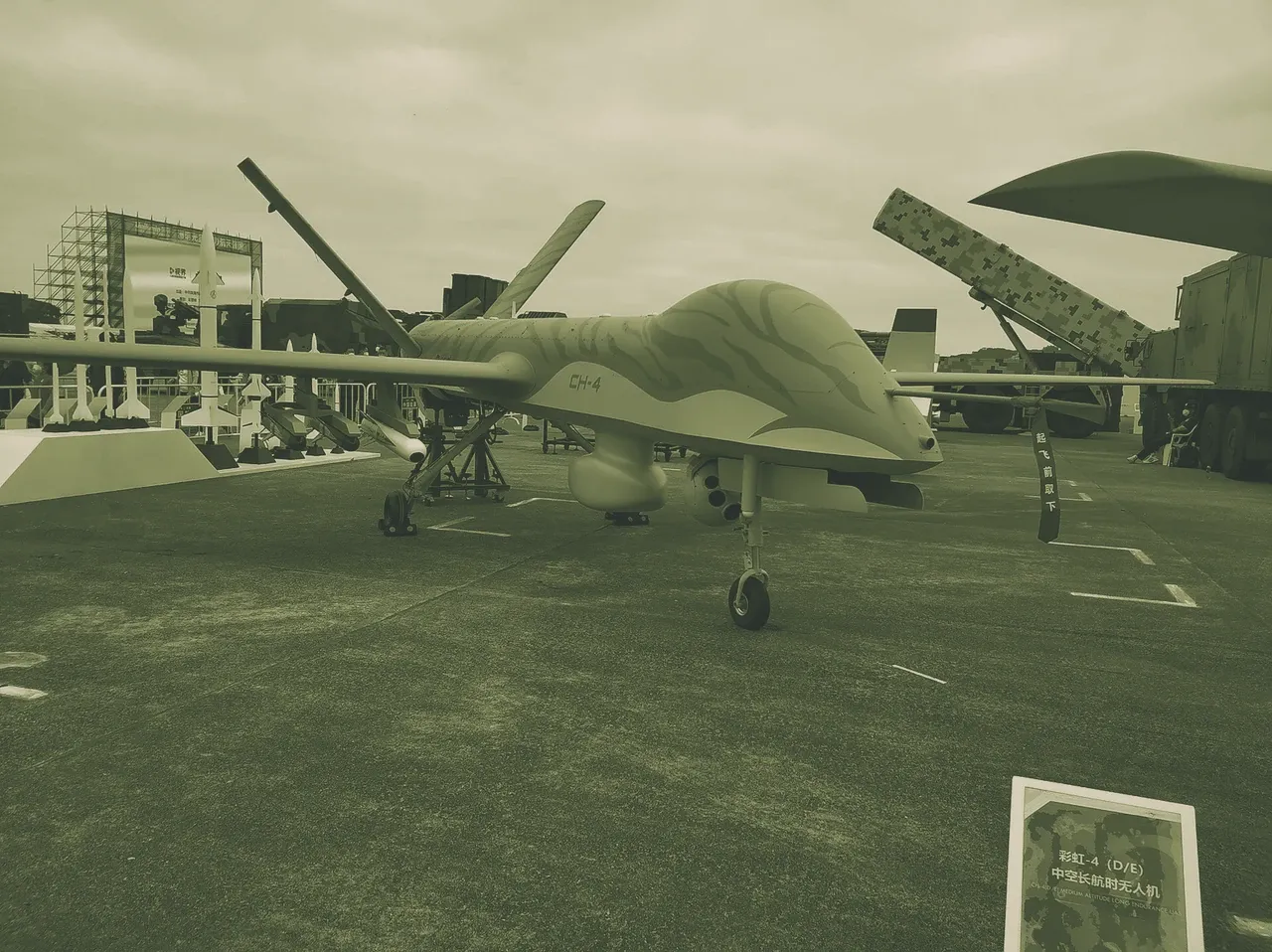
Overview
The CH-4 Rainbow, known in Chinese as Caihong-4, is a piston-engine medium-altitude long-endurance unmanned combat aerial vehicle (MALE UCAV) developed by the China Aerospace Science and Technology Corporation's CALT-Rainbow division. Marketed as a cost-effective alternative to the American MQ-9 Reaper, the CH-4 has become the most combat-blooded Chinese export drone, flown by Iraq, Saudi Arabia, Egypt, Jordan, Algeria, and a growing list of African and Asian operators. Its twin-boom, pusher-propeller configuration, long-endurance reconnaissance ability, and compatibility with satellite communications make it a persistent armed overwatch platform tailored for counter-insurgency and low-intensity conflicts.
Development
CALT-Rainbow launched the CH-4 programme around 2012–2013, aiming directly at the mid-tier export market left largely unfilled by tight U.S. export restrictions on armed MQ-1 and MQ-9 variants. First flight occurred approximately in 2013, and production deliveries began the following year. The system debuted on the export market when Iraq became the first known operator, receiving its initial CH-4B units in early 2015 and flying combat missions against the Islamic State as early as that October, an event that marked the first recorded combat strike by a Chinese armed drone, according to The Diplomat. Follow-on orders from Saudi Arabia and the United Arab Emirates followed rapidly, and CASC continued to refine the platform, incorporating optional satellite communication and an expanded weapon set. A fresh export deal, reported by Asian Military Review, confirmed that demand for the Rainbow line remained buoyant into the 2020s.
Design & capabilities
The CH-4 adopts a conventional twin-boom layout with a single pusher propeller driven by a piston engine, drawing clear visual and configurational inspiration from earlier U.S. designs. Its airframe is optimised for endurance rather than speed: a clean reconnaissance-configured CH-4A can stay aloft for up to 30–40 hours, while the strike-configured CH-4B typically operates for around 12 hours fully armed. The aircraft carries a payload of 250–345 kg across up to six hardpoints, accommodating the AR-1 laser-guided missile (a weapon broadly comparable to the AGM-114 Hellfire, with a reported circular error probable of ~1.5 m), the lighter AR-2, and a range of Chinese-developed precision-guided bombs such as the FT-7, FT-9, and FT-10, as detailed by the U.S. Army’s ODIN database. A standard electro-optical/infrared turret and an optional synthetic-aperture radar provide the sensor suite.
Control is normally line-of-sight with a radius of approximately 250 km, but the CH-4B can be fitted with a satellite-communications package that extends operational reach to around 2,000 km, a capability demonstrated by Indonesia’s CH-4B fleet. The system is not autonomous in the strike sense; it is remotely piloted with waypoint-navigation assistance, and weapons release always requires a human operator in the loop.
Variants
- CH-4A: Pure reconnaissance version with maximum endurance (up to 40 hours) and a sensor-only payload.
- CH-4B: The main strike variant, carrying up to six weapons (typically AR-1 missiles and precision bombs) and capable of SATCOM-extended control.
- Export configurations: Tailored to customer requirements, including the addition of SAR radar and indigenous datalink modifications. CASC has also marketed the CH-4 to naval operators and has demonstrated a maritime surveillance capability.
Combat record / operational use
The CH-4 Rainbow earned its reputation as the most combat-tested Chinese drone through a string of export-operator conflicts. Iraq’s first operational CH-4B strike, flown from al-Kut Air Base in October 2015 against an ISIS mortar position, was a watershed that proved a Chinese UCAV could deliver real-world effects, as reported by The Diplomat. The Saudi-led coalition subsequently flew CH-4s extensively over Yemen against Houthi forces; by July 2022, over a dozen Saudi CH-4s had been lost to ground fire, according to open-source compilations by GlobalSecurity.org. Egypt and Jordan also employed the type in counter-insurgency operations, while the United Arab Emirates transferred CH-4s to Libyan National Army forces in violation of the UN arms embargo. More recently, the Republic of the Congo ordered and received nine CH-4 Rainbow drones in 2023, as recorded by Army Recognition, extending the platform’s footprint on the African continent. China’s own People’s Liberation Army Ground Force operates a small number of CH-4Bs, primarily for border surveillance and doctrine development, but the aircraft has not been used in Chinese combat operations.
Advantages
- Low acquisition cost: Positioned as a low-single-digit million-dollar airframe, far below the MQ-9 Reaper’s ~$30 million tag, making it accessible to less affluent air forces.
- High endurance: Up to 40 hours in reconnaissance trim gives persistent overwatch for days with a single aircraft rotation.
- Export availability: Not subject to Missile Technology Control Regime-category restrictions in Chinese practice, allowing it to reach customers blocked from U.S. systems.
- Combat-proven design: Over a decade of real-world strikes in Iraq, Yemen, and Libya, with continuous refinement of the weapon-integration package.
- SATCOM extension: Optional beyond-line-of-sight control turns the aircraft into a strategic asset.
Drawbacks / limitations
- Survivability in contested airspace: Like all piston-engine MALE UCAVs, the CH-4 is vulnerable to man-portable air-defence systems, anti-aircraft artillery, and electronic warfare — as the high Saudi loss rate in Yemen illustrates.
- Modest speed: A cruise around 180 km/h means long transit times to a distant target area and slow repositioning after an engagement.
- Payload limitations: A maximum weapon lift of ~250–345 kg is modest compared with the MQ-9’s 1,700 kg, restricting the number and size of munitions per sortie.
- Baseline line-of-sight control: The standard datalink radius of ~250 km forces forward basing unless a SATCOM package is purchased, and SATCOM-equipped units can still suffer latency and bandwidth constraints.
- No true autonomy: The system relies on a remote pilot; the air-to-ground weapon release cycle remains man-in-the-loop, which can limit reaction speed in complex tactical situations.
Counterparts
- MQ-9 Reaper (USA)
- Bayraktar TB2 (Türkiye)
Outlook
The CH-4 Rainbow occupies a well-established niche as the bargain-basement combat-proven MALE UCAV, with a customer list that grows largely among nations that cannot or will not purchase Reaper-class Western systems. CASC continues to secure follow-on orders, underscored by Congo’s 2023 acquisition, and is marketing a successor (the larger CH-5). However, the platform faces increasing competition from the sister AVIC Wing Loong II and from Turkey’s Bayraktar TB2, both of which offer improved performance or better combat-network integration. Its long-term relevance will depend on whether CASC can field upgraded datalinks, better self-protection, and a credible maritime-strike capability before the export market moves toward turboprop or jet-powered alternatives.
Key specifications
| Spec | Value |
|---|---|
| Type | Piston-engine MALE UCAV |
| Endurance | ~30–40 h (recon) / ~12 h (strike) |
| Range | LOS radius ~250 km / ferry ~3,500–5,000 km / SATCOM ~2,000 km |
| Cruise / max speed | cruise ~180 km/h / max ~350–435 km/h |
| Payload | 250–345 kg, up to 6 weapons |
| Datalink / control | LOS + optional SATCOM |
| Autonomy level | Remotely piloted with waypoint navigation; man-in-the-loop weapon release |
| Dimensions / MTOW | wingspan ~18 m / length ~8.5 m / ~1,330 kg |
| Launch & recovery | runway |
Sources
- The Diplomat — “Revealed: Chinese Killer Drones in Iraq” — https://thediplomat.com/2015/10/revealed-chinese-killer-drones-in-iraq/
- GlobalSecurity.org — “Chang Hong-4 (CH-4) Rainbow-4” — https://www.globalsecurity.org/military/world/china/ch-4.htm
- ODIN / U.S. Army TRADOC — “CH-4B (CH-4B Rainbow) Chinese Unmanned Aerial Vehicle (UAV)” — https://odin.t2com.army.mil/WEG/Asset/CH-4B_(CH-4B_Rainbow)_Chinese_Unmanned_Aerial_Vehicle_(UAV)
- Asian Military Review — “China’s CASC wins follow-on CH-4 UAV export order” — https://www.asianmilitaryreview.com/2022/09/chinas-casc-wins-follow-on-ch-4-uav-export-order/
- Army Recognition — “Congo armed forces receive 9 Chinese CASC CH-4 Rainbow combat drones” — https://armyrecognition.com/news/aerospace-news/2023/congo-armed-forces-receive-9-chinese-casc-ch-4-rainbow-combat-drones
- GlobalMilitary.net — “CH-4 Rainbow” — https://www.globalmilitary.net/aircraft/ch-4-rainbow/