CH-47 Chinook
The Boeing CH-47 Chinook is the West's premier heavy-lift tandem-rotor helicopter, in continuous service since 1962 — moving troops, artillery, and cargo across every major U.S. conflict and fielded by more than a dozen allies.
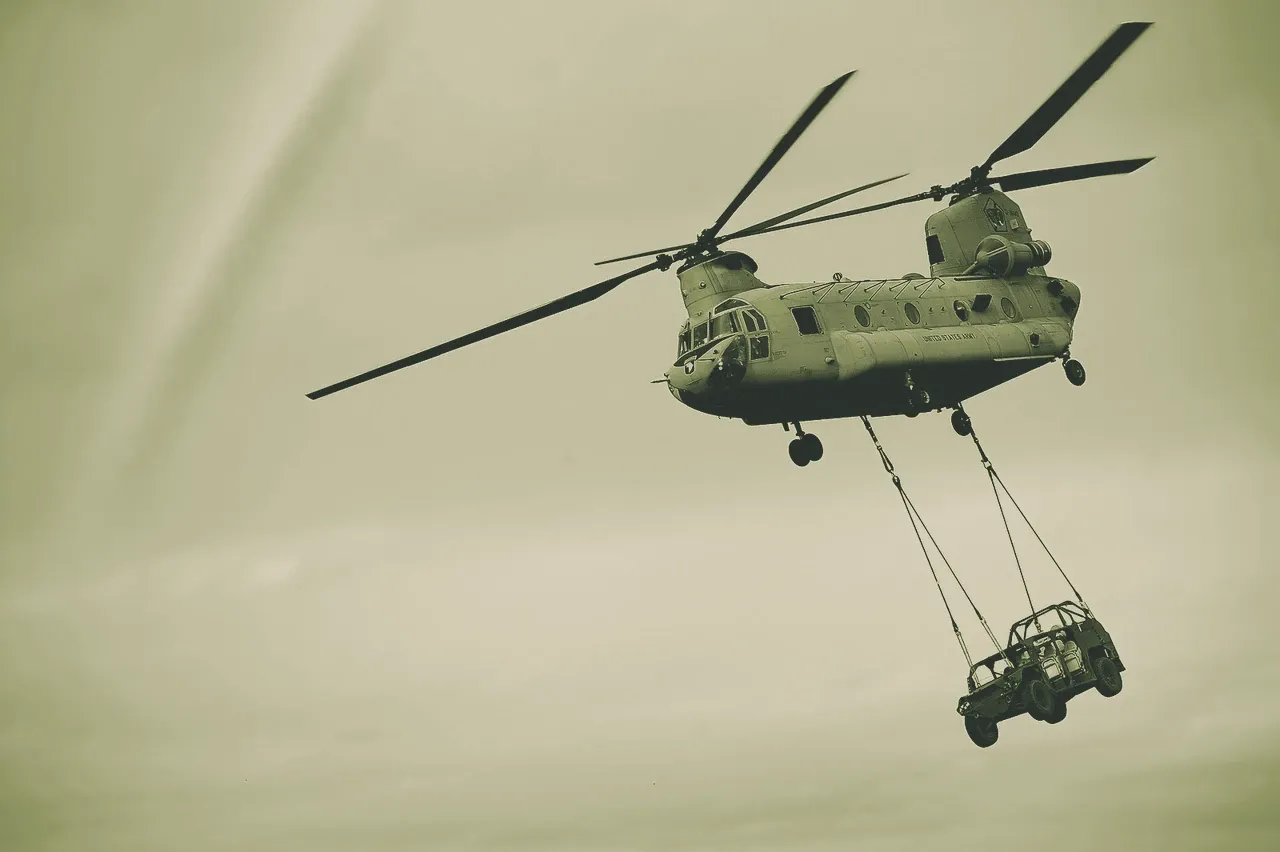
The West's premier heavy-lift tandem-rotor helicopter — continuously in service since 1962 and a fixture of troop, artillery, and cargo movement across every major U.S. conflict.
Overview
The Boeing CH-47 Chinook is a twin-engine, tandem-rotor heavy-lift transport helicopter that has anchored U.S. and allied medium-to-heavy vertical lift for over six decades. A single airframe can carry up to 55 troops or lift an M777 howitzer beneath its three cargo hooks, making it indispensable for air-assault, artillery displacement, battlefield resupply, and special operations. The current production standard, the CH-47F Block II, combines a reinforced airframe, uprated Honeywell T55 engines, and a modern digital cockpit to deliver a 24.5-t max takeoff weight and a mission radius of about 306 km. The type is flown by the U.S. Army, U.S. Special Operations Command (as the MH-47G), and more than a dozen export customers.
Development
Boeing (then Vertol) flew the prototype YCH-47A for the first time in September 1961, and the type entered U.S. Army service the following year as the CH-47A GlobalMilitary. Vietnam-era airframes proved the tandem-rotor formula, and the helicopter was progressively upgraded through the CH-47D (new engines, composite rotor blades, improved transmission) during the 1980s. The CH-47F, introduced around 2007, brought a Common Avionics Architecture System (CAAS) digital cockpit, a new monolithic airframe, and the T55-GA-714A engine; the current Block II further increases max gross weight to 24,494 kg and adds an advanced digital automatic flight control system (DAFCS) Airforce Technology. The special-operations MH-47G variant adds a terrain-following radar, aerial refueling probe, and additional defensive aids.
Design & capabilities
The Chinook’s signature feature is its tandem-rotor layout — two counter-rotating three-blade rotors — which eliminates the need for a tail rotor and directs all engine power into lift, giving the aircraft an unusually high payload fraction for its weight class. In the Block II configuration the helicopter has an empty weight of about 11,100 kg and can lift a center-hook load of up to 11,793 kg, or a combined tandem-hook load of 11,340 kg Airforce Technology. Internally it carries 33–55 troops (typically 33–44) or 24 litters, with a useful load of roughly 10.9–12.5 t. The rear loading ramp and triple-hook cargo system allow rapid on-/off-loading of vehicles, artillery pieces, pallets, and underslung loads without leaving the cockpit.
The flight deck is built around the CAAS glass cockpit with five multifunction displays, the DAFCS, and a Common Missile Warning System (CMWS) for self-protection. Defensive armament is limited to crew-served M240 or M134 machine guns on the door and ramp; the Chinook is not an attack platform and carries no offensive stores. Two Honeywell T55-GA-714A turboshafts rated at 4,733 shp each give the Block II a maximum speed of approximately 315 km/h and a cruise speed of 291 km/h, with a service ceiling of 6,096 m.
Variants
- CH-47F Block I – baseline modernised Chinook (CAAS, T55-GA-714A, MTOW 22,680 kg).
- CH-47F Block II – uprated with a reinforced airframe, new rotor blades, improved DAFCS, and a 24,494 kg MTOW.
- MH-47G – U.S. Army Special Operations variant with terrain-following radar, aerial refueling probe, additional fuel tanks, and enhanced defensive suite.
- CH-47D – earlier upgrade standard (now largely retired from frontline U.S. service) with composite blades and T55-L-712 engines.
- Multiple customer-specific export configurations (e.g., Chinook HC.4 for the Royal Air Force).
Combat record / operational use
The Chinook first saw combat in Vietnam, where it moved artillery, ammunition, and troops in the high-hot environment of the Central Highlands. It was subsequently the heavy-lift backbone of every major U.S. operation, from Grenada and Panama to the Gulf War, the Balkans, Somalia, Afghanistan, and Iraq. In Afghanistan in particular the helicopter’s ability to operate from high-altitude forward bases and lift howitzers, containers, and casualty loads made it indispensable. The heavy operational tempo of the post-9/11 wars placed enormous stress on the fleet, driving the U.S. Army to buy back retired airframes for remanufacture Simple Flying. The type continues to serve in force with the U.S. Army and Special Operations Command, and appears regularly in allied operations, disaster relief, and humanitarian missions.
Advantages
- Massive lift capacity — can carry a 155 mm M777 howitzer as an underslung load or an entire infantry platoon internally.
- Tandem-rotor layout eliminates tail-rotor power losses and provides exceptional low-speed stability and precision in confined landing zones.
- Proven in the most demanding high-hot environments for six decades.
- Broad allied user base simplifies multi-national logistics and interoperability.
- Special-operations MH-47G variant adds deep-penetration, terrain-following, and aerial refueling capability.
Drawbacks / limitations
- No offensive armament; dependent on escort or air-superiority for contested airspace.
- Large radar cross-section and slow speed make it vulnerable to man-portable air-defence systems (MANPADS) and anti-air artillery.
- High acquisition and life-cycle costs — the unit flyaway price is estimated at about US$38 million.
- High operational tempo during the counter-insurgency years has strained depot-level maintenance and the supply of serviceable airframes.
Counterparts
- Mi-8 Hip (Russia) — medium twin-turbine transport / armed-assault helicopter, the most prolific rotary-wing transport globally.
- Z-20 (China) — Black-Hawk-class medium utility helicopter that underpins the PLA’s modern air-assault capability, though with only one-third the Chinook’s lift capacity.
Outlook
Production of the CH-47F Block II continues for the U.S. Army and several export partners, while the MH-47G remains the centerpiece of U.S. special-operations heavy-lift. The fleet faces challenges in maintaining readiness rates across a large, aging airframe inventory, but the Chinook’s unique combination of lift, range, and proven reliability ensures it will remain the Western alliance’s premier heavy-lift rotorcraft well into the 2040s.
Key specifications
| Spec | Value |
|---|---|
| Crew | 3 (pilot, co-pilot, flight engineer) |
| Length / wingspan | Length 30.14 m (rotors turning) / Rotor diameter 18.29 m each |
| Max speed | ~315 km/h |
| Service ceiling | 6,096 m |
| Combat radius / range | Mission radius ~306 km (ferry range extendable with auxiliary tanks) |
| Payload | Internal ~10.9–12.5 t; sling up to ~11,340 kg (tandem) / ~11,793 kg (center hook) |
| Hardpoints | Three external cargo hooks (no weapons stations) |
| Radar / sensors | CAAS digital cockpit, DAFCS, CMWS survivability suite; MH-47G adds terrain-following radar |
| Powerplant | 2 × Honeywell T55-GA-714A turboshaft, ~4,733 shp each |
| Armament | Door/ramp M240 or M134 machine guns only (self-defence) |
Sources
- GlobalMilitary.net — CH-47 Chinook specifications and history. https://www.globalmilitary.net/aircraft/ch-47-chinook/
- Airforce Technology — MH-47G / CH-47F Chinook Special Operations Helicopter (Block II specs). https://www.airforce-technology.com/projects/mh-47g-chinook-special-operations-helicopter/
- Vero Beach Air Show — CH-47 Chinook (Block I/II weight data). https://veroairshow.com/aircraft-display/ch-47-chinook/
- Simple Flying — Why The US Army Is Buying Retired CH-47 Chinooks. https://simpleflying.com/us-army-buying-retired-ch-47-chinooks/