GRID-REF 37°47′N 122°25′W
DISPATCH 02/26 · 9 Jun 2026
BATTLEPOLICY
Startup to front line. Strategy to consequence.
Lexicon · China

DF-17

China's road-mobile DF-17 marries a medium-range ballistic missile booster to the DF-ZF hypersonic glide vehicle — a maneuvering, low-altitude payload built to outwit missile defenses and hit fixed high-value targets at 1,800–2,500 km.
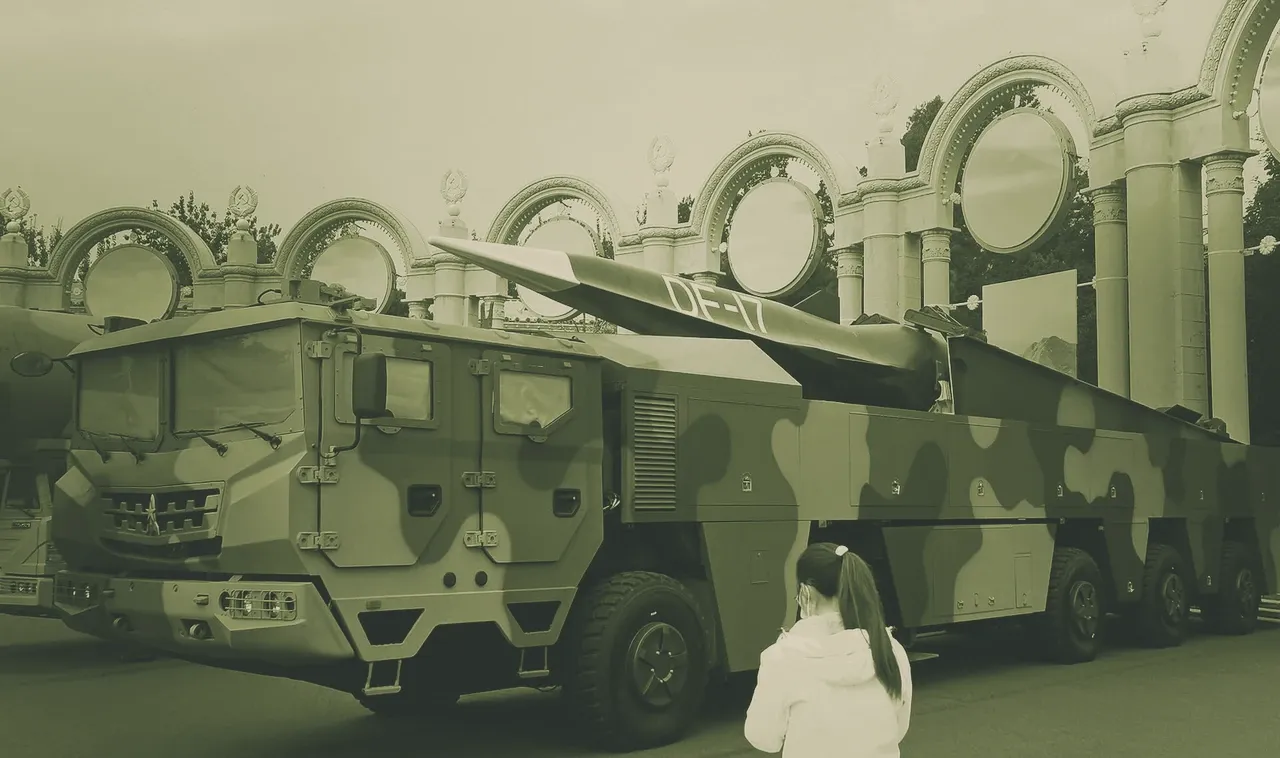
DF-17
FIG.01 · China Image - DF-17. Photo by 颐园居, CC BY-SA 4.0, via Wikimedia Commons.
China's road-mobile DF-17 marries a medium-range ballistic missile booster to the DF-ZF hypersonic glide vehicle — a maneuvering, low-altitude payload built to outwit missile defenses and hit fixed high-value targets at 1,800–2,500 km.

Overview

The DF-17 (Dong Feng-17), assigned the US designation CH-SS-22, is a road-mobile medium-range ballistic missile system fielded by the People's Liberation Army Rocket Force. Its distinguishing feature is the DF-ZF hypersonic glide vehicle (HGV) — a wedge-shaped, maneuvering payload that separates from the ballistic booster after ascent and glides through the upper atmosphere at speeds assessed between Mach 5 and Mach 10. The combination is designed to defeat layered missile defenses by flying a depressed, non-ballistic trajectory that evades mid-course intercept and compresses terminal warning times. The DF-17 entered operational service by 2019 and remains the only operationally fielded HGV system acknowledged by any nuclear-weapon state, according to CSIS Missile Threat.

Development

The DF-ZF glide vehicle emerged from a PLA program tracked by US intelligence under the early designator Wu-14. Testing began at the Taiyuan Satellite Launch Center, with the first flight recorded in January 2014. At least nine flight tests were conducted between January 2014 and November 2017, during which US officials observed what they described as "extreme maneuvers," per CSIS Missile Threat. The developmental pace — roughly two tests per year — indicated a focused, well-resourced effort to move the HGV from experiment to operational system. The DF-17 made its public debut at the 1 October 2019 National Day parade in Beijing, where 16 transporter-erector-launchers carrying the missile rolled past Tiananmen Square, signaling initial operational capability. US intelligence assessments through the Defense Intelligence Agency subsequently confirmed that the system had been fielded with the PLA Rocket Force and was assessed as a conventional precision-strike capability with potential nuclear applications, as analyzed by the Washington Times.

Design & capabilities

The DF-17 system integrates a solid-fuel medium-range ballistic missile booster with the DF-ZF HGV — an unpowered, lifting-body vehicle that executes a pull-up maneuver after booster separation and enters a prolonged hypersonic glide phase at altitudes between roughly 30 and 60 kilometers. This depressed trajectory keeps the vehicle below the engagement ceiling of exo-atmospheric mid-course interceptors while its speed and maneuverability complicate terminal-phase tracking and fire-control solutions. According to CSIS Missile Threat, the DF-ZF is assessed to reach speeds of Mach 5–10 (approximately 1.72–3.43 km/s) during the glide phase, with a range estimated by US intelligence at 1,800–2,500 kilometers — sufficient to hold at-risk targets across the first island chain, including US bases in Japan and potentially Guam, though the latter would require forward deployment or range-extension assumptions. The vehicle's maneuvering capability has been described in state-linked test accounts as delivering accuracy "within meters," though no formal CEP has been published.

The DF-17 is road-mobile, launched from a wheeled transporter-erector-launcher (TEL), which provides dispersal and survivability against preemptive strike. The system's reported dimensions of approximately 11 meters in length and a launch weight around 15,000 kilograms are consistent with the DF-16-class booster it is believed to employ, as noted in the broader Dongfeng family reference. The warhead is publicly assessed as conventional or nuclear, making the DF-17 a dual-capable system — a classification that aligns with US intelligence assessments of the PLA Rocket Force's increasing reliance on precision conventional strike to achieve theater effects without crossing the nuclear threshold.

Combat record / operational use

The DF-17 has no confirmed combat use. The system's operational history is limited to the test campaign at Taiyuan (2014–2017) and its parade debut in 2019. Since fielding, open-source satellite imagery has identified DF-17 TELs deployed to PLA Rocket Force bases in eastern and central China, indicating a primary orientation toward the Western Pacific theater, according to CSIS Missile Threat. No operational launch against a live target has been publicly documented, and the system's combat performance — particularly the DF-ZF's terminal accuracy and its ability to maintain maneuvering flight through the thermal and aerodynamic stresses of the glide phase against a defended target — remains untested outside controlled range conditions.

Advantages

  • Hypersonic glide trajectory compresses defender reaction time and exploits the gap between exo-atmospheric and endo-atmospheric intercept layers.
  • Assessed Mach 5–10 speed combined with maneuvering flight degrades track prediction and fire-control solutions.
  • Road-mobile basing on TEL complicates pre-launch targeting.
  • Dual-capable payload provides conventional precision-strike flexibility for theater operations.
  • Operational fielding since 2019 gives the PLA Rocket Force a unique, fielded HGV capability unmatched by any other military.

Drawbacks / limitations

  • No combat-proven performance data; all assessments rest on controlled-range tests.
  • HGV thermal-management and terminal-guidance challenges at extended glide ranges remain an engineering uncertainty.
  • Range of 1,800–2,500 km leaves key regional targets — notably Guam — at the edge of reach without forward basing.
  • Reliance on a boost-glide architecture means the system is still vulnerable during the ballistic ascent phase, before HGV separation.
  • Production scale and unit cost are not publicly established, limiting assessment of force-level sustainability.

Counterparts

  • ATACMS (USA) — short-range quasi-ballistic missile, the Western theater-strike counterpart.
  • Kinzhal (Russia) — air-launched aeroballistic missile marketed as hypersonic; a different architecture (air-launched ballistic) but the closest Russian analogue in the maneuverable-strike category.

Outlook

The DF-17 remains the world's only operationally fielded hypersonic glide vehicle system and a central symbol of China's shift toward maneuverable, defense-penetrating strike weapons. Its ongoing deployment to PLA Rocket Force brigades facing the Western Pacific signals that Beijing sees the DF-17 as a critical anti-access/area-denial instrument. The US and allies are pursuing their own glide-vehicle programs (the US Army's Long-Range Hypersonic Weapon, the US Navy's Conventional Prompt Strike), but these have not yet achieved operational status. The DF-17's real-world effectiveness — particularly against modern terminal-phase defenses like the Patriot PAC-3 MSE — remains an open question that only combat can resolve.

Key specifications

Spec Value
Type Road-mobile medium-range ballistic missile with hypersonic glide vehicle
Range 1,800–2,500 km (US-intel assessment)
Speed (Mach / km·s⁻) Mach 5–10 (~1.72–3.43 km/s) glide phase (assessed)
Warhead (type & weight) Conventional or nuclear (weight not publicly established)
Guidance Ballistic boost + maneuvering HGV terminal guidance
Accuracy (CEP) "Within meters" per test claims; no formal CEP published
Launch platform(s) Road-mobile TEL
Propulsion Solid-fuel boost → unpowered hypersonic glide
Length / diameter / launch weight ~11 m / not publicly established / ~15,000 kg

Sources

  1. CSIS Missile Threat — DF-17 profile. https://missilethreat.csis.org/missile/df-17/
  2. The Washington Times — "DIA reveals details of Chinese missile threat." https://www.washingtontimes.com/news/2026/apr/22/inside-ring-dia-reveals-details-chinese-missile-threat/
  3. Wikipedia — Dongfeng (missile) family overview. https://en.wikipedia.org/wiki/Dongfeng_(missile)
FIELD DISPATCH · WEEKLY

BattlePolicy Weekly — free.

Defense tech, startups, and security — weekly. No paywall.

Related
China · Air Defense · taiwan · interceptors · patriot

China is building air-defense mass opposite Taiwan while America spends its own

Beijing fielded the HQ-16F, a Patriot-class mobile air-defense missile, opposite Taiwan in the same weeks the US burned through the interceptors it would need to defend the island. The contest is magazine depth, not exquisite platforms.

China · Air Defense · taiwan · interceptors · patriot
China · Land · grenade-launcher · precision · sniper · 35mm · 40mm · norinco

QLU-11

China's semi-automatic precision grenade launcher, fielded in 35mm for the PLA and 40mm for export — delivering airburst rounds through a window at 600 m.

China · Land · grenade-launcher · precision · sniper · 35mm · 40mm · norinco