E-7 Wedgetail
The E-7 Wedgetail is Australia's and the US's next-generation AEW&C aircraft, built on a Boeing 737-700 airframe and equipped with a fixed MESA AESA radar — the chosen successor to the E-3 Sentry across NATO and a growing allied fleet.
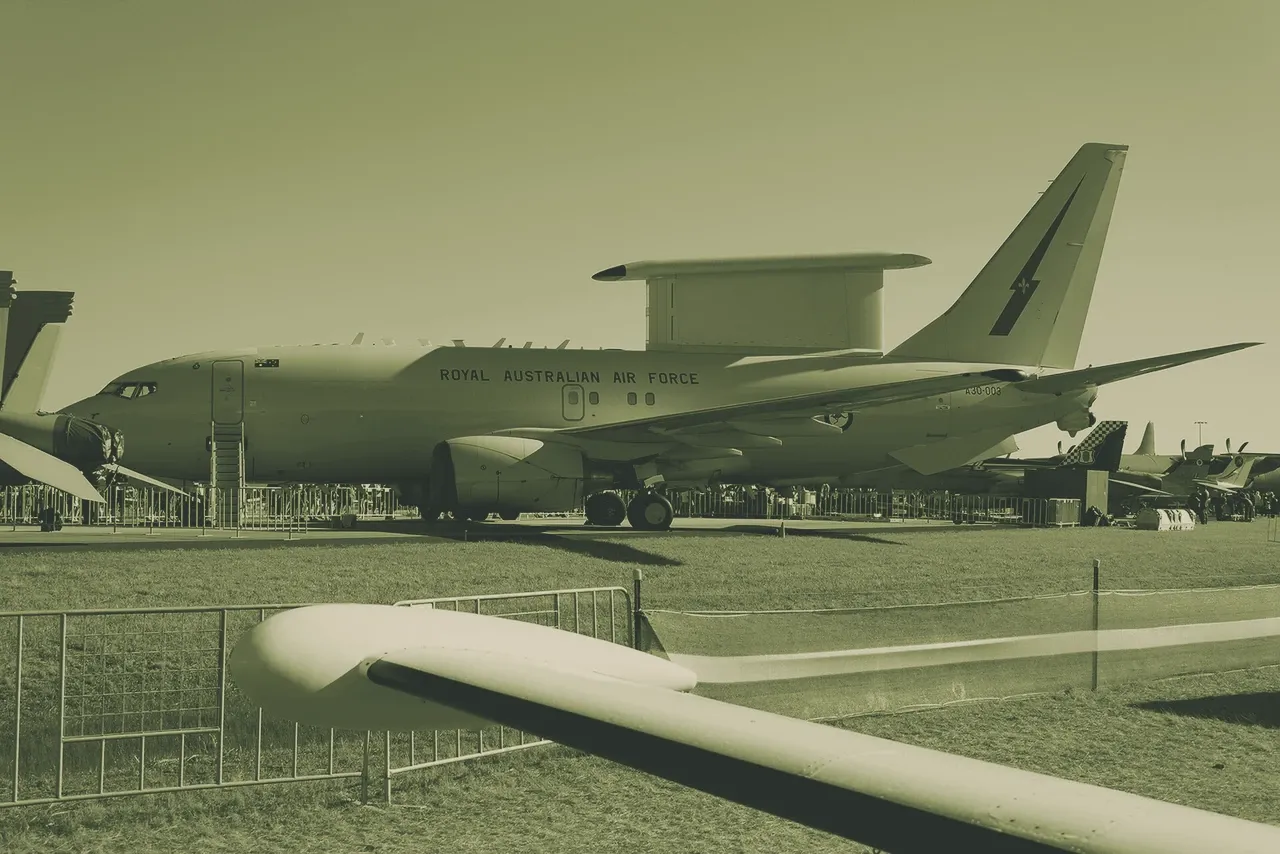
Australia and US-led AEW&C aircraft built on a Boeing 737-700, equipped with a fixed MESA AESA radar — the successor to the E-3 Sentry across NATO and a growing allied fleet.
Overview
The Boeing E-7A Wedgetail is a 737-700-based airborne early warning and control (AEW&C) platform fielded first by the Royal Australian Air Force and subsequently adopted by South Korea, Turkey, the United Kingdom, the United States, and NATO as the definitive replacement for the ageing E-3 Sentry AWACS fleet. At its centre is the Northrop Grumman Multi-role Electronically Scanned Array (MESA) radar, a fixed dorsal “top-hat” array that provides simultaneous 360° air and maritime surveillance without the mechanical rotodome of its predecessors.
Development
Boeing designed the Wedgetail for Australia’s Project Wedgetail, the country’s effort to acquire a modern AEW&C capability. The first aircraft flew in 2004, and the Royal Australian Air Force accepted its initial E-7A in 2009. The baseline airframe is a heavily modified Boeing 737-700IGW, and the mission-system prime integrator was Boeing Defence Australia with Northrop Grumman supplying the MESA radar. After the Australian lead, South Korea procured four “Peace Eye” aircraft and Turkey received four “Peace Eagle” examples, followed by a UK order for three aircraft under the name “Wedgetail AEW1,” and a long-debated US Air Force acquisition that survived a 2025 cancellation when Congress provided roughly $400 million to continue work on two prototypes, according to FlightGlobal.
Design & capabilities
The E-7 is built around a pair of CFM56-7B turbofans on a 737-700 airframe, crewed by two pilots and up to 6–10 mission operators (with total seating for up to 21), providing a high-loiter endurance of roughly 6,500 km and the capacity for aerial refuelling. The defining feature is the MESA fixed AESA antenna housed in a distinctive dorsal “top-hat” fairing; the array’s three-faced architecture gives true 360° simultaneous air-and-sea surveillance, integrated IFF, and the ability to control multiple fighter engagements at once. The platform’s open-architecture mission system allows rapid software updates and integration with allied datalinks, and the 737’s commercial supply chain substantially reduces operating costs compared with bespoke military airframes.
Combat record / operational use
The E-7 has been in continuous operational service with the RAAF since 2009, flying command-and-control sorties over Iraq and Syria as part of Operation Okra, according to Shephard Media. South Korea and Turkey operate their fleets for national air defence and coalition interoperability. In the NATO context, the E-7 was formally selected as the Alliance’s future AEW&C platform, while the US Air Force — after a brief cancellation — moved to field the type as its E-3 replacement, with the Pentagon chief reaffirming support for the programme in 2026. The UK Ministry of Defence has three Wedgetails on order, with the first aircraft scheduled for entry into Royal Air Force service later this decade, as outlined by Defence Equipment & Support.
Advantages
- Fixed MESA AESA radar eliminates mechanical rotation lag and provides simultaneous 360° surveillance.
- Common 737-700 airframe taps a global commercial logistics chain, trimming sustainment costs.
- Multi-role simultaneous track-while-scan coverage over air and sea.
- Air-refuellable, allowing extended on-station times well beyond the E-3 Sentry’s unrefuelled endurance.
- Open-architecture mission suite facilitates rapid upgrades and allied data-link integration.
Drawbacks / limitations
- Subsonic cruise and non-stealthy airframe limit survivability in contested airspace where the platform must maintain stand-off.
- High unit cost and programme delays have complicated acquisition timelines for the US and UK.
- Mission-crew complement is smaller than that of the E-3 Sentry, which can restrict simultaneous battle-management tasks.
- Reliance on twin-engine commercial turbofans places a premium on engine health in an environment that previously used four-engine platforms for redundancy.
Counterparts
- A-50 Mainstay (Russia)
- KJ-500 (China)
Outlook
With Australia, South Korea, Turkey, the United Kingdom, the United States, and NATO all committed to the E-7, the platform is poised to become the Western standard AEW&C system for at least the next three decades. Production rates and the integrated programme of allied spiral upgrades will determine how quickly the elderly E-3 fleet can be retired, but the political and industrial alignment now behind the Wedgetail suggests a stable, multi-decade production run.
Key specifications
| Spec | Value |
|---|---|
| Crew | 2 (flight) + 6–10 mission operators (up to 21 total) |
| Length / wingspan | 33.6 m / 35.8 m |
| Max speed | ~853 km/h (Mach 0.78) |
| Service ceiling | ~12,500 m |
| Combat radius / range | ~6,482 km (air-refuelable) |
| Payload | Not applicable (mission equipment — sensors, consoles) |
| Hardpoints | None |
| Radar / sensors | Northrop Grumman MESA fixed AESA dorsal array (360° simultaneous air & sea surveillance, IFF) |
| Powerplant | 2 × CFM56-7B turbofans |
| Armament | None |
Sources
- Wikipedia — Boeing E-7 Wedgetail. https://en.wikipedia.org/wiki/Boeing_E-7_Wedgetail
- Shephard Media — Insight: What future remains for the E-7 Wedgetail aircraft? https://www.shephardmedia.com/news/air-warfare/insight-what-future-remains-for-the-e-7-wedgetail-aircraft/
- Simple Flying — What Features Make the E-7 Wedgetail a Game-Changer. https://simpleflying.com/features-e-7-wedgetail-game-changer-surveillance/
- UK MoD Defence Equipment & Support — E7 Wedgetail. https://des.mod.uk/what-we-do/raf-procurement-support/e7-wedgetail/
- FlightGlobal — Pentagon chief reverses course on E-7. https://www.flightglobal.com/archive/2026/05/pentagon-chief-reverses-course-on-e-7-now-supports-us-air-force-acquisition/