F/A-18 Super Hornet
The US Navy's carrier-borne multirole workhorse — a twin-engine, supersonic strike fighter that succeeded the F-14 Tomcat and A-6 Intruder, with an extensive combat record and ongoing Block III upgrades.
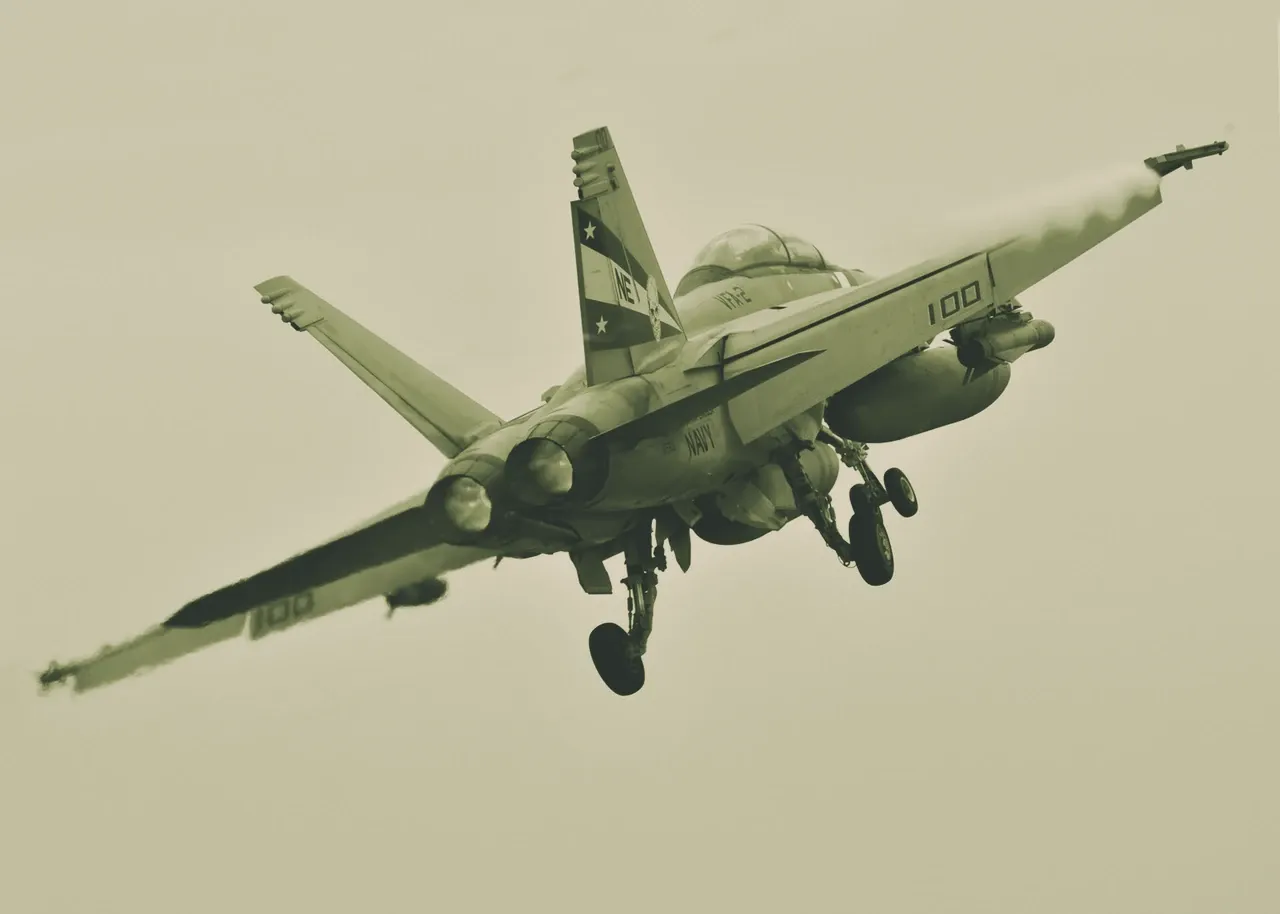
The U.S. Navy’s carrier-borne multirole workhorse — a twin-engine, supersonic strike fighter that succeeded the F-14 Tomcat and A-6 Intruder, with an extensive combat record and ongoing Block III upgrades.
Overview
The F/A-18E (single-seat) and F/A-18F (two-seat) Super Hornet is a 4.5-generation carrier-capable multirole strike fighter that forms the backbone of the U.S. Navy’s carrier air wings. Introduced at the turn of the century as a larger, more survivable evolution of the original F/A-18A–D Hornet, the Super Hornet combines a large weapons payload with an active electronically scanned array (AESA) radar and a proven combat record stretching from Iraq to Red Sea air-defense operations. New U.S. production ended in 2025, but the fleet continues to be upgraded to the Block III standard, while Australia and Kuwait also operate the type.
Development
Boeing (originating with McDonnell Douglas) developed the Super Hornet as a major redesign of the F/A-18 Hornet, enlarging the airframe to carry more fuel and weapons while improving survivability and bringing-back capability for carrier operations. The aircraft first flew in 1995 and entered U.S. Navy service from 1999, achieving initial operational capability in 2001, according to Boeing. It was conceived to replace the A-6 Intruder and F-14 Tomcat in a single multirole platform, and saw its first combat deployment in 2002 during Operation Iraqi Freedom. Production of the Block II Super Hornet, which introduced the AN/APG-79 AESA radar, concluded in April 2020, with the U.S. Navy taking delivery of the final airframe and shifting emphasis to Block III upgrades and remanufacture.
Design & capabilities
The Super Hornet is a carrier-based, twin-engine aircraft with a trapezoidal wing and twin canted vertical stabilizers. Its 11 hardpoints can carry a wide mix of air-to-air and air-to-ground ordnance, up to a maximum payload of approximately 8,050 kg, as detailed by the U.S. Navy Fact File. The Block II aircraft’s Raytheon AN/APG-79 AESA radar provides high-resolution tracking, enhanced electronic warfare capabilities, and simultaneous air-to-air and air-to-ground modes. Block III upgrades add an IRST21 infrared search-and-track pod, advanced cockpit displays, a distributed targeting processor, and a 9,000-flight-hour service life extension.
The aircraft is powered by two General Electric F414-GE-400 afterburning turbofans, each producing roughly 98 kN (22,000 lbf) of thrust, enabling a maximum speed of Mach 1.6–1.8 and a combat radius of about 720 km in a strike configuration. The broader fuel capacity and increased bring-back weight make the Super Hornet well suited to the cyclic tempo of carrier flight-deck operations.
Variants
- F/A-18E: single-seat strike fighter.
- F/A-18F: two-seat variant, operated as a trainer and for missions requiring a weapons systems officer.
- Block II: introduced the AN/APG-79 AESA radar and improved avionics; deliveries completed in 2020.
- Block III: current upgrade path adding conformal fuel tanks, IRST21, advanced networking, and a 9,000-hour airframe life.
- EA-18G Growler: electronic-attack derivative built on the F/A-18F airframe, optimized for airborne electronic warfare and suppression of enemy air defenses.
Combat record / operational use
The Super Hornet has seen extensive U.S. Navy combat use, beginning with Operation Iraqi Freedom in 2003 and continuing through operations over Afghanistan, anti-ISIS strikes in Iraq and Syria, and air-defense operations against Houthi targets in the Red Sea region from 2023, as documented by the U.S. Navy. In June 2017, an F/A-18E made the type’s first air-to-air kill, shooting down a Syrian Su-22 that had attacked U.S.-backed forces. The Royal Australian Air Force, which operates the F/A-18F, has used the aircraft for training and operational deployments in the Middle East, according to the RAAF.
Advantages
- Proven multirole carrier platform with high sortie-generation rates.
- Large payload — 11 hardpoints with up to ~8,050 kg of ordnance — and wide weapon integration including AIM-120, AIM-9X, AGM-158C LRASM, and JDAM.
- AN/APG-79 AESA radar provides robust detection, tracking, and electronic protection.
- Block III enhancements bring IRST, increased fuel range, and a 9,000-hour airframe life.
- Extensive combat experience and mature carrier-deck compatibility.
Drawbacks / limitations
- Combat radius (~720 km) is moderate compared to land-based heavy fighters, requiring tanker support for distant operations.
- The airframe is not stealthy; relies on electronic warfare and tactics to survive in contested airspace.
- U.S. new-build production ended in 2025, capping the fleet’s size and driving reliance on Service Life Extension Programs.
- The Block III upgrade program is incremental, and full fleet modernization will take years.
- Older Block II aircraft lack the conformal fuel tanks and IRST of the Block III standard.
Counterparts
- Su-57 Felon (Russia)
- J-20 Mighty Dragon (China)
Outlook
With U.S. production concluded, the Super Hornet’s future lies in the Block III upgrade and service-life extension, ensuring the platform remains relevant into the 2030s alongside the F-35C. The Growler variant will continue its electronic-attack role. Australia and Kuwait will sustain their fleets, while the U.S. Navy gradually transitions to a mixed F-35C / F/A-XX force in the 2030s. The Super Hornet’s operational tempo in ongoing Red Sea operations underscores that carrier-based strike remains central to U.S. power projection.
Key specifications
| Spec | Value |
|---|---|
| Crew | 1 (E) / 2 (F) |
| Length / wingspan | 18.3 m / 13.7 m |
| Max speed | Mach 1.6–1.8+ (~1,900 km/h clean) |
| Service ceiling | >15,240 m |
| Combat radius / range | ~720 km (strike, mission-dependent); ferry ~3,330 km |
| Payload | ~8,050 kg |
| Hardpoints | 11 |
| Radar / sensors | Raytheon AN/APG-79 AESA; IRST21 pod (Block III) |
| Powerplant | 2 × GE F414-GE-400 afterburning turbofans, ~98 kN each |
| Armament | 1 × 20 mm M61A2 Vulcan; AIM-120, AIM-9X, AGM-84 Harpoon, AGM-88 HARM, AGM-154 JSOW, AGM-158C LRASM, JDAM, Paveway |
Sources
- Boeing — F/A-18 Super Hornet & EA-18 Growler. https://www.boeing.com/defense/fighters-and-bombers/fa-18-super-hornet-and-ea-18-growler
- NAVAIR — F/A-18E/F Super Hornet. https://www.navair.navy.mil/product/FA-18EF-Super-Hornet
- U.S. Navy Fact File — F/A-18A-D Hornet and F/A-18E/F Super Hornet Strike Fighter. https://www.navy.mil/Resources/Fact-Files/Display-FactFiles/Article/2383479/fa-18a-d-hornet-and-fa-18ef-super-hornet-strike-fighter/
- Royal Australian Air Force — F/A-18F Super Hornet. https://www.airforce.gov.au/aircraft/18f-super-hornet