Geneva Talks End With a Two-Year Autonomous Weapons Mandate and No Commitment to a Binding Treaty
The compromise leaves the legal force of any future rules undecided until 2028, while drones with AI terminal guidance already fly in the Russia-Ukraine war.
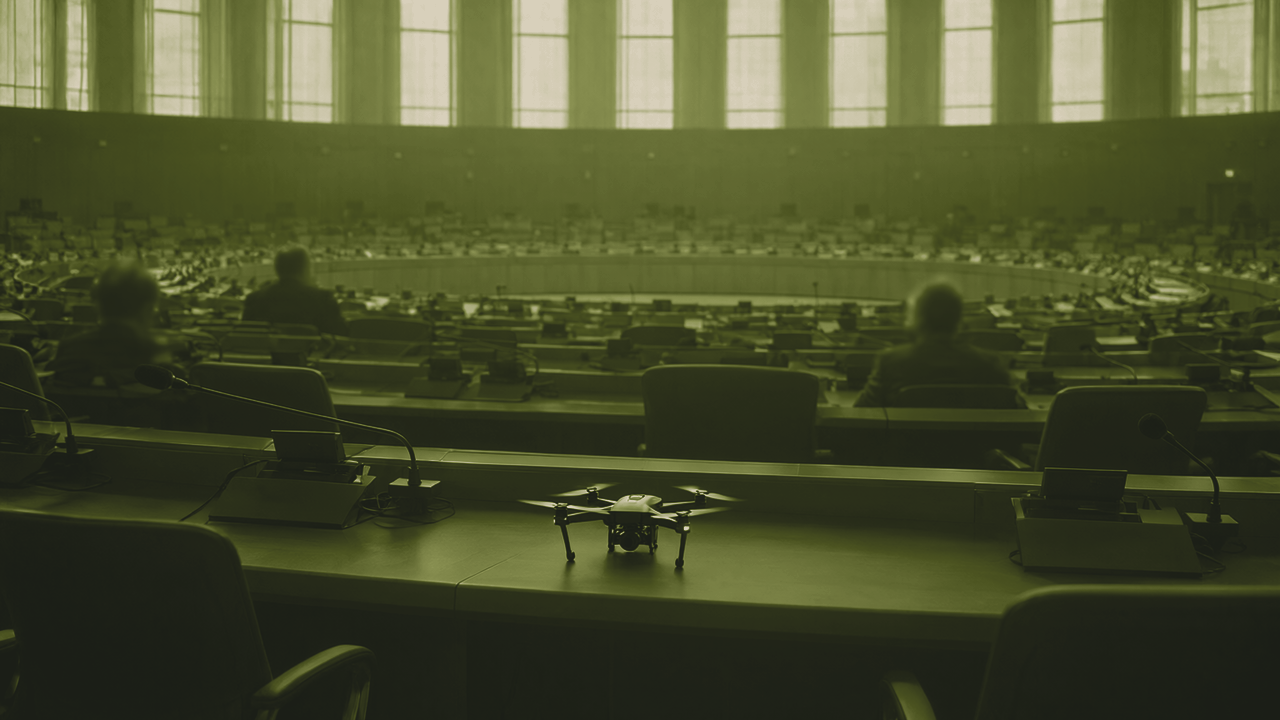
The compromise leaves the legal force of any future rules undecided until 2028, while drones with AI terminal guidance already fly in the Russia-Ukraine war.
States agreed in Geneva early on Nov. 21 to draft an international instrument on lethal autonomous weapons systems over 2027 and 2028, Switzerland's foreign ministry announced. The Seventh Review Conference of the Convention on Certain Conventional Weapons closed without the mandate to negotiate binding rules that a majority of states had requested. The instrument's legal form will be settled only once the drafting ends, the ministry said.
Frequently Asked Questions
What did the Geneva conference decide?
Switzerland's foreign ministry said the 128 states parties to the Convention on Certain Conventional Weapons agreed on Nov. 21 to draft an international instrument on lethal autonomous weapons systems over 2027 and 2028.
Will the new rules be legally binding?
That is undecided. The ministry said the instrument's legal form will be specified once the negotiations have concluded. Anadolu reported that governmental experts will recommend whether it becomes a binding protocol.
Which states opposed a binding mandate?
DW reported that the United States, Russia and Israel were among those opposing it. The Guardian wrote that Britain, France, Germany, South Korea, Japan and Turkey also preferred a nonbinding agreement, and that diplomats accused Russia of filibustering.
How many states wanted a treaty?
More than 95 voiced support during the week, according to the Stop Killer Robots campaign. Other outlets gave figures of 98 to more than 100.
How did humanitarian bodies respond?
The International Committee of the Red Cross said it regrets the failure to agree an immediate negotiating mandate and called for a treaty that prohibits unpredictable autonomous weapons and those that target humans directly. U.N. disarmament chief Izumi Nakamitsu called the outcome a significant achievement and said a binding instrument is still possible.
AI-generated summary, reviewed by an editor. More on our AI guidelines.
Read next — from the Lexicon
Below this point
7 more sections.
The weapons at issue can identify, select and engage a target without human intervention, in Al Jazeera's summary of the U.N. definition. Semi-autonomous drones in the Russia-Ukraine war already hand the final approach to AI, The Guardian noted.
More than 95 states voiced support for a treaty during the week, by the count of the Stop Killer Robots campaign, which called the result a "watered-down mandate" weakened by a small number of states in the final hours. The United States, Russia and Israel were among those opposing a binding mandate, DW reported.
All-night talks collapsed just before 5 a.m. over Russian objections, according to The Guardian. Diplomats said Russia filibustered while U.S. delegates worked toward a consensus text. Washington had proposed a five-year window for nonbinding guidelines, NPR reported. Britain, France, Germany, South Korea, Japan and Turkey also preferred a nonbinding agreement, the Guardian wrote.
The convention's 128 states parties decide by consensus, so any one can block the rest. A group of governmental experts may now develop the text and recommend whether it becomes a binding protocol, per Anadolu.
The International Committee of the Red Cross said it regrets the failure to agree an immediate negotiating mandate. It wants a treaty that prohibits unpredictable autonomous weapons and those that target humans directly. U.N. disarmament chief Izumi Nakamitsu called the outcome a "significant achievement" and said the path to a binding instrument "is still open."
Russia and the United States want a freer hand to develop such weapons, in the Associated Press's account. Secretary-General António Guterres, who set a 2026 deadline for launching negotiations, leaves office at year-end.
The states that resisted a binding mandate include the leading developers of AI weapons, and the drafting they accepted runs through 2028 with its legal force undecided. Nakamitsu asked delegations to start work as early as Monday.

Marcus Schuler
Marcus Schuler edits BattlePolicy, a daily defense-technology brief connecting the companies and capabilities behind modern war to the contest among Europe, the US, Russia, and China.