GRID-REF 37°47′N 122°25′W
DISPATCH 02/26 · 9 Jun 2026
BATTLEPOLICY
Startup to front line. Strategy to consequence.
Lexicon · China

HQ-17

China's indigenised short-range air defence system, derived from the Russian Tor-M1, providing mobile point and manoeuvre-unit protection against low-altitude threats.
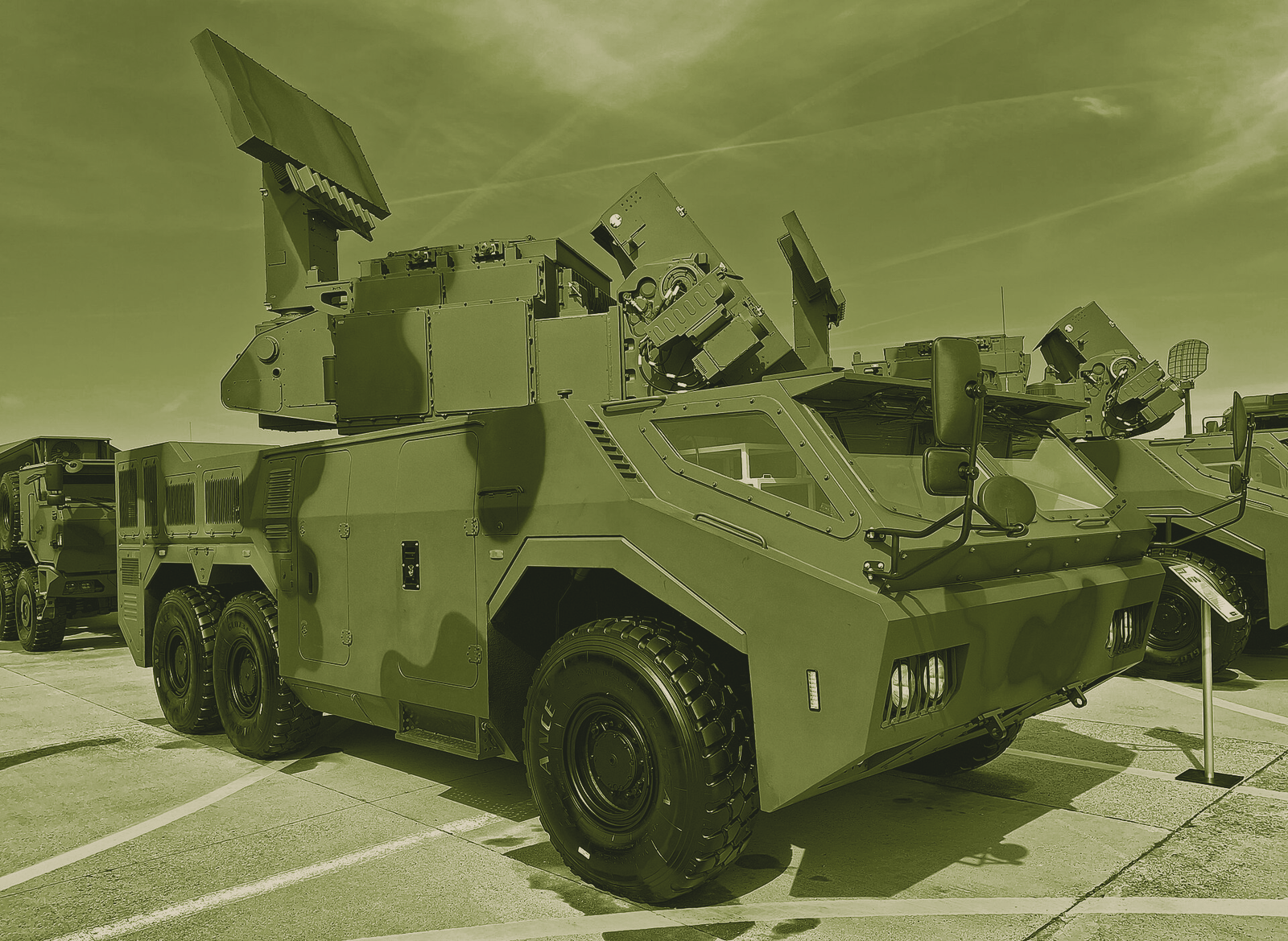
China's SHORAD layer to protect manoeuvre forces — a Tor-M1-derived vertical-launch SAM system available in tracked and wheeled configurations, engaging low-flying aircraft, drones, cruise missiles and precision munitions out to 15 km.

Overview

The HQ-17 (Hongqi-17) family is the People’s Liberation Army Ground Force’s organic short-range surface-to-air missile system, filling the innermost tier of China’s layered ground-based air defences. Derived from Russia’s Tor-M1 (SA-15 Gauntlet) and indigenised by the China Aerospace Science and Industry Corporation (CASIC), it pairs an autonomous search-and-track radar with cold-launched command-guided missiles on a single chassis, offering point and area protection for mechanised forces on the move. The system sits below the medium-range HQ-16 and long-range HQ-9 in the PLA’s integrated air defence network, as described in the US DoD’s annual China report.

Development

China acquired Tor-M1 systems from Russia in the late 1990s, and CASIC subsequently reverse-engineered and progressively improved the design into the fully indigenous HQ-17. The tracked HQ-17 entered service with the PLAGF by the mid-2010s, a date corroborated by the US Army’s ODIN reference. A wheeled 6×6 variant, the HQ-17A/HQ-17AE, was publicly unveiled during the 1 October 2019 National Day parade, with the export version designated FM-2000, according to Asian Military Review. The wheeled version is intended to accompany lighter, faster-moving brigade elements and to offer an exportable SHORAD package.

Design & capabilities

The HQ-17 uses a cold-launch, vertical-canister arrangement and fires a command-guided interceptor estimated at ~165 kg (with a ~15 kg warhead) at speeds around Mach 3. Its primary engagement envelope is reported at roughly 1.5–15 km in range and from 10 metres up to 10 km in altitude, as listed by ODIN. The system can simultaneously engage up to four targets while tracking dozens more via an integrated pulse-Doppler radar — a radar architecture that, like the Tor-M1, allows detection-on-the-move and short-halt firing.

The tracked HQ-17 rides on an armoured chassis for direct accompaniment of heavy manoeuvre forces, while the wheeled HQ-17A achieves road speeds up to 90 km/h and retains an engage-on-the-move capability, greatly expanding strategic mobility and deployment options, as detailed by Asian Military Review. A typical battery comprises multiple launchers, each carrying eight missiles.

Variants

  • HQ-17: tracked, Tor-derived baseline for heavy manoeuvre units.
  • HQ-17A/HQ-17AE: wheeled 6×6 version with higher road speed and lighter logistics, also marketed to export customers.
  • FM-2000: the export designation for the HQ-17AE, offered with restricted missile performance packages.

Combat record / operational use

No publicly established combat record exists for any HQ-17 variant; ODIN’s reference entry notes the system has not been observed in combat. The HQ-17 functions within the PLA’s tiered air-defence network, where the US DoD identifies it as the short-range element designed to counter unmanned aerial systems, cruise missiles and precision-guided munitions, but its effectiveness under real combat stress remains unverified. Export discussions with countries such as Serbia have been reported but no confirmed foreign sales have materialised to date.

Advantages

  • Inherits a proven Tor-class autonomous radar-missile integration, reducing reliance on external fire-control units.
  • High mobility: tracked variant accompanies heavy armour; wheeled HQ-17A reaches ~90 km/h and fires on the move.
  • 360° radar coverage and short reaction time give it utility against pop-up threats such as attack helicopters and drones.
  • A single vehicle engages four simultaneous targets, providing meaningful point-defence density in a compact footprint.
  • Indigenised production allows China to scale the force without dependence on Russian supply.

Drawbacks / limitations

  • Engagement range capped at ~15 km and altitude at ~10 km limits it to point and close-area defence; it cannot reach high-flying aircraft or medium-range stand-off weapons.
  • Command-guided missiles are potentially susceptible to electronic jamming of the radio-command link.
  • No combat-proven track record; the entire HQ-17 family’s performance against modern saturation attacks or high-speed threats is unknown.
  • Wheeled version’s lighter armour may reduce survivability in contested forward areas compared with the tracked version.
  • Export interest remains tentative, meaning the system has not built a reputation through foreign operators.

Counterparts

Outlook

The HQ-17 will remain the PLAGF’s standard manoeuvre SHORAD through at least the 2030s, with gradual improvements likely aimed at counter-drone and counter-loitering-munition capabilities — areas where Ukraine’s war has demonstrated the critical difference between a capable SAM and an affordable gun layer. If China pursues exports more aggressively, the FM-2000 could become a lower-cost Tor alternative for states that already operate Chinese IADS; however, without a combat record, its market appeal rests almost entirely on brochure promises.

Key specifications

Spec Value
Type Short-range autonomous SAM system (tracked / wheeled)
Engagement range ~1.5–15 km
Engagement altitude ~10 m – 10 km
Target set Low-flying aircraft, helicopters, UAS, cruise missiles, PGMs
Interceptor(s) HQ-17 family command-guided missile (~165 kg, ~15 kg warhead, ~Mach 3 est.)
Radar / fire control Integrated search + tracking pulse-Doppler radar, 360° coverage
Reaction time seconds-class (not publicly established)
Simultaneous engagements 4
Mobility Tracked (HQ-17) or wheeled 6×6 (HQ-17A, ~90 km/h); engage-on-the-move

Sources

  1. Asian Military Review — "China unveils homegrown HQ-17AE short-range air defence system" — https://www.asianmilitaryreview.com/2021/03/china-unveils-homegrown-hq-17ae-short-range-air-defence-system/
  2. ODIN (US Army TRADOC) — "HQ-17A (FM-2000) Chinese Short-Range Air Defense Missile System" — https://odin.t2com.army.mil/WEG/Asset/HQ-17A_(FM-2000)_Chinese_Short-Range_Air_Defense_Missile_System
  3. US Department of Defense — "Military and Security Developments Involving the People's Republic of China 2024" — https://media.defense.gov/2024/Dec/18/2003615520/-1/-1/0/MILITARY-AND-SECURITY-DEVELOPMENTS-INVOLVING-THE-PEOPLES-REPUBLIC-OF-CHINA-2024.PDF
FIELD DISPATCH · WEEKLY

BattlePolicy Weekly — free.

Defense tech, startups, and security — weekly. No paywall.

Related
China · Air Defense · taiwan · interceptors · patriot

China is building air-defense mass opposite Taiwan while America spends its own

Beijing fielded the HQ-16F, a Patriot-class mobile air-defense missile, opposite Taiwan in the same weeks the US burned through the interceptors it would need to defend the island. The contest is magazine depth, not exquisite platforms.

China · Air Defense · taiwan · interceptors · patriot
China · Land · grenade-launcher · precision · sniper · 35mm · 40mm · norinco

QLU-11

China's semi-automatic precision grenade launcher, fielded in 35mm for the PLA and 40mm for export — delivering airburst rounds through a window at 600 m.

China · Land · grenade-launcher · precision · sniper · 35mm · 40mm · norinco