Mi-24 Hind
The Mil Mi-24 Hind is a uniquely configured Soviet/Russian attack helicopter that combines a heavy gunship with an 8-troop transport compartment — the most combat-used rotary-wing type in history and still in production as the Mi-35M.
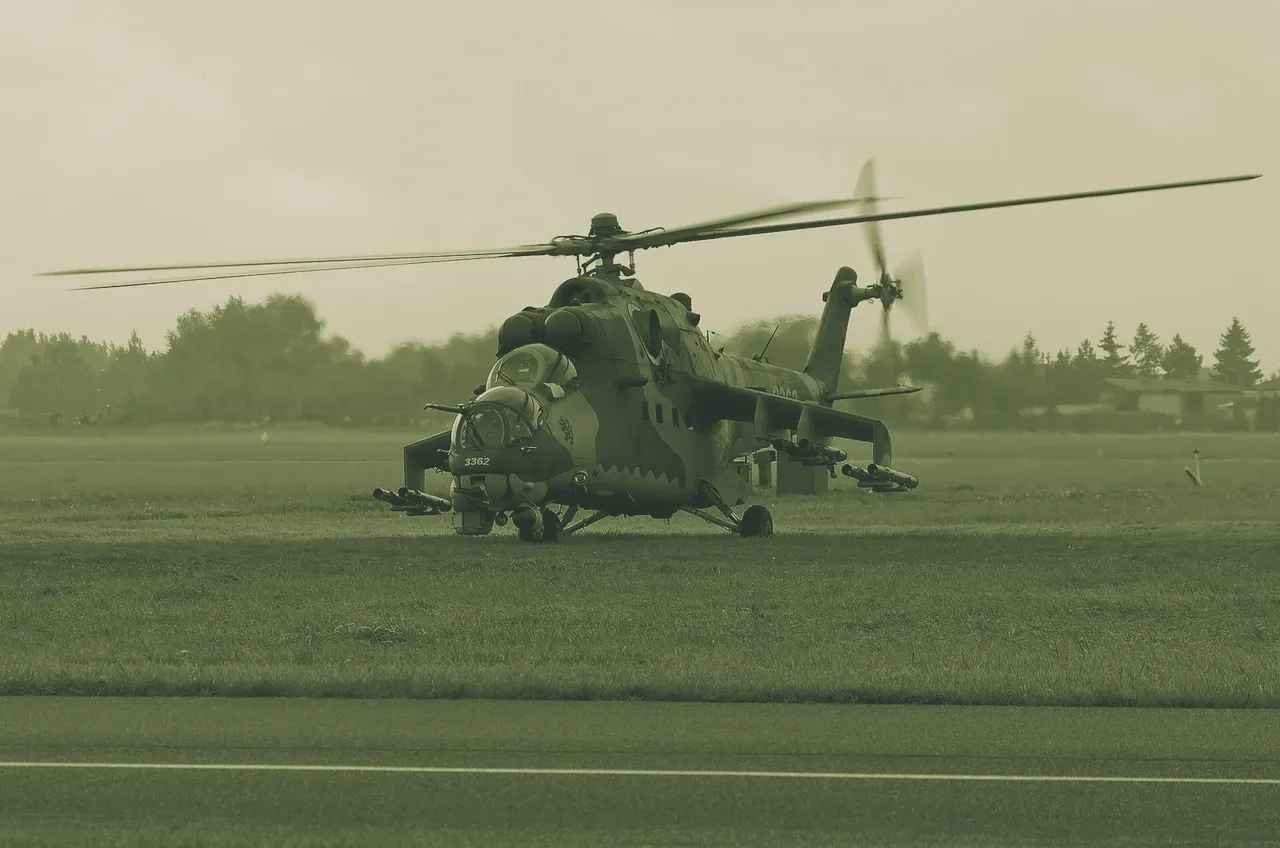
A uniquely configured Soviet/Russian attack helicopter combining a heavy gunship with an 8-troop transport compartment — the most combat-used rotary-wing type in history, still in production as the Mi-35M and fielded by operators on four continents.
Overview
The Mil Mi-24 "Hind" is a twin-engine armed helicopter designed by the Mil Moscow Helicopter Plant and built by Rostvertol. It fuses the firepower and armor of a dedicated attack helicopter with a passenger cabin able to carry up to eight fully equipped troops — a hybrid doctrine unmatched by any Western counterpart. Entering service in the early 1970s, it has been continuously modernized through the Mi-35M (NATO "Hind-E") standard and remains in serial production. Russia fields roughly 329 Mi-24/35 airframes, while total family production across all variants and export customers is estimated at several thousand, making it one of the most widely operated military helicopters ever built.
Development
The Mil design bureau conceived the Mi-24 in the late 1960s under the requirement for a heavily armed "infantry fighting vehicle of the air" — an assault helicopter that could deliver fire support and then land troops directly onto the objective. The V-24 prototype first flew in 1969, and the initial production Mi-24A reached Soviet front-line aviation units in the early 1970s, as chronicled in Key.Aero's comprehensive family review. The design evolved rapidly through the Mi-24D (standardized tandem cockpits), the Mi-24V with the Shturm-V (AT-6 Spiral) anti-tank guided missile system, and the Mi-24P with a fixed 30 mm cannon, drawing on combat feedback from Afghanistan. The modernized Mi-35M entered production in 2005 with a shortened stub wing, fixed landing gear, new sensors, and VK-2500 engines, while the parallel Mi-35P upgrade package retrofits night/adverse-weather capability onto earlier airframes.
Design & capabilities
The Hind's defining design feature is its troop-carrying fuselage sectioned behind the tandem cockpits, allowing the helicopter to serve simultaneously as a close air support platform and an air-assault transport. According to Airforce Technology, the Mi-35M main variant mounts a 23 mm GSh-23L twin-barrel cannon in the NPPU-24 chin turret with approximately 470 rounds, replacing the fixed 30 mm GSh-30-2 cannon of the earlier Mi-24P — a change that improves off-boresight engagement. Six stub-wing hardpoints carry up to eight 9M120 Ataka-V anti-tank guided missiles alongside S-8 and S-13 unguided rocket pods, with UPK-23 gun pods as an optional fit. The Mi-35M's OPS-24N gyro-stabilized sensor suite combines a forward-looking infrared imager, daylight television camera, and laser rangefinder, while the Mi-35P upgrade adds the OPS-24N-1L long-wave infrared imager and the PrVK-24-2 weapons computer for improved night and adverse-weather gunnery. Two Klimov TV3-117VMA or uprated VK-2500 turboshaft engines each deliver approximately 2,200–2,400 shaft horsepower.
Variants
The Hind family spans a large number of production and upgrade standards. Key operational variants include the Mi-24V with the Shturm-V missile system and under-nose 12.7 mm YakB rotary machine gun; the Mi-24P with a fixed starboard-side 30 mm GSh-30-2 cannon; and the Mi-24VP with the GSh-23L in a limited-traverse turret. The current-production Mi-35M features a shortened stub wing with only two hardpoints per side, non-retractable landing gear, the NPPU-24 turret, and VK-2500 engines. The Mi-35P is a comprehensive upgrade of legacy Mi-24P airframes with the OPS-24N-1L targeting system and a modern glass cockpit. Export subvariants include the Mi-35M2/Mi-35M3 and the Mi-35P Phoenix.
Combat record / operational use
The Hind is among the most combat-used helicopters in aviation history. During the Soviet–Afghan War it earned the mujahideen nickname "Shaitan Arba" (Devil's Chariot) while suffering significant losses to Stinger man-portable air-defense systems, an experience that reshaped Soviet helicopter tactics and spurred the development of exhaust infrared suppressors. It has since appeared in virtually every major conflict involving Russian or Soviet-aligned forces — Chechnya, Syria, and dozens of African and Middle Eastern wars — as surveyed by Key.Aero. In Syria, at least two Russian Mi-35Ms were lost in 2016. The Russo-Ukrainian War has seen intensive use by both sides: documented Russian losses (May 2025) include roughly four Mi-24P, four Mi-24V/P/35M, and ten Mi-35M airframes, while Ukrainian forces lost two Mi-24P and seven Mi-24 aircraft, according to AirVectors' foreign-service combat audit. The type also saw sustained action in the Iran–Iraq War, the Sri Lankan Civil War, and multiple African counterinsurgency campaigns, underscoring its adaptability across vastly different threat environments.
Advantages
- Unique gunship-transport hybrid carries 8 troops on a heavily armed attack platform — no Western rotary-wing type replicates this capability.
- Heavy armor around the cockpit and engine bay provides small-arms protection unmatched in its class.
- Wide export base and large global fleet guarantee parts availability and deep operational experience.
- Modernized Mi-35M/P bring effective night/all-weather sensors and Ataka-V missiles competitive with contemporary attack helicopters.
- Stub-wing payload of up to 8 ATGMs plus rockets provides substantial firepower for close air support and anti-armor missions.
Drawbacks / limitations
- Large airframe and cabin volume produce a substantial radar and visual signature, making the Hind a priority target for air defenses.
- The troop compartment is cramped and uncomfortable for extended missions; dismounting under fire is a doctrinal vulnerability the design never fully resolved.
- Early variants lack adequate night-fighting capability; modernized Mi-35M/P only partially closes this gap relative to dedicated Western attack helicopters.
- The hybrid role imposes weight and aerodynamic penalties — the Hind is less agile and has a lower power-to-weight ratio than pure attack platforms like the Mi-28N or AH-64.
- Combat-recorded losses to man-portable air-defense systems remain historically high, and the type's infrared signature, while reduced on later models, remains a liability against modern MANPADS.
Counterparts
- AH-64 Apache (USA)
- Z-10 (China)
While neither the AH-64 Apache nor the Z-10 carries troops — making them doctrinally distinct from the Hind — they represent the dedicated attack helicopter standard that the Hind straddles alongside its transport function. The Mi-28N Havoc and Ka-52 Alligator are the Russian Federation's pure attack-helicopter contemporaries to the Hind.
Outlook
The Mi-35M remains in serial production at Rostvertol with a steady export pipeline, and the Mi-35P upgrade program extends the service life of legacy airframes in Russian Aerospace Forces service. The ongoing Russo-Ukrainian War has driven attrition but also underscored the type's continued utility in the close air support role, particularly when operating from forward arming and refueling points near the line of contact. As man-portable air defenses and loitering munitions proliferate, the Hind's survivability will depend increasingly on stand-off missile employment and integration with reconnaissance-strike networks — a trajectory reflected in the Mi-35P's improved sensor suite. The type will likely remain in widespread global service for at least another two decades.
Key specifications
| Spec | Value |
|---|---|
| Crew | 2 (tandem) + up to 8 troops |
| Length / wingspan | ~21.6 m fuselage / main-rotor ~17.3 m (Mi-35M) |
| Max speed | ~305 km/h (Mi-35M); earlier variants up to ~335 km/h |
| Service ceiling | ~4,500–5,750 m (variant-dependent) |
| Combat radius / range | ~460 km / ferry ~1,000 km (Mi-35M) |
| Payload | 8 troops or internal cargo equivalent |
| Hardpoints | 6 stub-wing stations |
| Radar / sensors | OPS-24N FLIR + TV + laser rangefinder (Mi-35M); OPS-24N-1L LWIR imager (Mi-35P) |
| Powerplant | 2 × Klimov TV3-117VMA or VK-2500 turboshaft, ~2,200–2,400 shp each |
| Armament | 23 mm GSh-23L twin-barrel in NPPU-24 turret; up to 8 × 9M120 Ataka-V ATGM; S-8/S-13 rockets; UPK-23 gun pods |
Sources
- Airforce Technology — Mi-35M (Hind E) Attack Helicopters, Russia. https://www.airforce-technology.com/projects/mi-35m-hind-e/
- Wikipedia — Mil Mi-24. https://en.wikipedia.org/wiki/Mil_Mi-24
- Key.Aero — Mil Mi-24 and Mi-35 Hind family reviewed. https://www.key.aero/article/mil-mi-24-and-mi-35-hind-family-reviewed
- Key.Aero — Hinds Still In Demand. https://www.key.aero/article/hinds-still-demand
- MilitaryFactory — Mil Mi-35 (Hind-E) Heavy Assault Gunship. https://www.militaryfactory.com/aircraft/detail.php?aircraft_id=1332
- Wikipedia — List of Mil Mi-24 variants. https://en.wikipedia.org/wiki/List_of_Mil_Mi-24_variants
- AirVectors — Hind In Foreign Service / Mi-28 Havoc. https://www.airvectors.net/avhind_2.html