GRID-REF 37°47′N 122°25′W
DISPATCH 02/26 · 9 Jun 2026
BATTLEPOLICY
Startup to front line. Strategy to consequence.
Lexicon · China

PL-15

China's premier long-range active-radar beyond-visual-range air-to-air missile, developed for the J-20 and other modern PLAAF fighters, and the first Chinese AAM to see combat—contested but revealing—in the 2025 India-Pakistan air clashes.
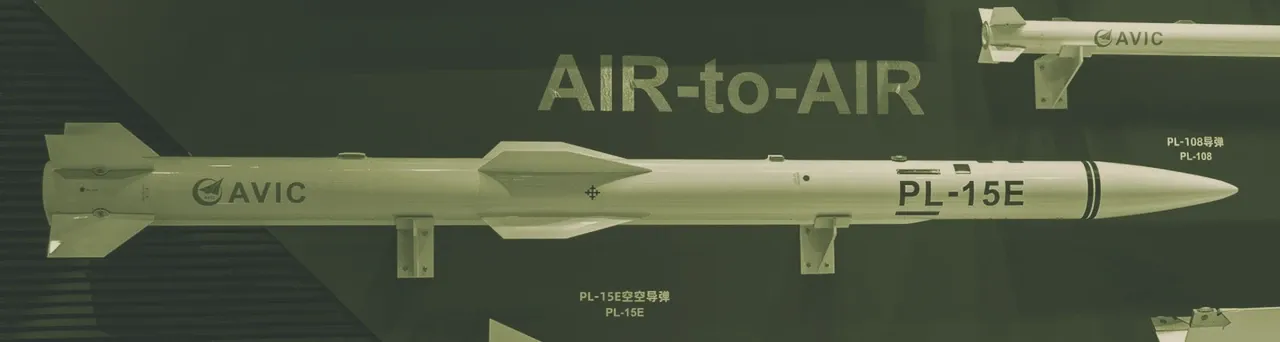
China's premier long-range active-radar beyond-visual-range air-to-air missile, developed for the J-20 and other modern PLAAF fighters, and the first Chinese AAM to see combat—contested but revealing—in the 2025 India-Pakistan air clashes.

Overview

The PL-15 (Pi Li-15) is a long-range active-radar-homing beyond-visual-range air-to-air missile (BVRAAM) developed by the China Airborne Missile Academy (Luoyang) for the People's Liberation Army Air Force (PLAAF). It entered service around 2018 and arms the J-20, J-16, and J-10C fighters, providing a stand-off engagement capability that competes with the latest Western missiles. An export variant, the PL-15E, is in service with the Pakistan Air Force on its J-10C and JF-17 Block III aircraft. The domestic PL-15 is credited with a range exceeding 200 km, while the export version is capped at roughly 145–150 km. The missile gained notoriety in May 2025 when Pakistan fired PL-15Es during the Operation Sindoor air battles with India, marking the first combat use of a Chinese BVRAAM and yielding an intact airframe for Indian analysis.

Development

The PL-15 was developed by the China Airborne Missile Academy (Luoyang), part of the state-owned Aviation Industry Corporation of China (AVIC), to replace the semi-active radar-homing PL-12 and give the PLAAF a weapon competitive with the American AIM-120D AMRAAM and the European MBDA Meteor. It was revealed publicly around 2015 and entered operational service with the J-20 approximately in 2018, as noted by The National Interest. The missile was subsequently integrated onto the J-16 and J-10C, and the export-oriented PL-15E was qualified on the Pakistan Air Force's J-10C and JF-17 Block III.

Design & capabilities

The PL-15 employs a dual-pulse solid rocket motor, which provides a boost-sustain-boost profile to maximize both range and end-game kinematics. Mid-course guidance relies on inertial navigation with target updates via a two-way datalink; terminal homing is performed by an active electronically scanned array (AESA) radar seeker, which offers a high resistance to jamming and the ability to engage low-observable targets. According to Asia Times, the seeker’s AESA architecture significantly compresses the enemy’s reaction window.

The domestic PL-15 is assessed to have a range in excess of 200 km, with some sources claiming up to 300 km. Export PL-15Es are deliberately short-ranged, with India’s Defence Intelligence Agency briefing a figure of approximately 145–150 km. Speed is reported as Mach 4–5. The missile measures roughly 4 m in length and 200 mm in diameter, as catalogued by CAT-UXO, though its launch weight remains not publicly established. The warhead is of the blast-fragmentation type, designed for proximity or contact fuzing.

Variants

  • PL-15: Domestic PLAAF variant with maximum range performance and full-specification AESA seeker.
  • PL-15E: Export variant with reduced range and potentially a downgraded seeker suite to comply with international missile technology control norms. This version was recovered intact by India in 2025, providing the first physical evidence of the missile’s internal layout.

Combat record / operational use

The PL-15’s combat debut occurred in May 2025 during the India-Pakistan air skirmishes known as Operation Sindoor. Pakistan Air Force J-10C fighters, armed with PL-15E missiles, claimed multiple beyond-visual-range kills, including at least one Indian Rafale, according to Reuters. India disputed the kill claims and attributed the loss of a Rafale to a technical malfunction. Nevertheless, the engagement produced a significant intelligence prize: an intact PL-15E that fell on Indian territory was recovered and examined by the Defence Research and Development Organisation (DRDO), as reported by The Defense Post. Analysis of the recovered hardware, described by National Security Journal, provided physical confirmation of the dual-pulse motor and compact AESA seeker, giving India and its partners critical data on the weapon’s performance parameters and potential countermeasures.

Advantages

  • Extremely long range for a BVRAAM, potentially out-ranging the AIM-120D AMRAAM and rivaling the Meteor in kinematic envelope.
  • Dual-pulse motor ensures high terminal energy and a large no-escape zone.
  • AESA terminal seeker provides superior resistance to jamming, home-on-jam capability, and better target discrimination against low-observable aircraft.
  • Internal carriage on the J-20 preserves the launch platform’s stealth profile.
  • Real combat data from the 2025 India-Pakistan clash has already fed back into Chinese upgrade cycles.

Drawbacks / limitations

  • The domestic variant’s extreme range figures remain unverified outside of Chinese state claims.
  • Significant mass and volume restrict internal carriage on smaller platforms; the J-20 can carry only four to six missiles in most stealth configurations (reports of eight are unconfirmed).
  • The export PL-15E is deliberately degraded in range and possibly in seeker fidelity, creating a tiered capability across operators.
  • Combat debut revealed potential reliability or guidance issues, though the exact cause of the Rafale loss remains contested.
  • No official NATO reporting name exists, complicating standardized threat documentation.

Counterparts

Outlook

The PL-15 is firmly established as the PLAAF’s frontline BVRAAM and will remain the primary air-superiority weapon for the J-20 fleet through the decade. The 2025 combat experience, however limited and contested, has already spurred accelerated work on improved seekers, enhanced electronic protection, and counters to DRDO-derived jamming techniques. An extended-range PL-17 or PL-XX is reportedly in development, while the PL-15E’s combat validation is expected to drive further sales to China’s strategic partners in Asia and Africa.

Key specifications

Spec Value
Type Beyond-visual-range air-to-air missile
Range Domestic >200 km (claims up to 300 km); export PL-15E ~145–150 km
Speed (Mach / km·s⁻) ~Mach 4–5
Warhead (type & weight) High-explosive blast-fragmentation (weight not publicly established)
Guidance INS/datalink mid-course + AESA active-radar terminal
Accuracy (CEP) Not applicable (guided)
Launch platform(s) J-20, J-16, J-10C, JF-17 (export)
Propulsion Dual-pulse solid rocket
Length / diameter / launch weight ~4 m / ~200 mm / weight not publicly established

Sources

  1. CAT-UXO — PL-15 Missile — https://cat-uxo.com/explosive-hazards/missiles/pl-15-missile
  2. The National Interest — "India Paid the Price for Underestimating China's PL-15 Missiles" — https://nationalinterest.org/blog/buzz/india-paid-price-underestimating-chinas-pl-15-missiles-ps-080625
  3. Asia Times — "Jamming could be key to dodging China's PL-15 missiles" — https://asiatimes.com/2025/06/jamming-could-be-key-to-dodging-chinas-pl-15-missiles/
  4. Reuters — "How Pakistan shot down India's cutting-edge fighter using Chinese gear" — https://www.reuters.com/business/aerospace-defense/how-pakistan-shot-down-indias-cutting-edge-fighter-using-chinese-gear-2025-08-02/
  5. The Defense Post — "India to Adopt Chinese Missile Tech After Recovering Intact PL-15" — https://thedefensepost.com/2025/10/22/india-pl-15-missile/
  6. National Security Journal — "Let the Secrets Flow: China's PL-15E Missile Was Recovered by India" — https://nationalsecurityjournal.org/let-the-secrets-flow-chinas-pl-15e-missile-was-recovered-by-india
FIELD DISPATCH · WEEKLY

BattlePolicy Weekly — free.

Defense tech, startups, and security — weekly. No paywall.

Related
China · Air Defense · taiwan · interceptors · patriot

China is building air-defense mass opposite Taiwan while America spends its own

Beijing fielded the HQ-16F, a Patriot-class mobile air-defense missile, opposite Taiwan in the same weeks the US burned through the interceptors it would need to defend the island. The contest is magazine depth, not exquisite platforms.

China · Air Defense · taiwan · interceptors · patriot
China · Land · grenade-launcher · precision · sniper · 35mm · 40mm · norinco

QLU-11

China's semi-automatic precision grenade launcher, fielded in 35mm for the PLA and 40mm for export — delivering airburst rounds through a window at 600 m.

China · Land · grenade-launcher · precision · sniper · 35mm · 40mm · norinco