The Wire · live GRID-REF 37°47′N 122°25′W
DISPATCH 03/26 · 24 Aug 2026
BattlePolicy
Startup to front line. Strategy to consequence.
Lexicon · Israel

Rampage

Israel's supersonic stand-off missile — a low-cost, quasi-ballistic strike weapon derived from the EXTRA artillery rocket that lets fighters engage high-value fixed targets from outside enemy air defenses.
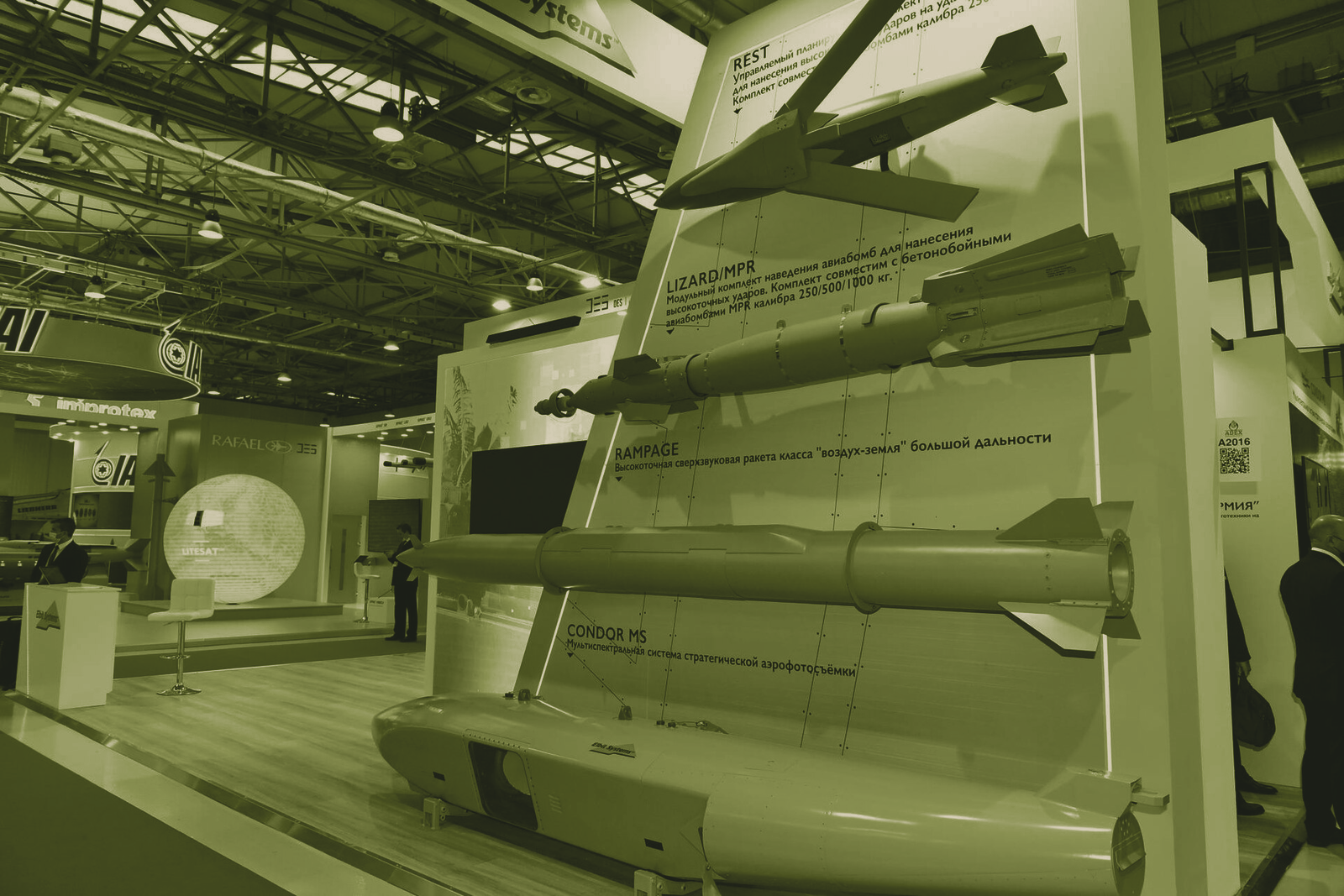
Israel’s supersonic stand-off precision missile — a quasi-ballistic, low-cost adaptation of the EXTRA artillery rocket that delivers GPS/INS-guided strikes beyond the reach of enemy air defenses from a wide range of fighter aircraft.

Overview

Rampage is an air-launched supersonic stand-off weapon developed by IMI Systems (now part of Elbit Systems) with Israel Aerospace Industries (IAI). It is derived from the ground-launched EXTRA guided rocket, sharing the same 306 mm caliber and solid-propellant propulsion, but redesigned with reinforced hardpoints for fighter-carriage and a suite of anti-jam navigation electronics. The missile fills a gap in the Israeli and allied strike portfolio: a comparatively cheap, salvo-capable munition that gives non-stealthy F-16s and F-15s the ability to destroy time-critical, high-value fixed targets — air bases, air-defense sites, command posts and munitions bunkers — from stand-off ranges that keep the launch aircraft outside the engagement envelope of modern surface-to-air missile systems.

Development

The requirement for a short-notice, affordable stand-off weapon crystallized after the February 2018 loss of an Israeli F-16 to a Syrian S-200 battery, and against the backdrop of denser Russian-supplied air defenses in the region. IMI had already adapted its EXTRA 306 mm artillery rocket for air launch, marketing the concept as MARS (Multi-purpose, Air-launched Rocket System) from about 2013. In cooperation with IAI, which supplied the ADA anti-jam GNSS/INS navigation suite, the missile was formally unveiled as Rampage in June 2018, according to Airforce Technology. Elbit Systems’ November 2018 acquisition of IMI consolidated the program, and the weapon quickly became a key element of Israeli deep-strike planning.

Design & capabilities

Rampage is a fire-and-forget weapon guided by a GPS/INS system that incorporates an IAI-developed ADA GNSS anti-jam receiver and a MEMS inertial measurement unit. The manufacturer states a circular error probable (CEP) of 10 m, though no independent verification is publicly available. The solid-propellant rocket accelerates the missile to supersonic speed throughout its flight, with an impact velocity of 350–550 m/s (~Mach 1.0–1.6), after release from altitudes between 3,000 and 40,000 ft at launch-aircraft speeds of Mach 0.7–0.95, per Elbit Systems. The 4.7-m-long, 306-mm-diameter missile weighs 570–580 kg and carries a versatile warhead — reported as a ~150 kg blast-fragmentation/penetration design with a radio proximity fuze — that can be matched to the target set. The all-weather INS/GPS guidance enables steep (up to 90°) terminal impacts that complicate interception and aid warhead penetration.

No terminal seeker is fitted; Rampage relies on pre-loaded target coordinates and an in-flight mission profile that can be either pre-programmed or adjusted after launch via a data link. Integration with launch aircraft is designed to be simple: the weapon can be loaded on standard hardpoints with a wireless stand-alone interface that requires no deep avionics modification, allowing a single-seat F-16 to carry up to four rounds, as detailed by IAI. The missile reaches maximum range within approximately five minutes, and its quasi-ballistic trajectory — a shaped, non-purely-ballistic flight path — presents a challenging target for defensive systems tuned for cruise-missile or glide-bomb threats.

Variants

A single production configuration is publicly known. While the ground-launched EXTRA rocket is the progenitor and Elbit’s separate REST (Range Extension & Smart Tail) kit family converts general-purpose bombs into stand-off munitions, Rampage itself has not spawned operational variants. The missile is externally almost identical to the EXTRA rocket apart from the reinforced center-body section with aircraft attachment lugs.

Combat record / operational use

Rampage’s reported combat debut occurred on 13 April 2019, when Israeli F-16s are believed to have struck an IRGC-linked rocket production and storage site at Masyaf, Syria — a target defended by advanced Russian-origin air defenses. The claim, attributed to analyst Babak Taghvaee and supported by post-strike satellite imagery from ImageSat International, has never been officially confirmed by Israel, as noted by CSIS Missile Threat and The Aviationist.

The first unequivocal official documentation came on 19 December 2024, when the Israel Defense Forces released imagery of Rampage-armed F-16Is alongside Popeye-laden F-15s participating in strikes on Houthi ports and energy infrastructure at Sana’a, Hodeidah and Ras Isa in Yemen, a roughly 2,000-km mission profile, according to The War Zone. On 28 February 2026, during Operation Lion’s Roar — the Israeli component of the joint US-Israeli campaign against Iranian air-defense, missile and command-and-control targets — the IDF’s Farsi-language account published photos of an F-16I Sufa armed with four Rampage missiles, as reported by Army Recognition.

India gave the weapon its second national combat record. During Operation Sindoor in May 2025, Indian sources claimed Rampage strikes from Su-30MKI, MiG-29 and Jaguar aircraft against militant camps at Bahawalpur and Muridke on 7 May and against Pakistani air bases on 10 May — battle-damage claims not independently verified. The Indian Defence Acquisition Council subsequently approved a fast-track package of Israeli munitions worth ~$8.7 billion that included additional Rampage rounds, as covered by The Week.

Advantages

  • Stand-off reach — manufacturer-stated ~150 km, with estimates up to ~250 km depending on launch conditions — keeps non-stealthy fighters outside most modern SAM engagement envelopes, enabling strikes on heavily defended targets.
  • Supersonic speed and steep terminal dive complicate interception and improve penetration of hardened sites.
  • GPS/INS with combat-proven anti-jam GNSS immunity maintains effectiveness in heavy electronic-warfare environments; a key factor for India’s adoption against jamming-capable adversaries.
  • Low cost relative to cruise missiles such as Storm Shadow/SCALP-EG makes mass salvo employment feasible; a medium fighter can carry four missiles and ripple-fire them against multiple aimpoints.
  • Simple wireless integration avoids deep avionics modification and enables carriage on a wide range of platforms — F-16, F-15, Su-30MKI, MiG-29/MiG-29K, Jaguar.
  • Combat-proven across multiple theaters (Syria, Yemen, India-Pakistan, Iran) strengthens export credibility and operational confidence.

Drawbacks / limitations

  • GPS/INS-only guidance with no terminal seeker restricts the weapon to fixed, pre-coordinated targets; it cannot engage relocatable or moving targets, and time-sensitive strikes depend on fresh coordinate data.
  • Warhead is modest (~150 kg class reported) compared with heavy cruise missiles and the larger Air LORA, reducing destructive effect per round against large hardened complexes.
  • Range claims vary widely — the manufacturer’s ~150 km figure versus analyses suggesting up to ~250 km — and the true envelope is strongly dependent on launch altitude and aircraft speed; the 10 m CEP is a manufacturer claim not independently verified.
  • The quasi-ballistic flight profile is increasingly the threat class that modern air-defense radars and interceptors are being tuned to counter, and once launched the weapon cannot be retargeted or aborted, unlike man-in-the-loop weapons (Popeye, Spice).
  • Most combat employments lack official confirmation; operational record rests partly on attributed analyst claims and imagery interpretation, which limits independent battle-damage assessment.

Counterparts

Outlook

Rampage occupies a distinct niche validated by the 2024–26 wars: an affordable, salvo-capable stand-off weapon that allows fourth-generation fighters to suppress air defenses and strike time-critical targets without relying on stealth platforms or large support packages. The strongest demand signals originate from India — reflected in the January 2026 ~$8.7 billion package that includes additional Rampage rounds and reported interest in licensed production — and from Greece, which is planning F-16 integration. The missile’s low-cost, high-volume profile ensures it will remain the accessible lower tier of Israel’s expanding family of air-launched ballistic-missile weapons, even as heavier munitions such as Air LORA and Rocks stretch the top end of the range-payload curve.

Key specifications

Spec Value
Type Air-launched supersonic stand-off precision missile
Range ~150 km (manufacturer); reported up to ~250 km (est.)
Speed (Mach / km·s⁻¹) Supersonic; impact velocity 350–550 m/s (~Mach 1.0–1.6)
Warhead (type & weight) ~150 kg blast-fragmentation/penetration with radio proximity fuze (reported)
Guidance GPS/INS with IAI ADA anti-jam GNSS and MEMS IMU
Accuracy (CEP) 10 m (manufacturer claim)
Launch platform(s) F-16, F-15, Su-30MKI, MiG-29/MiG-29K, Jaguar
Propulsion Solid-propellant rocket
Length / diameter / launch weight 4.7 m / 306 mm / 570–580 kg

Sources

  1. Elbit Systems — Rampage: Long-range precise air-to-ground supersonic missile — https://www.elbitsystems.com/air-space/air-surface-munitions/missiles-rockets/rampage
  2. Israel Aerospace Industries — Rampage product page — https://www.iai.co.il/product/rampage/
  3. Airforce Technology — Rampage Air-to-Ground Precise Strike Weapon, Israel — https://www.airforce-technology.com/projects/rampage-air-to-ground-precise-strike-weapon-israel/
  4. The War Zone — Israeli Air Force Strikes Yemen With Popeye And Rampage Standoff Missiles — https://www.twz.com/air/israeli-air-force-strikes-yemen-with-popeye-and-rampage-standoff-missiles
  5. CSIS Missile Threat — Israel Uses Rampage ALBM in Combat — https://missilethreat.csis.org/israel-uses-rampage-albm-in-combat/
  6. The Aviationist — Let’s Talk About The Israeli “Rampage” Stand-Off Weapon Reportedly Used in Combat in Syria For The First Time — https://theaviationist.com/2019/04/24/lets-talk-about-the-israeli-rampage-stand-off-weapon-reportedly-used-in-combat-in-syria-for-the-first-time/
  7. Army Recognition — Israel Reveals F-16I Sufa Jet Armed with RAMPAGE Missiles During Operation Lion’s Roar Against Iran — https://www.armyrecognition.com/news/aerospace-news/2026/israel-reveals-f-16i-sufa-jet-armed-with-rampage-missiles-during-operation-lions-roar-against-ira
  8. The Week — India to buy Israel’s Rampage, Air LORA, and Ice Breaker missiles for IAF? — https://www.theweek.in/news/defence/2026/01/03/india-to-buy-israel-s-rampage-air-lora-and-ice-breaker-cruise-missiles-for-the-iaf-here-s-why-they-matter-10-facts.html
🔒 The Analyst Section on Rampage is for BattlePolicy Pro members. Below the line: procurement and contract history, the suppliers and companies behind the system, our head-to-head analyst view of the systems it actually competes with, and the BattlePolicy assessment note. Unlock the full file with BattlePolicy Pro →
Related
Israel · software · command-softwarePro

UVision CORTEX

UVision's CORTEX is a battle-intelligence and mission-management layer, launched in June 2026, that fuses sensor feeds and routes targets to the company's Hero, Viper and Peregrine loitering munitions, letting one operator supervise many munitions across air, land and sea.

Israel · Space · counter-uavPro

D-Fend EnforceAir

D-Fend's EnforceAir is an Israeli counter-drone system that detects a rogue drone's radio protocol, takes over its control link and lands it at a predefined safe spot - no jamming, no shooting. Motorola Solutions agreed in June 2026 to buy D-Fend for $1.5 billion.