RQ-4 Global Hawk
High-altitude, unarmed strategic reconnaissance UAV that serves as the U.S. Air Force's persistent global ISR backbone, also operated by NATO’s AGS force and South Korea.
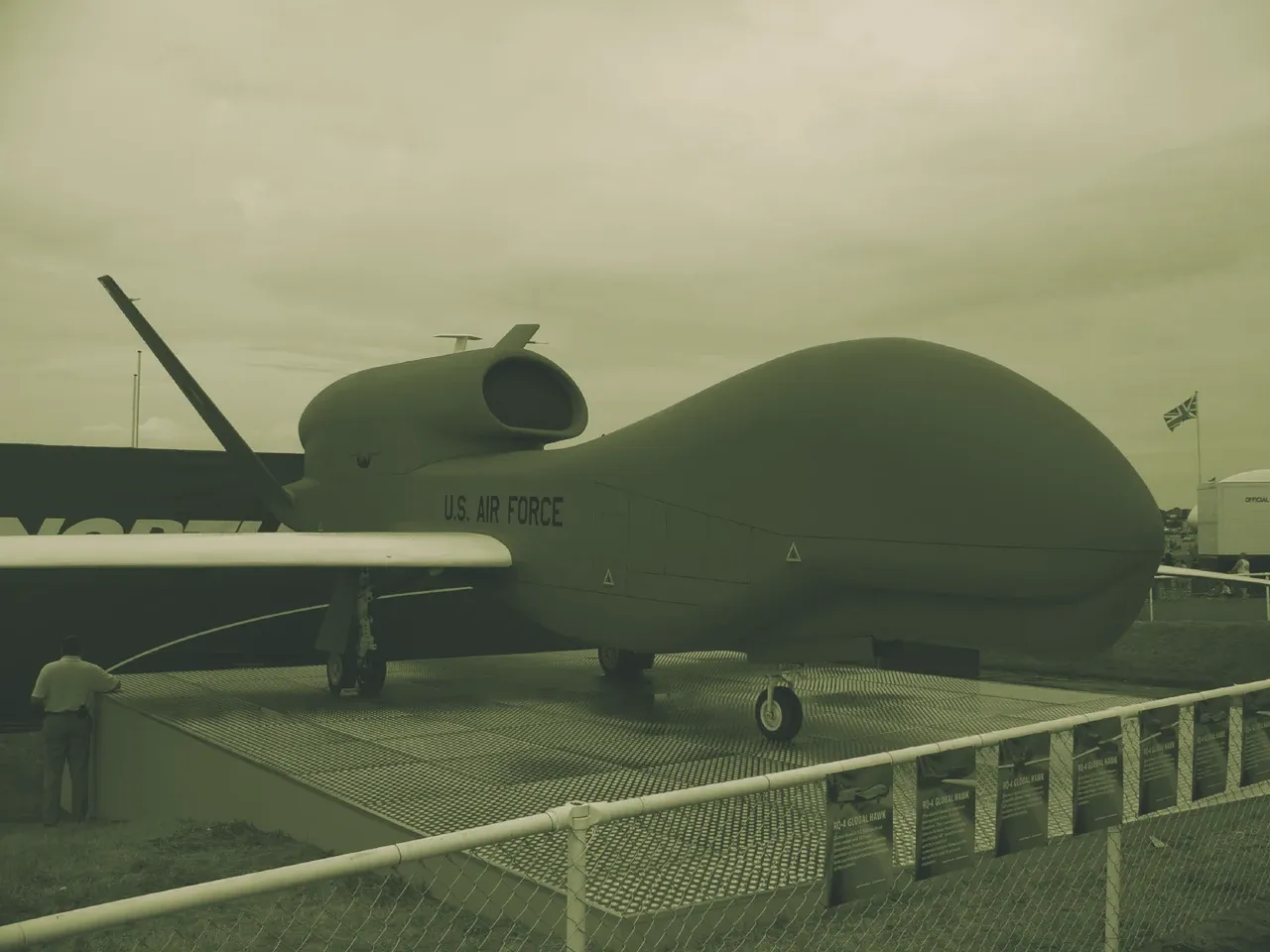
High-altitude, unarmed strategic reconnaissance UAV — the U.S. Air Force's persistent global ISR backbone, flying extended-duration missions from a handful of overseas bases.
Overview
The RQ-4 Global Hawk is a high-altitude, long-endurance (HALE) uncrewed aerial vehicle designed exclusively for intelligence, surveillance, and reconnaissance (ISR). Operated primarily by the U.S. Air Force (USAF), it carries no weapons and instead packs a large internal sensor suite — synthetic aperture radar, electro-optical/infrared cameras, and signals intelligence payloads. The Northrop Grumman-built aircraft has been in continuous service since the early 2000s, with variants fielded by the NATO Alliance Ground Surveillance (AGS) force (RQ-4D) and the Republic of Korea Air Force, while a maritime derivative, the MQ-4C Triton, serves the U.S. Navy and Australia.
Development
Northrop Grumman developed the Global Hawk under an Advanced Concept Technology Demonstration contract in the 1990s. The aircraft first flew in February 1998, and an early Block 10 configuration achieved initial operational capability with the USAF in 2001. Subsequent Blocks introduced progressively more capable sensors: the Block 30 added an advanced signals-intelligence suite, while the Block 40 fielded the Multi-Platform Radar Technology Insertion Program (MP-RTIP) ground-moving target indicator. The USAF began retiring its oldest Block 30 airframes in the 2020s as costs grew, while the Block 40 and NATO’s RQ-4D fleet remain operational.
Design & capabilities
The Global Hawk is a single-turbofan HALE platform with a 39.9 m wingspan — larger than a Boeing 737 — and a maximum take-off weight of about 14,600 kg. It can remain aloft for over 30 hours and cover more than 22,700 km on a ferry flight, cruising at roughly 575 km/h. Its sensor payload, up to 1,360 kg, integrates an electro-optical/infrared turret, a synthetic aperture radar with ground moving-target indication, and SIGINT gear — all linked via line-of-sight and satellite communications. The aircraft operates with a high degree of autonomy, following mission-planned waypoints under remote supervision, and recovers to a conventional runway.
Variants
- RQ-4A — Initial production model; smaller, later upgraded.
- RQ-4B — Enlarged fuselage; current USAF baseline in Block 30 (SIGINT) and Block 40 (radar) configurations.
- RQ-4D Phoenix — NATO AGS variant, equipped with a multi-mode radar for wide-area surveillance.
- MQ-4C Triton — Maritime derivative for the U.S. Navy and Australia; features a 360° active-electronically-scanned array radar and full electronic support measures.
Combat record / operational use
RQ-4s flew extensive ISR missions in Iraq and Afghanistan and have, since 2022, executed regular surveillance orbits over the Black Sea to monitor the war in Ukraine — unarmed, but continuously feeding imagery and signals data to allied commanders. In June 2026 a U.S. Navy MQ-4C Triton was lost near the Strait of Hormuz amid heightened tensions with Iran, demonstrating the platform’s vulnerability in non-permissive airspace despite its strategic stand-off altitude.
Advantages
- Extreme endurance of 30+ hours and trans-oceanic range enable persistent multi-day ISR coverage.
- Large sensor payload fuses radar, EO/IR, and SIGINT on a single uncrewed airframe.
- High operating altitude (≈18,000 m) complicates engagement by most short-range air-defense systems.
- Highly autonomous mission profile reduces manning and basing footprint.
- Interoperable via SATCOM with multiple ground stations and allied networks.
Drawbacks / limitations
- Entirely unarmed — cannot defend itself or prosecute targets of opportunity.
- Large radar cross-section and predictable flight paths make it a high-value target for modern integrated air-defense systems.
- Very high acquisition and operating cost constrains fleet size (~$130 M per air vehicle, system cost ~$240 M).
- Reliance on satellite links creates potential single-point-of-failure under electronic attack.
- Limited production numbers (≈45 airframes) mean attrition directly erodes the surveillance capacity.
Counterparts
- Orlan-10 (Russia)
- WZ-7 Soaring Dragon (China)
Outlook
The USAF is retiring its oldest RQ-4 Block 30s earlier than planned, shifting funding toward other ISR capabilities, while the NATO AGS fleet and South Korean aircraft will continue to fly. The MQ-4C Triton line remains in active production for the U.S. Navy and Australia, though the 2026 loss near the Strait of Hormuz has sharpened scrutiny of the platform’s ability to survive against peer adversaries. The Global Hawk’s niche — long-endurance, high-altitude surveillance over uncontested or semi-permissive airspace — will likely persist, but the service’s appetite for a non-stealthy, unarmed, and expensive ISR asset is declining.
Key specifications
| Spec | Value |
|---|---|
| Type | Single-turbofan HALE UAV |
| Endurance | ~30–34 h |
| Range | >22,700 km ferry (RQ-4) |
| Cruise / max speed | ~575 km/h cruise, ~629 km/h max |
| Payload | ~1,360 kg sensors (no weapons) |
| Datalink / control | LOS + SATCOM |
| Autonomy level | Autonomous / mission-planned |
| Dimensions / MTOW | Wingspan ~39.9 m, length ~14.5 m, MTOW ~14,600 kg |
| Launch & recovery | Runway |
Sources
- U.S. Air Force — RQ-4 Global Hawk Fact Sheet. https://www.af.mil/About-Us/Fact-Sheets/Display/Article/104516/rq-4-global-hawk/
- Air & Space Forces Magazine — RQ-4 Global Hawk Weapon System. https://www.airandspaceforces.com/weapons/rq-4/
- Wikipedia — Northrop Grumman RQ-4 Global Hawk. https://en.wikipedia.org/wiki/Northrop_Grumman_RQ-4_Global_Hawk
- Defence Security Asia — US Navy Confirms Loss of US$240M MQ-4C Triton Near Strait of Hormuz. https://defencesecurityasia.com/en/us-navy-mq4c-triton-lost-persian-gulf-strait-of-hormuz-iran-ceasefire-2026/