GRID-REF 37°47′N 122°25′W
DISPATCH 02/26 · 18 Jun 2026
BATTLEPOLICY
Startup to front line. Strategy to consequence.
Lexicon · Ukraine

Saker Scout

The Saker Scout is Ukraine's fielded AI-powered ISR and autonomous strike drone system, enabling machine-speed target detection and jamming-resistant operations.
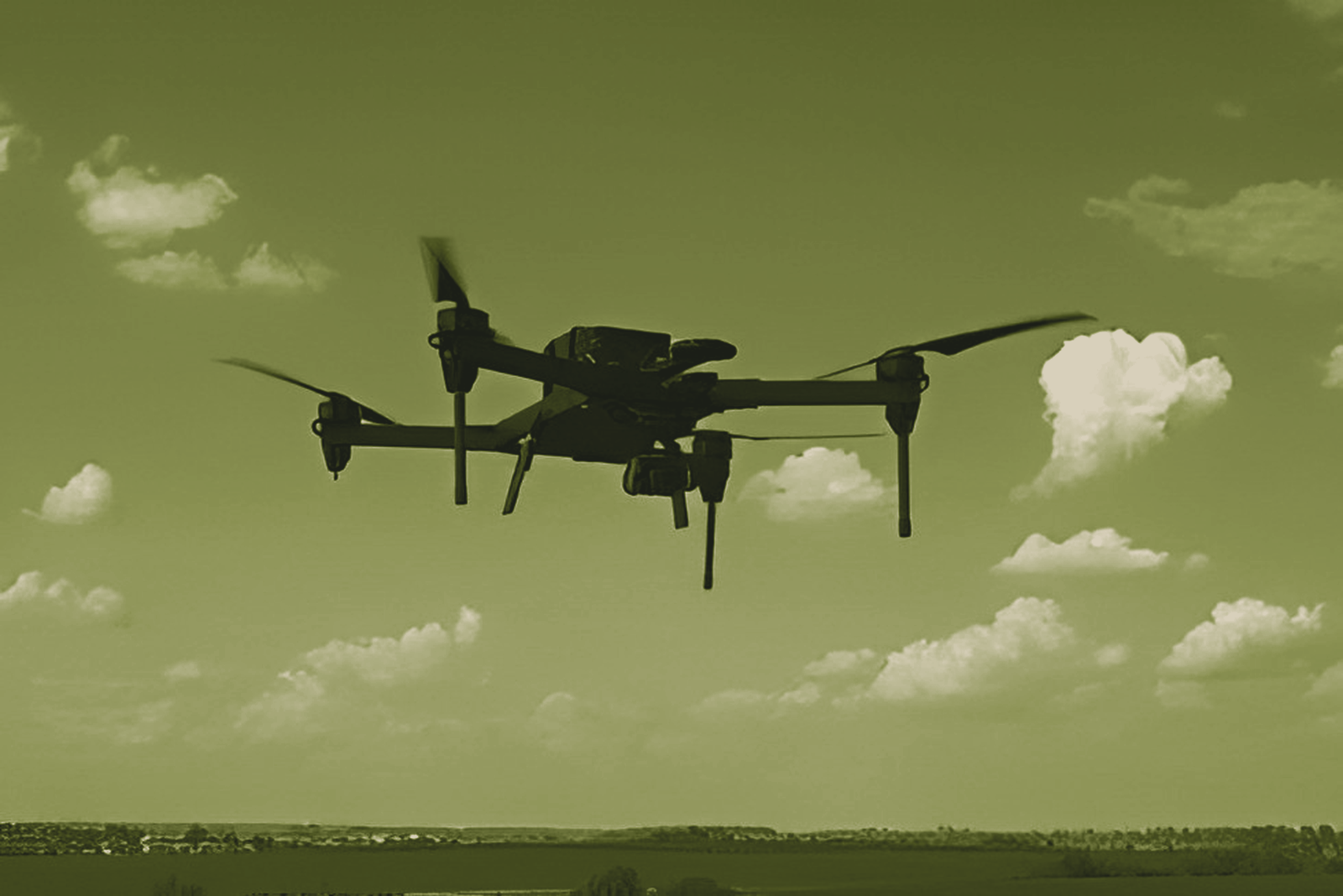
Ukraine's fielded AI-powered reconnaissance and autonomous strike drone system, fusing machine-speed target detection, Delta system integration, and jamming-resistant navigation to shorten the kill chain against Russian forces.

Overview

The Saker Scout is an AI-enabled multi-rotor unmanned aerial system developed by the Ukrainian start-up Saker and delivered to the Armed Forces of Ukraine through the Ministry of Defence Accelerator programme. It combines a quadcopter reconnaissance flagship with a swarm of FPV kamikaze strike drones. The system’s machine-learning model detects up to 64 categories of Russian military equipment — including camouflaged and tree-concealed vehicles — and transfers targeting data via the Delta battlefield-management system. When operator datalinks are lost due to electronic warfare (EW) jamming, the drone can engage targets autonomously, a capability confirmed in limited operational use. Saker Scout represents one of the first documented deployments of AI-assisted autonomous targeting in an active high-intensity conflict.

Development

The developer, Saker (often operating as Twist Robotics), was founded in 2021 with a focus on affordable AI vision systems for agricultural crop-protection applications. After Russia’s full-scale invasion in February 2022 the company pivoted to military technology, developing an AI system to help drone operators spot vehicles concealed by vegetation or camouflage, as described by Forbes. The Ukrainian Ministry of Defence validated the system under its fast-track Accelerator mechanism and on 4 September 2023 issued the formal permit for combat supply, according to Shephard Media. The accelerated process — from pivot to combat-approved system in under 18 months — exemplifies Ukraine’s wartime model for injecting commercial AI into the frontline.

Design & capabilities

The Saker Scout system comprises a quadcopter reconnaissance drone and multiple accompanying FPV strike drones. The flagship drone’s operational range is reported at approximately 10 km by Defense Express, while Automated Decision Research cites a maximum of 12 km. Its payload capacity of up to 3 kg is typically used to carry munitions or coordinate FPV attack runs. The AI core relies on a machine-learning model trained to identify 64 target categories: tanks, APCs, trucks and other combat vehicles; the model is continuously updated to counter Russian camouflage and new equipment types, as detailed by Forbes. The drone employs inertial navigation to maintain position and return to base in GPS-denied and EW-jammed environments, a feature critical for surviving Russian jamming that defeats many commercial-derived UAVs (Defense Express). Targeting data is fused into the Delta situational-awareness platform, connecting the Saker’s detections with satellite, drone and other ISR feeds. The system’s autonomy level is configurable: normally a human operator verifies and authorises strikes, but an autonomous engagement mode — where the system independently detects, locks onto and attacks targets — is available and has been activated at small scale when jamming cuts the datalink (Forbes). Optical and thermal sensors enable day/night operation.

Combat record / operational use

The Saker Scout received its combat-use permit on 4 September 2023 and entered operations the same month (Shephard Media). Its primary battlefield role has been AI-assisted reconnaissance and cueing for FPV strike drones: the flagship detects and geolocates targets, transmits coordinates to the Delta system, and FPV operators execute attacks. A Saker company spokesman confirmed to Forbes that the autonomous attack mode has been used “on a small scale,” most probably when Russian electronic warfare severed operator control links. Automated Decision Research notes that analyst Paul Scharre assessed the Saker as a field-documented instance of AI-assisted autonomous targeting in a large-scale conflict, distinct from earlier unconfirmed allegations. While reports of fully autonomous strikes exist, broader assessments in early 2024 noted that transformational AI use at scale had yet to materialise on Ukraine’s battlefields, though the Saker remained a milestone case.

Advantages

  • AI target detection compresses the kill chain to machine speed, bypassing human decision-making bottlenecks (Forbes).
  • Inertial navigation provides substantial resistance to Russian GPS and EW jamming, keeping the system operable where many commercial drones fail (Defense Express).
  • Integration with the Delta system fuses Saker data with other ISR feeds, creating a composite command-level picture.
  • Continuous machine-learning updates allow the model to adapt to new camouflage and vehicle variants without hardware changes (Shephard Media).
  • Detects camouflaged and tree-concealed targets that often elude human operators, using both optical and thermal sensors.

Drawbacks / limitations

  • AI accuracy remains imperfect, and false-positive risks in complex environments are not publicly characterised (Forbes).
  • The autonomous strike mode removes human judgement at the point of engagement, raising unresolved International Humanitarian Law questions — a concern spotlighted for comparable autonomous systems by the Lieber Institute.
  • Short operational range (~10–12 km) limits utility for deep reconnaissance and interdiction behind well-defended front lines.
  • Production scale and institutional robustness of the start-up remain unverified; scaling AI-training pipelines at operational tempo is resource-intensive.
  • Expert scepticism persists about the scale of truly autonomous combat use; late-2023 assessments noted the “revolution” of AI drones had “fizzled” and questioned published autonomy claims (Automated Decision Research).

Counterparts

Outlook

The Saker Scout stands as the first publicly confirmed fielded AI-targeting system with an acknowledged autonomous-strike capability, however limited in practice. Its trajectory hinges on whether the start-up can sustain the data-labelling and model-retraining pipeline while production expands. If it succeeds, the system provides a template for a disaggregated, EW-hardened, low-cost ISR-strike network that threatens Russian armour without requiring a trained FPV pilot for every engagement. For NATO allies, the Saker episode demonstrates that a country under existential pressure will deploy autonomous lethal AI without waiting for international consensus, a concrete data point that will inform future regulatory and operational-doctrine debates.

Key specifications

Spec Value
Type AI-enabled multi-rotor quadcopter UAS
Endurance not publicly established
Range ~10–12 km (est.)
Cruise / max speed not publicly established
Payload up to 3 kg
Datalink / control Integrated with Delta system; inertial navigation for GPS-denied ops
Autonomy level AI-assisted detection with human cmd; autonomous engagement mode available (limited use)
Dimensions / MTOW not publicly established
Launch & recovery vertical take-off; reconnaissance recovery standard; FPV strike drones single-use

Sources

  1. Defense Express — “Ukrainian Forces Get an AI-Powered Saker Scout Drone, and Its Algorithms Can Solve an Important Problem” — https://en.defence-ua.com/weapon_and_tech/ukrainian_forces_get_an_ai_powered_saker_scout_drone_and_its_algorithms_can_solve_an_important_problem-7842.html
  2. Forbes — “Ukraine's AI Drones Seek And Attack Russian Forces Without Human Oversight” — https://www.forbes.com/sites/davidhambling/2023/10/17/ukraines-ai-drones-seek-and-attack-russian-forces-without-human-oversight/
  3. Automated Decision Research — “Saker Scout UAV” — https://automatedresearch.org/weapon/saker-scout-uav/
  4. Shephard Media — “Ukraine approves AI-enabled Saker drone for use in combat” — https://www.shephardmedia.com/news/uv-online/ukraine-approves-ai-enabled-saker-drone-for-use-in-combat/
  5. Lieber Institute, West Point — “The Kargu-2 Autonomous Attack Drone: Legal & Ethical Dimensions” — https://lieber.westpoint.edu/kargu-2-autonomous-attack-drone-legal-ethical/
  6. United24 Media — “How Ukraine Is Using AI Drones to Outsmart Russia on the Battlefield” — https://united24media.com/latest-news/how-ukraine-is-using-ai-drones-to-outsmart-russia-on-the-battlefield-3833
FIELD DISPATCH · WEEKLY

BattlePolicy Weekly — free.

Defense tech, startups, and security — weekly. No paywall.

Related
Ukraine · Europe · Policy · Diehl Defence · Fire Point · hensoldt · mbda · Flamingo · FREYJA

Europe lines up to build Ukraine's missiles, starting with the Flamingo

Combat-proven Ukrainian strike weapons are becoming NATO's shortcut around a deep-strike gap that Europe's own programs will not close until the 2030s.

Ukraine · Europe · Policy · Diehl Defence · Fire Point · hensoldt · mbda · Flamingo · FREYJA
Ukraine · Russia · Europe · Air Defense · Fire Point · hensoldt · Origin Robotics · Lockheed MartinPro

Russia Is Now Short on Air-Defense Missiles Too. The Race Is to Replace Them Cheaply.

Ukrainian intelligence says Moscow is burning through its S-300 interceptors faster than it can replace them, and the same arithmetic now drives Ukraine and its partners toward a cheaper interceptor.

Ukraine · Russia · Europe · Air Defense · Fire Point · hensoldt · Origin Robotics · Lockheed Martin