T-14 Armata
Russia's next-generation MBT — a radical unmanned-turret design with a crew armoured capsule, Afganit active protection, and a 125 mm gun, but the program remains mired in low-rate prototypes and has seen no meaningful frontline service.
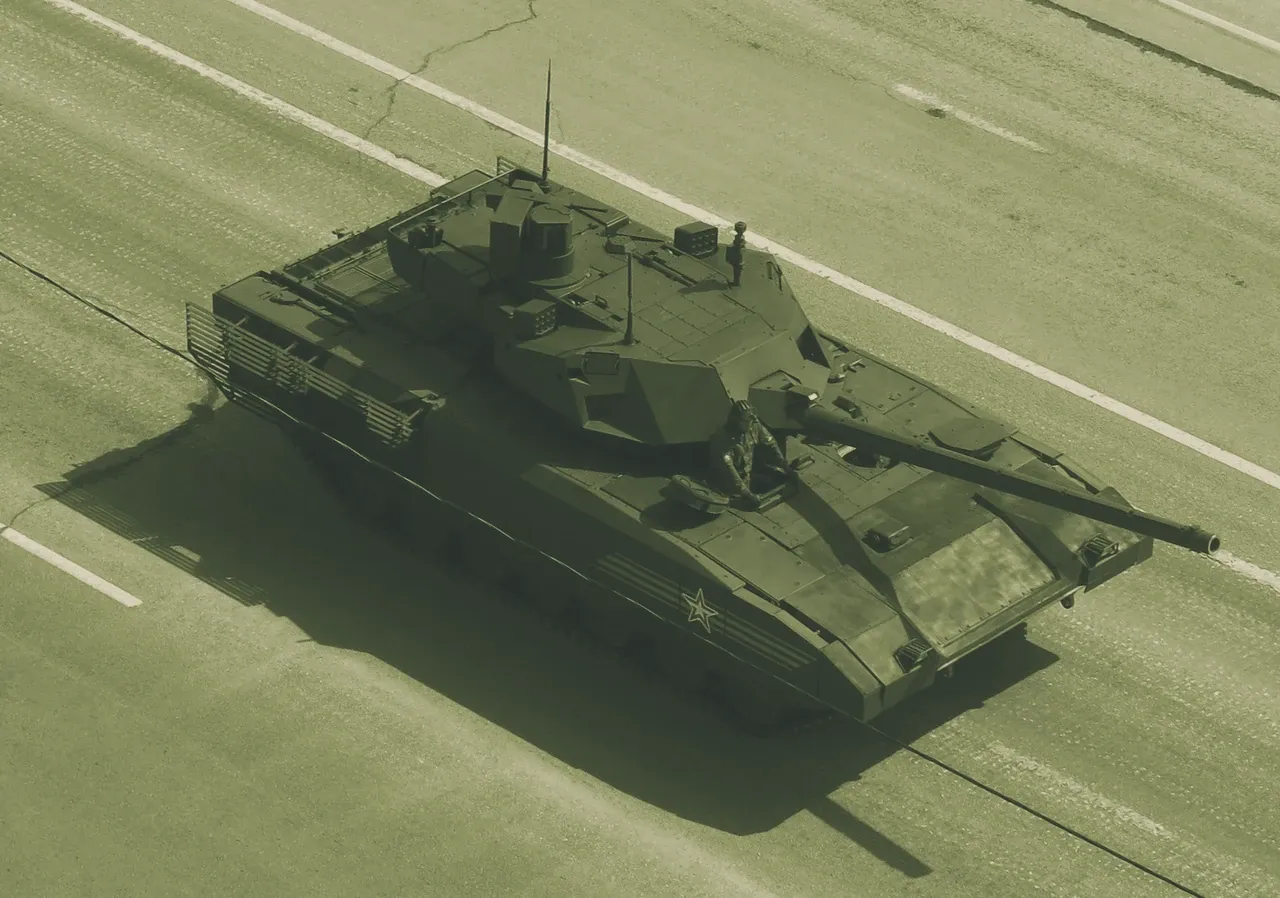
Russia's radical next-generation main battle tank — an unmanned-turret design with a three-man armoured capsule, claimed Afganit active protection, and a 125 mm smoothbore, but a program stalled at the pre-series stage that has never been committed to large-scale frontline service.
Overview
The T-14 Armata is a developmental Russian main battle tank designed around the Armata Universal Combat Platform. It departs from all preceding Russian MBTs by placing the crew in a forward, well-protected capsule while mounting a fully unmanned turret. The vehicle has been presented as a fourth-generation design capable of hosting a future 152 mm gun, though the current armament is a 125 mm 2A82-1M smoothbore. Series production has been repeatedly announced and postponed; open-source assessments count only a handful to perhaps 20 vehicles, and the type has not entered meaningful operational service.
Development
The T-14 was publicly unveiled during the 2015 Moscow Victory Day parade rehearsal. At that point Uralvagonzavod and Rostec projected serial production would begin shortly, but deadlines have consistently slipped. According to Wikipedia, state tests were originally expected to conclude in 2016–2017, yet no series contract has materialised. The Russian MoD has periodically announced small batches — a 2020 statement spoke of a “pilot batch” — but the numbers that can be independently verified remain in the low double digits. The defense-analysis outlet 19FortyFive reported that the program is “an acknowledged failure” in terms of scaling production, citing technical complexity and cost as the primary hurdles.
Design & capabilities
The Armata’s signature design feature is an unmanned turret paired with an armoured crew capsule at the front of the hull. The capsule, claimed to use advanced composite materials, isolates the three-man team from the turret-borne ammunition. Army Technology notes that the 125 mm 2A82-1M smoothbore is served by an autoloader, with manufacturer claims of higher muzzle energy than the established 2A46-M series and compatibility with gun-launched guided missiles. A remote weapon station provides secondary armament, though exact configurations have not been made consistent in open literature. The manufacturer also asserts that the vehicle carries the Afganit active-protection system and Malachit explosive reactive armour, but neither has been observed in sustained combat. Propulsion comes from a ChTZ 12N360 turbo-diesel that can theoretically produce up to 2,000 hp but is reportedly derated to between 1,200 and 1,500 hp for service-life reasons; a road speed of about 80 km/h is claimed. Weight estimates range from 48 to 55 t, reflecting the uncertainty around a design still in pre-series form.
Variants
The Armata platform has been exhibited in several guises — the T-15 heavy infantry fighting vehicle, the T-16 armoured recovery vehicle, and the 2S35 Koalitsiya-SV self-propelled howitzer — but all share the prototype status of the foundational T-14. No operational sub-variants have been fielded.
Combat record / operational use
The T-14 has no confirmed combat record. Reports that a small number were moved near Ukraine for “testing” in 2022–2023 have been neither sustained by independent evidence nor followed by deployment to frontline units. 19FortyFive described the tank’s combat status as “zero-combat” and noted that Russian state media have largely stopped showcasing it since 2023. The program is widely regarded in open-source analysis as stalled by cost, complexity, and the priority given to upgrading existing T-72, T-80, and T-90 fleets for the war in Ukraine.
Advantages
- Unprecedented crew-capsule layout, isolating personnel from the turret’s ammunition — a potential step-change in survivability.
- If the Afganit active-protection system is matured, it would offer a hard-kill umbrella alongside a radar-guided soft-kill suite.
- High-horsepower diesel and claimed power-to-weight ratio (up to ~31 hp/t) promise strong mobility.
- The platform architecture allows a common chassis for a family of heavy vehicles, reducing logistics and industrial burden if adopted at scale.
Drawbacks / limitations
- The program has failed to transition from prototype to series production over more than a decade; the ~$8–12 million unit-cost estimate makes fleet procurement economically prohibitive at scale.
- The unmanned turret, while theoretically protecting the crew, places all on-board ammunition in an exposed, lightly armoured structure — a vulnerability that the war in Ukraine has underscored on other tanks.
- Neither the Afganit APS nor Malachit ERA has been validated in combat; manufacturer claims remain aspirational.
- The absence of a stable production line means spare-parts, maintenance doctrine, and crew-training pipelines are all immature.
Counterparts
- M1A2 Abrams (USA)
- Type 99A (China)
- Leopard 2 (Europe)
Outlook
The T-14 Armata continues to appear in parade rehearsal footage but occupies an increasingly ambiguous place in the Russian ground-forces modernisation story. With resources overwhelmingly allocated to rebuilding and upgrading the T-72, T-80, and T-90 fleets, and a per-unit price that rivals Western top-line MBTs, large-scale series production appears unlikely in the near term. The platform may yet serve as a technology demonstrator whose subsystems filter into future upgrades, but as a fielded frontline tank the Armata remains a promise unfulfilled.
Key specifications
| Spec | Value |
|---|---|
| Crew | 3 (in forward armoured capsule — design claim) |
| Combat weight | ~48–55 t (est., range) |
| Length / width / height | Not publicly established (figures vary) |
| Main armament | 125 mm 2A82-1M smoothbore with autoloader |
| Secondary armament | Remote weapon station (7.62 mm); specifics not consistently established |
| Armor & protection | Crew capsule + composite; Afganit APS and Malachit ERA claimed by manufacturer |
| Engine & power | ChTZ 12N360 (A-85-3A) turbo-diesel; ~1,200–1,500 hp (derated for service life) |
| Power-to-weight | ~27–31 hp/t (calc., est.) |
| Road / cross-country speed | ~80–82 km/h road (claimed); cross-country not established |
| Operational range | >500 km (claimed) |
Sources
- Wikipedia — T-14 Armata. https://en.wikipedia.org/wiki/T-14_Armata
- Army Technology — T-14 Armata Main Battle Tank. https://www.army-technology.com/projects/t-14-armata-main-battle-tank/
- 19FortyFive — “Russia’s T-14 Armata: From ‘Most Advanced Tank on Earth’ To Failure.” https://www.19fortyfive.com/2025/12/russias-t-14-armata-from-most-advanced-tank-on-earth-to-failure/