GRID-REF 37°47′N 122°25′W
DISPATCH 02/26 · 9 Jun 2026
BATTLEPOLICY
Startup to front line. Strategy to consequence.
Lexicon · Russia

T-90M Proryv

Russia's most modern serial main battle tank — a deeply upgraded T-90 with a new turret, Relikt reactive armour and a fire-control suite, fielded from 2020 and now the benchmark of Russian armour attrition in Ukraine.
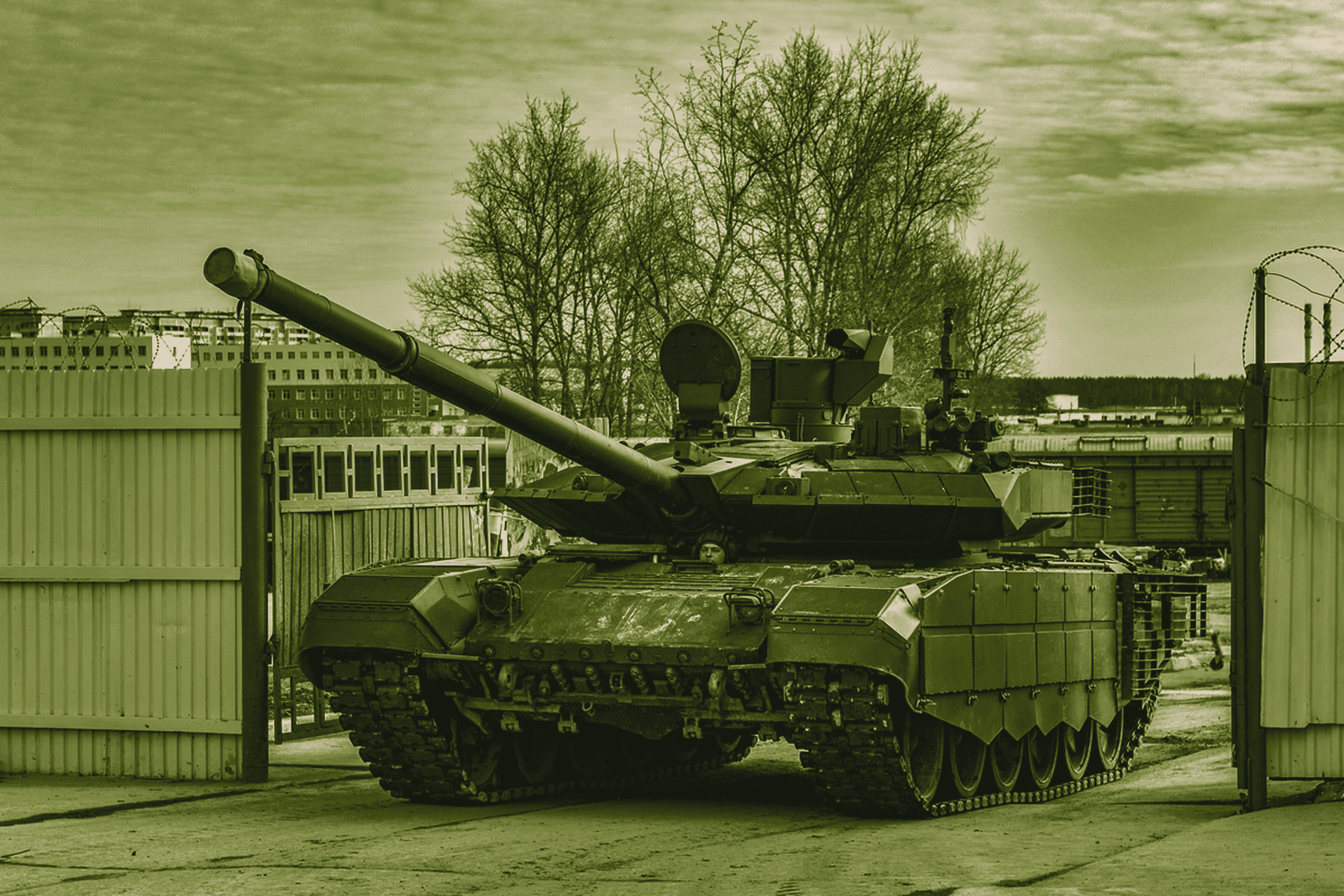
T-90M Proryv
FIG.01 · Russia Image - A Russian T-90M Proryv main battle tank. Photo by Ministry of Defence of the Russian Federation, CC BY 4.0, via Wikimedia Commons.
Russia's most modern serial main battle tank — a deeply upgraded T-90 with a new welded turret, Relikt reactive armour and a digital fire-control suite, fielded from 2020 and now the headline measure of Russian armour attrition in Ukraine.

Overview

The T-90M Proryv ("Breakthrough") is the latest serial-production variant of Russia's T-90 main battle tank, built by Uralvagonzavod in Nizhny Tagil. It pairs the proven T-90 hull and three-man autoloader layout with a redesigned turret, the Relikt explosive reactive armour package, a 125 mm gun able to fire guided missiles through the barrel, and a modern day/night fire-control system. Unlike most Russian armour it carries no NATO reporting name — Western references simply use the factory index. The T-90M anchors the upper tier of Russia's active tank fleet and, since 2022, has become both the showcase of Russian armour modernization and the most-counted casualty of it.

Development

Uralvagonzavod developed the T-90M as the production form of the T-90AM "Proryv" modernization, itself an evolution of the Kartsev–Venediktov T-72/T-90 lineage. Serial deliveries to the Russian Army began in 2020, with the first vehicles going to the 1st Guards Tank Army, according to the T-90M technical data sheet at Army Recognition. The baseline T-90A had entered Russian service in 2004; the T-90M is a "new-build and rebuild" standard that brings older hulls and fresh production up to a common modernized configuration. The closely related export model is the T-90MS/T-90SM.

Design & capabilities

The T-90M's most visible change is its welded turret carrying Relikt reactive armour on the front and sides, with modular reactive armour on the hull glacis, slat/bar armour at the rear and a 360-degree anti-RPG metal net. Its 125 mm 2A46M-5 smoothbore gun fires the standard APFSDS, HEAT and HE rounds and can launch the 9M119 Refleks (AT-11 "Sniper") laser-beam-riding guided missile through the barrel to roughly 5,000 m, per Army Recognition. A 7.62 mm PKT is mounted coaxially and a 12.7 mm NSVT sits in a commander's remote weapon station. Power comes from a V-92S2F diesel rated at 1,130 hp — an uprating over the 1,000 hp V-92S2 of the T-90A — giving a power-to-weight of about 24 hp per tonne and a road speed of 60 km/h. The manufacturer also advertises a soft- and hard-kill active protection capability "similar to Afganit," but this should be treated as a manufacturer claim rather than a confirmed fielded fit.

Variants

  • T-90A — the 2004 baseline this standard modernizes, with the lower-rated V-92S2 engine.
  • T-90M / "Proryv-3" — the domestic serial standard described here.
  • T-90MS / T-90SM — the export configuration; India contracted 464 T-90MS in a 2019 deal worth about \$2.8 billion, according to The Diplomat.
  • Later 2025–26 production batches have reportedly added anti-drone and top-attack countermeasures, reflecting front-line lessons.

Combat record / operational use

The T-90M was first documented in combat in Ukraine in the Kharkiv region in April 2022, and the first example was captured by Ukrainian forces by December 2022, per Army Recognition. Its reputation as Russia's best tank was punctured in January 2024 near Avdiivka, when a Ukrainian M2 Bradley crewed by only two soldiers disabled a T-90M with sustained 25 mm autocannon fire — a striking illustration of how cheap infantry vehicles, drones and precision munitions have eroded the value of expensive armour. The Oryx visually-confirmed-loss database records well over 150 T-90M destroyed, damaged or abandoned, a floor that understates the true figure.

Advantages

  • Relikt ERA and layered add-on protection markedly improve survivability over older T-72/T-90 hulls.
  • 125 mm gun with a gun-launched ATGM gives a stand-off anti-armour reach beyond direct-fire range.
  • Uprated 1,130 hp engine restores mobility lost to added weight.
  • Modern day/night fire control and a commander's independent sight improve first-round hit probability over Soviet-era tanks.
  • Small three-man, low-silhouette autoloader layout is lighter and harder to spot than four-crew Western tanks.

Drawbacks / limitations

  • The carousel autoloader stores ammunition in the crew compartment, a long-criticised cause of catastrophic "jack-in-the-box" turret-loss detonations.
  • Baseline armour is light by Western standards and vulnerable to top-attack and drone-delivered munitions, driving improvised cage/"cope" additions.
  • The advertised Afganit-class active protection is not confirmed as a fielded fit on serial vehicles.
  • High unit cost and constrained production limit how fast losses can be replaced.
  • Real production and fleet figures are opaque; most are external estimates.

Counterparts

  • M1A2 Abrams (USA) — the heavier, four-crew Western benchmark, also supplied to Ukraine.
  • Leopard 2A7 (Europe) — the coalition main-battle-tank standard.
  • Type 99A (China) — the PLA's top-tier MBT, with a comparable 125 mm-plus-ATGM layout but no combat record.

Outlook

The T-90M remains in serial production and is the most modern tank Russia builds in quantity, with in-war output reportedly surged from roughly 60 a year before 2022 to as much as ~300 a year by 2025 (an external estimate). But the Ukraine war has rewritten the question it must answer: survivability against drones, top-attack missiles and precision artillery now matters more than raw gun or armour figures, and the next production batches are being adapted accordingly. Russia continues to field the T-90M as the backbone of its modernized armour while the much-delayed T-14 Armata remains effectively absent from frontline service.

Key specifications

Spec Value
Crew 3 (commander, gunner, driver; autoloader)
Combat weight ~46.5 t (up to ~48 t with add-on armour)
Length / width / height 6.68 m (hull) / 3.78 m / 2.23 m
Main armament 125 mm 2A46M-5 smoothbore (APFSDS / HEAT / HE + 9M119 Refleks gun-launched ATGM, ≤5 km)
Secondary armament 7.62 mm PKT coaxial; 12.7 mm NSVT in a remote weapon station
Armor & protection Composite + welded turret with Relikt ERA; modular hull ERA; slat/anti-RPG cage; manufacturer-claimed soft/hard-kill APS (not confirmed as fielded)
Engine & power V-92S2F diesel, 1,130 hp (~830 kW)
Power-to-weight ~24 hp/t
Road / cross-country speed 60 km/h (road)
Operational range 550 km (road)

Sources

  1. Army Recognition — T-90M Model 2017 "Proryv-3" main battle tank technical data sheet. https://armyrecognition.com/military-products/army/main-battle-tanks/main-battle-tanks/t-90m-model-2017-mbt-main-battle-tank-technical-data-sheet
  2. Defense Update — "Russian Army Receives New T-90M MBT" (cost comparison). https://defense-update.com/20200420_t90m.html
  3. The Diplomat — "India's Defense Ministry Signs \$2.8 Billion Deal For 464 T-90MS Main Battle Tanks." https://thediplomat.com/2019/11/indias-defense-ministry-signs-2-8-billion-deal-for-464-t-90ms-main-battle-tanks/
  4. Oryx — "Attack On Europe: Documenting Russian Equipment Losses" (visually-confirmed-loss database; floor, not total). https://www.oryxspioenkop.com/2022/02/attack-on-europe-documenting-equipment.html
  5. Kyiv Post — "Analysis: How Ukraine's M2 Bradleys Take Out Russia's Best T-90M." https://www.kyivpost.com/analysis/26992
FIELD DISPATCH · WEEKLY

BattlePolicy Weekly — free.

Defense tech, startups, and security — weekly. No paywall.

Related
Ukraine · Russia · Policy · Chornobyl · Energoatom · shahed

Russia strikes Ukraine's central spent-fuel store at Chornobyl with a Shahed

A Russian drone hit the receiving building of the Holtec-built dry-cask site that freed Ukraine from shipping its nuclear waste to Russia, metres from where spent fuel sits.

Ukraine · Russia · Policy · Chornobyl · Energoatom · shahed