Typhon (Mid-Range Capability)
The US Army’s containerized mid-range launcher that puts Tomahawk and SM-6 on land — restoring a 500–2,000+ km strike band after the INF Treaty, and the centerpiece of Army Pacific deterrence and an export saga that collapsed in Europe.
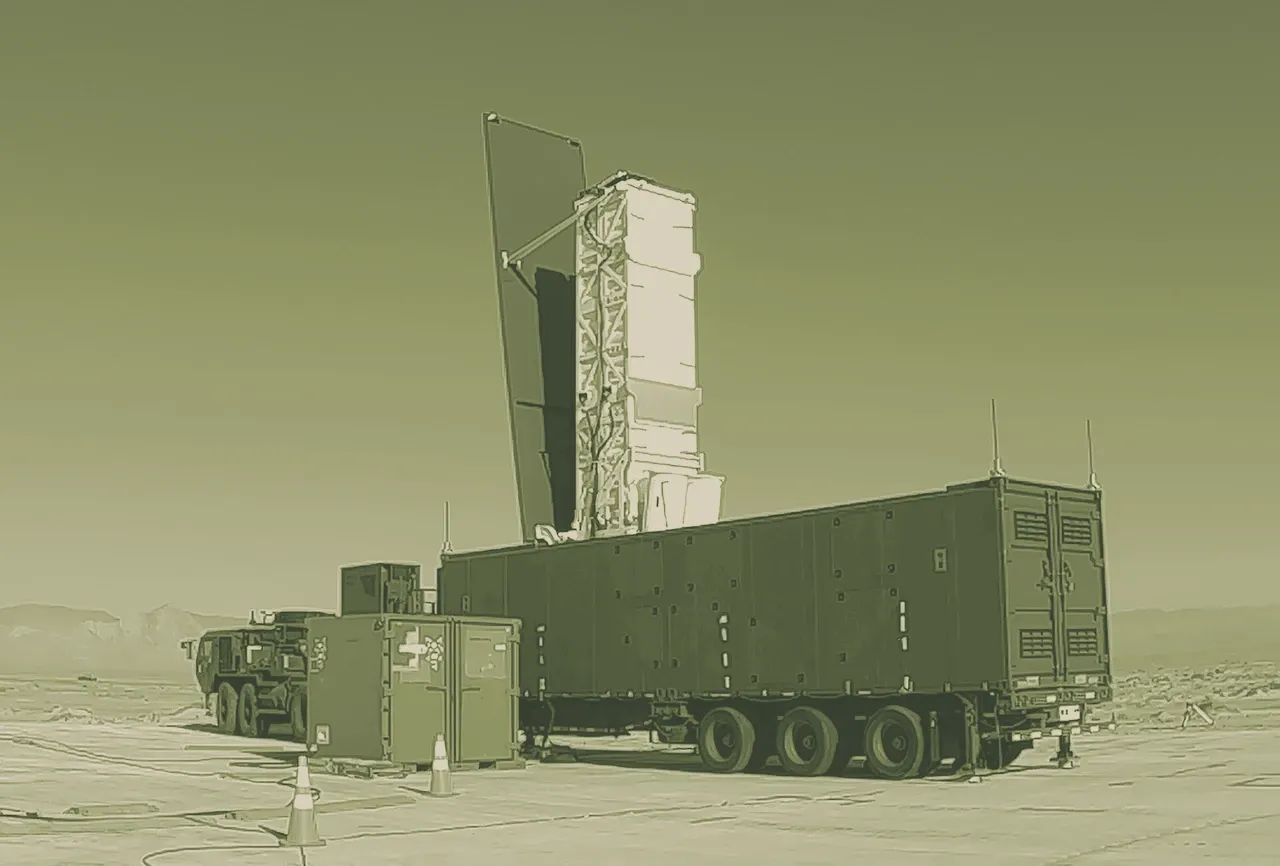
The US Army’s mobile, containerized launcher that puts Navy Tomahawks and SM-6s on land — restoring a 500–2,000+ km strike band, and now the most geopolitically charged new fielding in the American ground arsenal.
Overview
Typhon Mid-Range Capability (MRC), also known as the Strategic Mid-Range Fires System (SMRF), is a truck-mounted, containerized vertical-launch system that repurposes the Navy’s Tomahawk cruise missile and SM-6 multi-role missile for land-based use. A single battery pairs four Typhon launchers — each carrying four strike-length Mark 41 VLS cells — with a Battery Operations Center, giving the Army a 16-missile salvo weight with anti-ship, deep-strike, and air-defense reach in a single sortable package. The system entered service at the end of 2023, restored the ground-based mid-range envelope that the Intermediate-Range Nuclear Forces Treaty had banned for more than three decades, and has already been deployed to the Philippines, Australia, and Japan, triggering protests from Beijing and Moscow while a prospective German sale has collapsed amid trans-Atlantic tensions.
Development
The Army conceived Typhon under its Long Range Precision Fires (LRPF) modernization priority after the United States withdrew from the INF Treaty in August 2019, opening the legal space for land-based missiles with ranges between 500 and 5,500 km. Rather than wait for a clean-sheet missile, the service chose to field a launcher that could fire existing Navy Tomahawk and SM-6 stocks, trading design purity for speed to field. Lockheed Martin was selected as the launcher integrator, and the programme moved rapidly: a Tomahawk land-launch test from the Typhon Payload Delivery System succeeded on 27 June 2023, and the first operational battery reached Initial Operational Capability in the fourth quarter of FY2023, according to the Congressional Research Service. The Army originally planned four batteries — one per Multi-Domain Task Force — but by mid-2024 had already fielded at least two batteries within the 1st MDTF, signalling that the target had been exceeded.
Design & capabilities
The Typhon launcher integrates four Mark 41 strike-length VLS cells inside a 40-ft (12 m) ISO-container-footprint trailer towed by a commercial prime mover. A full SMRF battery comprises four launchers (16 cells total) plus a Battery Operations Center. The system is C-17-transportable and can be operational within hours of arriving at an airfield, as demonstrated when D Battery, 5-3 Field Artillery, was airlifted into Luzon in April 2024 and placed within Tomahawk range of the South China Sea.
The two missile types give the battery a layered capability. The RGM/UGM-109E Tactical Tomahawk Block V provides a subsonic 1,600+ km deep-strike reach with a 450 kg warhead, guided by GPS/INS, terrain contour matching, and a digital scene-matching terminal seeker. The RIM-174 SM-6 adds a supersonic (Mach 3.5) surface-to-surface mode with a range of ~370 km, and its active radar seeker enables an anti-ship role, a capability the Army expressly demonstrated during the first overseas live-fire at Exercise Talisman Sabre 25, where an SM-6 sank a maritime target, as reported by Army.mil. The mixed load therefore allows one battery to prosecute land attacks, hold ships at risk, and contribute to local air defence — a multi-domain fires concept central to the MDTF construct.
Variants
No distinct variants of the Army Typhon launcher are in service, though the Navy’s containerized Mk 70 Mod 1 Payload Delivery System, tested aboard USS Savannah (LCS-28), shares the same Mark 41-derived approach and can fire PAC-3 MSE. The German request for Typhon specifically sought a Tomahawk-only configuration, the export baseline offered, while the Philippines’ announced acquisition intent remains at a pre-contract stage.
Combat record / operational use
As of June 2026, Typhon has not been used in combat. Its deployment history is nevertheless dense and politically charged. The first overseas deployment — D Battery to Luzon for Exercise Salaknib 24 in April 2024 — poised a US Army battery within Tomahawk range of PLA bases in the South China Sea and was met with immediate formal protests from Beijing, detailed in Defense News. The battery stayed longer than initially planned while Manila evaluated a more permanent arrangement. A second battery was activated in January 2024. The first overseas live-fire occurred on 15 July 2025 at Talisman Sabre 25 in Australia’s Northern Territory: an SM-6 destroyed a surface target, proving the anti-ship role in a real firing. In August–September 2025, US Marine Corps personnel conducted Typhon operational training at MCAS Iwakuni, Japan — no launches, but the rotation drew warnings from Russia’s Foreign Ministry. Around May 2026 a Typhon battery conducted the first live-fire on Philippine soil during joint drills with Filipino and Japanese forces.
The German chapter tells a different story. On 15 July 2025 Germany submitted a Letter of Request to purchase Typhon with Tomahawk missiles as a “bridge” until European long-range strike systems mature, documented by The Aviationist. By June 2026, however, the Pentagon was likely to cancel the deal, with Politico reporting that the move was part of a broader US retrenchment from NATO after President Trump’s order to withdraw 5,000 troops from Germany and the German chancellor’s public falling-out with Washington over the Iran war.
Advantages
- Restores the ground-based 500–2,000+ km strike band abolished by the INF Treaty, giving the Army a strategic reach that does not rely on air- or sea-based platforms.
- Uses mature Navy Tomahawk and SM-6 production lines, accelerating fielding and capping per-round cost at roughly $1.5–2 million (Tomahawk) and $4.3 million (SM-6).
- C-17-transportable containerised design enables rapid, within-hours deployment to any allied airfield, as Luzon 2024 proved.
- SM-6 surface-to-surface mode confers an anti-ship capability that extends the Army’s ability to contest sea lanes — a doctrinal first for the land force.
- The mix of Tomahawk (deep strike) and SM-6 (anti-ship, air defence) in a single battery creates a flexible multi-domain salvo.
Drawbacks / limitations
- The launcher carries only 16 missiles per battery with no organic reload capability; at the burn rates seen in Operation Epic Fury — over 850 Tomahawks fired at Iran in the opening weeks, according to TURDEF — a single battery’s magazines can be emptied in minutes.
- The German acquisition has collapsed under the weight of Trump-era NATO retrenchment, demonstrating that political alignment can kill an export even after a formal purchase request.
- Every deployment has triggered diplomatic protests and coercive counter-measures from China and Russia, making allied host-nation consent a persistent vulnerability.
- The combined cost of a full 16-missile load — upwards of $50–70 million — makes the system a deep-magazine weapon that strains industrial replenishment in a prolonged conflict.
- Battery-level acquisition cost is not publicly disclosed, obscuring the financial picture for prospective buyers and oversight bodies.
Counterparts
- Dark Eagle (USA) — the Army’s hypersonic mid-range strike system, intended as a complementary but faster-penetration alternative.
- DF-21D (China) — the People’s Liberation Army’s dedicated anti-ship ballistic missile, a single-purpose ship-killer versus Typhon’s multi-role loadout.
Outlook
Typhon is simultaneously the US Army’s most consequential new fielding and its most politically contested. The Pacific model — episodic deployments during exercises — has delivered the deterrence message Beijing and Moscow object to, but it leaves coverage intermittent rather than persistent. The Philippines’ gradual movement toward a basing agreement offers the prospect of a permanent anchor, even as the German collapse underscores that European reliance on US strategic commitment is no longer guaranteed. The Tomahawk supply-chain stress of the Iran war adds a further variable: the same industrial base that would need to fill Typhon magazines in a Taiwan scenario has already been stretched by operations against Tehran. The Army is evaluating the longer-range Precision Strike Missile (PrSM) as a future, smaller-footprint organic strike option, but for now Typhon remains the only US land system able to prosecute targets at INF-prohibited distances.
Key specifications
| Spec | Value |
|---|---|
| Type | Mobile ground-based launcher for Tomahawk Block V and SM-6 |
| Range | Tomahawk: 1,600+ km; SM-6 (surface-to-surface): ~370 km |
| Speed (Mach / km·/s) | Tomahawk: subsonic ~0.74 (880 km/h); SM-6: Mach 3.5 |
| Warhead (type & weight) | Tomahawk: 450 kg WDU-36/B conventional blast/penetrator; SM-6: not publicly established |
| Guidance | Tomahawk: GPS/INS + TERCOM + DSMAC; SM-6: inertial + active radar seeker |
| Accuracy (CEP) | Tomahawk: <10 m (claimed); SM-6: not publicly established |
| Launch platform(s) | Typhon transporter-erector-launcher (4 Mk 41 VLS cells per launcher, 4 launchers per battery) |
| Propulsion | Tomahawk: turbofan (Williams F107-WR-402) + solid booster; SM-6: dual-thrust solid rocket |
| Length / diameter / launch weight | Typhon launcher: 40-ft ISO container; Tomahawk: 5.56 m / 0.52 m / ~1,590 kg; SM-6: 6.55 m / 0.34 m / ~1,500 kg |
Sources
- Wikipedia — Typhon missile system — https://en.wikipedia.org/wiki/Typhon_missile_system
- Congressional Research Service — The U.S. Army’s Typhon Mid-Range Capability (MRC) System (CRS IF12135) — https://www.congress.gov/crs_external_products/IF/PDF/IF12135/IF12135.27.pdf
- ICDS — Typhon: An Effective Step Towards European Long-Range Strike? — https://icds.ee/en/typhon-an-effective-step-towards-european-long-range-strike/
- Army.mil — Army deploys, fires midrange capability during Talisman Sabre 25 — https://www.army.mil/article/287282/army_deploys_fires_midrange_capability_during_talisman_sabre_25
- The Aviationist — Germany Requests to Buy U.S. Typhon Missile Launchers — https://theaviationist.com/2025/07/16/germany-typhon-missile-launchers/
- Politico — Pentagon likely to cancel missile deal with Germany over fears of Russia — https://politico.com/news/2026/06/04/us-germany-tomahawks-missiles-cancel-00950284
- Army Recognition — Germany rushes to save 400 Tomahawk missile deal after Trump withdraws 5,000 troops — https://www.armyrecognition.com/news/army-news/2026/germany-rushes-to-save-400-tomahawk-missile-deal-after-trump-withdraws-5-000-troops-from-the-country
- CombatTech.net — Typhon Missile System: Pacific Deployment & Strategic Impact — https://www.combattech.net/typhon-missile-system-deployment-strategic-analysis/
- Defense News — China bristles at US Army’s Typhon missile launcher in Japan — https://www.defensenews.com/global/asia-pacific/2025/09/19/china-bristles-at-us-armys-typhon-missile-launcher-in-japan/
- TURDEF — US fires 850 Tomahawks at Iran, raising stockpile concerns — https://turdef.com/article/us-fires-850-tomahawks-at-iran-raising-stockpile-concerns