GRID-REF 37°47′N 122°25′W
DISPATCH 02/26 · 9 Jun 2026
BATTLEPOLICY
Startup to front line. Strategy to consequence.
Lexicon · USA

UH-60 Black Hawk

The United States' primary medium-lift utility helicopter since 1979, the UH-60 Black Hawk serves in air assault, MEDEVAC, special operations, and cargo roles across dozens of operators worldwide.
UH-60 Black Hawk
FIG.01 · USA Image - UH-60 Black Hawk. Photo by U.S. Army via en:User:Casito, Public domain, via Wikimedia Commons.
America’s primary medium-lift utility helicopter since 1979 — a four-blade, twin-engine workhorse built for air assault, MEDEVAC, cargo lift, and special operations, now fielded by over two dozen nations.

Overview

The Sikorsky UH-60 Black Hawk (company designation S-70) is a twin-engine, four-blade medium utility helicopter that has anchored U.S. Army rotary-wing aviation for more than four decades. Introduced as the UH-60A in 1979 and continuously modernized into the current digital-cockpit UH-60M, the type lifts up to 11 combat-equipped troops, slings external loads approaching 4,000 kg, and can be armed with door guns and wing-mounted munitions. By mid-2026 the global fleet surpassed 5,000 aircraft, with the helicopter in service with the U.S. Army, Navy, Air Force, and a large export roster that includes Australia, Taiwan, Saudi Arabia, Israel, Poland, South Korea, and Japan. Australia’s new battlefield lift helicopter is the UH-60M, where its performance and compatibility with allied operations were key procurement drivers, according to Lockheed Martin Australia. Unit flyaway cost is approximately $21 million, rising above $25 million fully equipped for export, according to WION.

Development

The UH-60 was developed in the 1970s to meet a U.S. Army requirement for a turbine-powered utility tactical transport aircraft system (UTTAS) to replace the Bell UH-1 Iroquois. Sikorsky’s YUH-60A prototype first flew on 17 October 1974 and won the fly-off against Boeing Vertol’s YUH-61. The production UH-60A entered Army service in 1979, as recorded by Wikipedia. A later engine-upgraded UH-60L arrived in the late 1980s, while the definitive UH-60M, with a fully integrated digital glass cockpit and more powerful General Electric T700-GE-701D engines, entered service in the late 2000s. The UH-60M remains the current production standard and the baseline for further modernization, including the Improved Turbine Engine Program (ITEP) and advanced survivability suites.

Design & capabilities

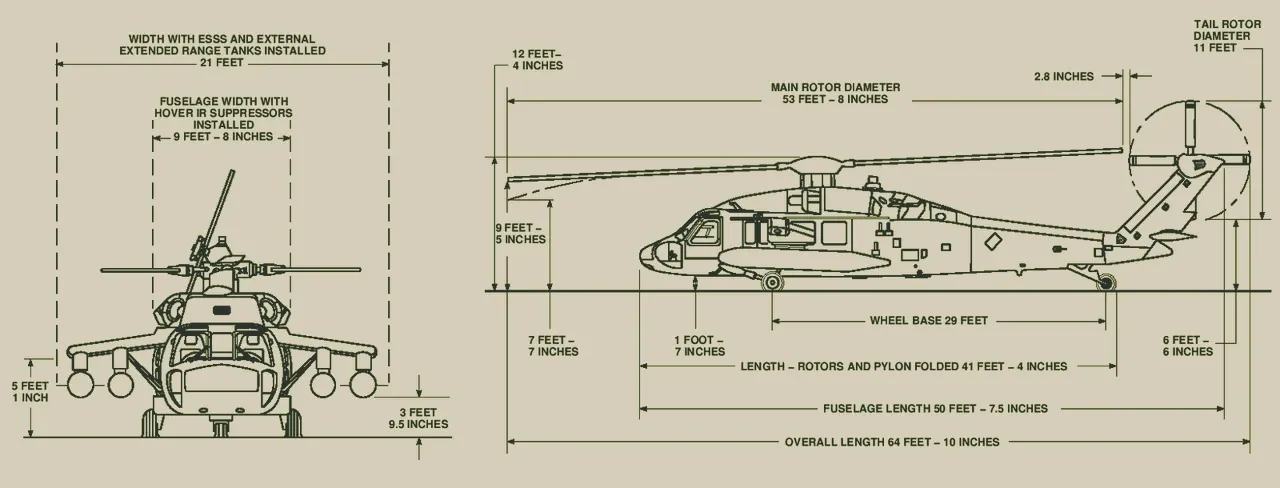
The UH-60M is a conventional helicopter with a four-blade articulated main rotor, a tail rotor canted to provide additional lift, and a rear-loading configuration for troops or cargo. The crew comprises two pilots and two crew chiefs/gunners. Inside, the cabin accommodates up to 11 fully equipped soldiers; alternatively, a cargo hook permits sling loads of up to approximately 4,080 kg. According to Lockheed Martin, the aircraft features an all-glass digital cockpit, improved avionics, and the upgraded T700-GE-701D engines that deliver better high/hot performance. Maximum speed is about 294 km/h, with a cruise speed near 280 km/h and a combat radius of around 480 km, extendable with external tanks.

For armed escort or light attack missions, the helicopter can be fitted with the External Stores Support System (ESSS) stub wings that carry AGM-114 Hellfire missiles, Hydra 70/APKWS rocket pods, and AIM-92 Stinger air-to-air missiles. Door-mounted weapons include M240 7.62 mm machine guns, M134 7.62 mm Miniguns, or GAU-19 .50-caliber Gatling guns. The UH-60M also incorporates crashworthy crew and passenger seats, self-sealing fuel tanks, and an integrated defensive aids suite with chaff/flare dispensers. These optional weapon fits and survivability upgrades are discussed in detail by The National Interest.

Variants

The Black Hawk family spans numerous subtypes tailored to specific roles. The principal Army-focused variants include:

  • UH-60A – original 1979 production aircraft.
  • UH-60L – upgraded engines (T700-GE-701C) introduced in the late 1980s.
  • UH-60M – current digital-cockpit standard with T700-GE-701D engines and improved airframe.
  • HH-60M – dedicated MEDEVAC variant with an advanced medical interior.
  • MH-60 Black Hawk – special operations derivatives with aerial refueling probes, additional sensors, and heavy armament, operated by the 160th Special Operations Aviation Regiment (Airborne).

Additionally, the SH-60/MH-60 Seahawk series of naval helicopters share the S-70 airframe but are treated as separate naval-specific platforms.

Combat record / operational use

The Black Hawk saw its first combat in the 1983 invasion of Grenada and has since been a fixture of U.S. and coalition operations: Panama (1989), the Gulf War (1991), the Balkans (1990s), Somalia (notably the 1993 Battle of Mogadishu), Afghanistan (2001-2021), and Iraq (2003-2011), as catalogued by Wikipedia. It has also been extensively deployed in humanitarian assistance and disaster relief missions worldwide. Export operators such as Israel, Taiwan, and Colombia have employed the Black Hawk for counterinsurgency, special operations, and high-altitude rescues. The type’s ability to operate from austere forward arming and refueling points, aboard ships, and in extreme climates has cemented its reputation as the Western benchmark for the medium utility class.

Advantages

  • Mature, combat-proven design continuously upgraded since 1979.
  • Versatile single-platform family: air assault, MEDEVAC, CSAR, special operations, cargo lift.
  • Carries 11 troops or slings up to ~4,080 kg, meeting the medium-lift sweet spot.
  • Optional ESSS wing weaponization turns a utility helicopter into a capable light gunship.
  • Global fleet exceeding 5,000 aircraft guarantees extensive logistical, training, and upgrade pipelines.
  • High commonality with naval Seahawk variants and strong allied interoperability.

Drawbacks / limitations

  • Inherently vulnerable to man-portable air-defense systems, small-arms fire, and shoulder-fired missiles in low-altitude flight, as underscored by losses in Mogadishu and subsequent conflicts.
  • Relatively slow top speed (~294 km/h) compared to emerging tiltrotor or compound-helicopter designs.
  • No integrated offensive sensor suite in baseline utility models; combat configurations require add-on turrets and external stores.
  • Maintenance-intensive rotor and drive-train systems demand considerable forward-base support.
  • Survivability upgrades against modern air-defense systems are continuous, as noted by The National Interest, but do not eliminate the platform’s inherent vulnerability in contested environments.

Counterparts

  • Mi-8 Hip (Russia) — the world’s most-produced medium twin-engine transport, with an armed gunship derivative.
  • Z-20 (China) — China’s indigenous 10-tonne class utility helicopter, fielded from 2019 and visibly influenced by the Black Hawk class.

Outlook

The UH-60M will remain the backbone of U.S. Army aviation into the 2040s pending the emergence of a Future Vertical Lift (FVL) medium rotorcraft. Ongoing modernizations under ITEP, improved mission equipment, and digital backbone upgrades aim to keep the type relevant against increasingly lethal short-range air defenses. Export demand persists, with additional orders from Central Europe, the Middle East, and Indo-Pacific allies. While a notional replacement may eventually arrive via the Future Long Range Assault Aircraft (FLRAA) tiltrotor and the FVL medium platform, the Black Hawk’s enormous installed base guarantees it will stay in frontline service for decades.

Key specifications

Spec Value
Crew 2 pilots + 2 crew chiefs/gunners
Length / wingspan 19.76 m (incl. rotor) / main rotor 16.36 m
Max speed ~294 km/h
Service ceiling ~5,790 m
Combat radius / range combat radius ~480 km / range ~590 km
Payload up to 11 troops; sling load up to ~4,080 kg
Hardpoints 2 ESSS stub wings (optional) for weapons/fuel tanks
Radar / sensors integrated digital cockpit; optional FLIR/EO turret
Powerplant 2 × GE T700-GE-701D turboshaft
Armament optional door-mounted M240/M134/GAU-19; ESSS-compatible Hellfire, rockets, Stinger

Sources

  1. Lockheed Martin — "Sikorsky UH-60M Black Hawk Helicopter" — https://www.lockheedmartin.com/en-us/products/sikorsky-uh-60m-black-hawk-helicopter.html
  2. Lockheed Martin Australia — "UH-60M Black Hawk" — https://www.lockheedmartin.com/en-au/black-hawk-australia.html
  3. The National Interest — "Why Does the US Army Want to Overhaul Its Black Hawks?" — https://nationalinterest.org/blog/buzz/why-does-us-army-want-to-overhaul-black-hawk-helicopters-hk-030326
  4. WION — "How much does a US Black Hawk helicopter really cost?" — https://www.wionews.com/photos/-multi-million-dollar-war-machine-how-much-does-a-us-black-hawk-helicopter-really-cost-1775461201481
  5. Wikipedia — "Sikorsky UH-60 Black Hawk" — https://en.wikipedia.org/wiki/Sikorsky_UH-60_Black_Hawk
FIELD DISPATCH · WEEKLY

BattlePolicy Weekly — free.

Defense tech, startups, and security — weekly. No paywall.

Related
Ukraine · USA · Funding · Swarmer · drones · defense tech · venture capital · Pentagon

Ukraine turned its drone war into an industry. Now Wall Street is pricing it.

Swarmer's Nasdaq debut, a wave of Western venture money and a Pentagon FPV contract show Ukrainian defense tech crossing from battlefield to balance sheet, at a valuation that has outrun the revenue.

Ukraine · USA · Funding · Swarmer · drones · defense tech · venture capital · Pentagon
USA · Autonomy · Shifters · Ace Capital Partners

Shifters raises $10.2M to put robots first into tunnels and rubble

The US-Israeli startup raised a $10.2 million seed led by Ace Capital Partners to scale ground robots that enter tunnels and rubble before troops.

USA · Autonomy · Shifters · Ace Capital Partners
USA · Policy · AI · Anthropic · autonomous weapons · Pentagon

Trump orders faster military AI and bars vendors from switching off fielded models

A new national security memo tells the Pentagon to onboard frontier commercial AI at speed, strips vendors of the power to shut it down mid-mission, and resets the rules for autonomous weapons within 90 days.

USA · Policy · AI · Anthropic · autonomous weapons · Pentagon