Ukraine's $111 million Logistics Lockdown has cut every road into Crimea
Drone strikes closed all three road corridors between occupied Crimea and the mainland in four days. Military cargo traffic on Russia's main supply highway is down 71 percent by Kyiv's count, and Sevastopol is rationing gasoline by QR code.
Drone strikes closed all three road corridors between occupied Crimea and the mainland in four days. Military cargo traffic on Russia's main supply highway is down 71 percent by Kyiv's count, and Sevastopol is rationing gasoline by QR code.
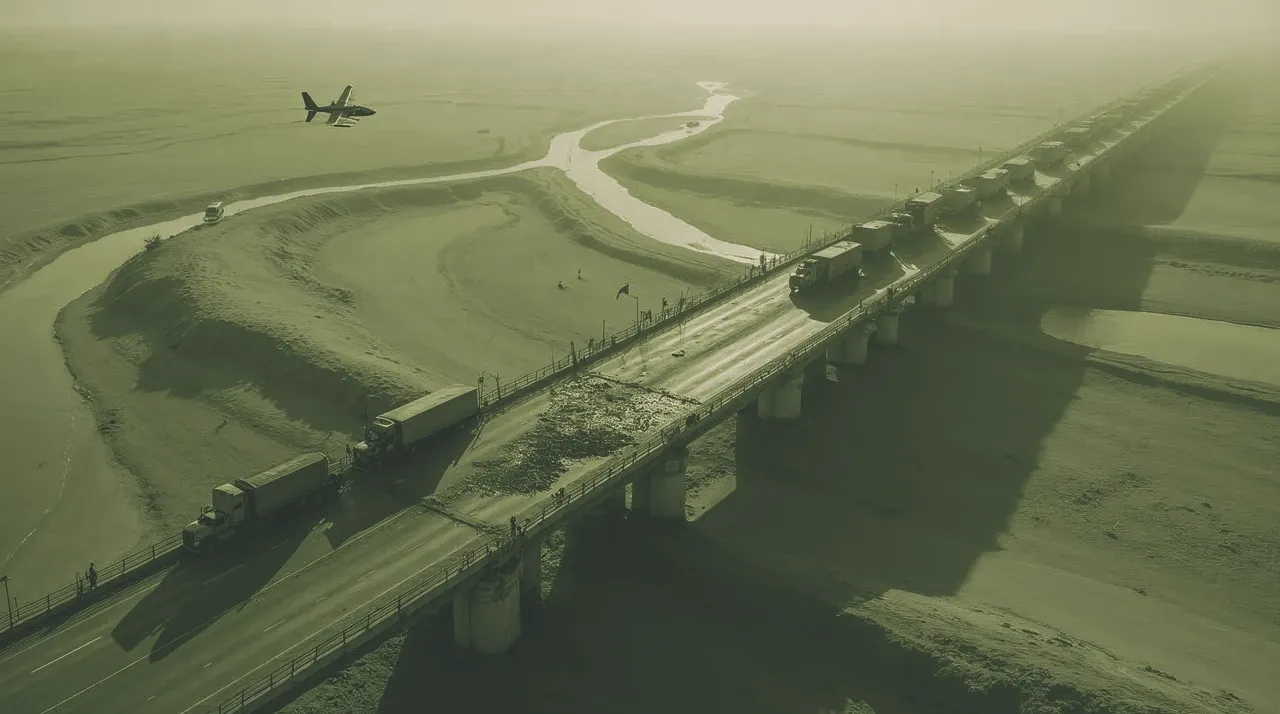
Ukrainian drones damaged four bridges around Armiansk overnight into June 11, the third set of Crimean crossings struck in four days. "It appears there are no intact bridges left at the land entrances to the peninsula," Russian monitoring channels wrote that morning, per Kyiv Post. Every road corridor linking occupied Crimea to the occupied mainland is now closed or under repeated strike. The weapon behind the closures is a class of mid-range strike drones that Defense Minister Mykhailo Fedorov began funding on May 27 under a UAH 5 billion ($111 million) program he named Logistics Lockdown. Ukraine has hit these crossings before with missiles and sabotage, and Russia repaired them within months. What is different sixteen days into Fedorov's program is that the strikes no longer stop, and the aircraft doing the work cost less than the trucks they destroy.
Three corridors, four days
The closures came in sequence. Ukrainian drones struck the Chonhar bridge, the main road link between occupied Kherson region and Crimea, on June 7 and again on June 9, closing it both times, according to Euromaidan Press. On June 10, a strike halted traffic on the bridge connecting Henichesk to the Arabat Spit, the alternative eastern corridor, per Vladimir Saldo, the Russian-installed head of occupied Kherson region. That left the western route through Armiansk and Perekop, where the drones went next. Overnight into June 11, Saldo acknowledged damage to four spans at once: the Perekop-Armiansk road bridge, a bridge near Stavky, and two crossings over the North Crimean Canal near Myrne and Preobrazhenka.
Saldo counted at least 45 separate drone attacks on the Armiansk bridges alone, Business Insider noted. The same night, Ukraine confirmed a strike that destroyed about 50 military cargo vehicles loaded with fuel and ammunition massed at the Armiansk crossing, Euronews reported. The trucks had bunched up there in part because the other crossings were already shut. The operations paired the 1st Separate Assault Regiment with the 475th Assault Regiment and the Security Service of Ukraine's Alpha unit, per the units' own releases. Their footage shows the technique: drones flown into the same section of bridge deck again and again until the roadway fails, then re-struck when repair crews appear.
The $111 million program doing the cutting
Logistics Lockdown formalized what Kyiv calls the middle strike campaign, aimed at targets 20 to 200 kilometers behind the line. President Volodymyr Zelensky said on May 5 that such strikes had doubled since March and quadrupled since February. Fedorov put a budget behind the trend on May 27: "Our task now, as directed by the president, is to maximise the middle strike and, in coordination with the military, create a complete logistics lockdown for the enemy." The money flows through the military's e-points system, which pays units per verified strike, so funding concentrates on whoever is actually closing roads. Ukrainian defense outlet Oboronka counts at least 27 formations flying these missions at ranges up to 300 kilometers.
The aircraft are a distinct class, sitting between $500 FPV quadcopters and the long-range one-way aircraft Ukraine sends at refineries. The 1st Separate Assault Regiment said it used the FirePoint FP-2, an 18-foot-wingspan drone carrying a 220-pound warhead, and the smaller Hippo, which pairs a 77-pound thermobaric charge with 88 pounds of explosive. US-made Hornet drones, built by Swift Beat, the company former Google chief executive Eric Schmidt founded, patrol the supply roads almost continuously with AI-assisted targeting, The Guardian wrote; the Council on Foreign Relations puts the Hornet's cost under $10,000. A new Ukrainian fixed-wing drone called Morrigan launches from a slingshot or rail, with no runway needed. Bloomberg analysis of Ukrainian Defense Ministry data, published by The Japan Times, shows what the upgrades bought. Strikes on Russian tanker trucks rose 40 percent in May. The number of air-defense launchers destroyed more than doubled. The latest models resist jamming and find targets autonomously up to 150 kilometers out.
Gasoline by QR code
Robert Brovdi, commander of Ukraine's Unmanned Systems Forces, said military cargo traffic on the R-280 "Novorossiya" highway, Moscow's main land corridor to Crimea, fell 71 percent in two weeks. "Within another month, we will have total control over the road," he told reporters, per Euronews. The highway has been largely closed to civilian traffic since late May, The Guardian noted, and Ukrainian troops have taken to calling it the highway of death.
The battlefield and the startup story — free in your inbox every week. No paywall.
Subscribe Free →Inside Crimea, occupation authorities in Sevastopol began issuing gasoline by QR code on June 6 and cut the ration from 20 liters per day to 20 per week. Fuel tankers failed to reach the city entirely on June 10, governor Mikhail Razvozhaev acknowledged. Kyiv Post, citing estimates by the independent Russian outlet 7x7, listed AI-92 gasoline at 82 rubles per liter in Crimea against 69 in Moscow. Resellers were asking 130 to 150 rubles. The same estimates count fuel shortages across 25 Russian regions, or 31 counting the occupied territories. Kremlin spokesman Dmitry Peskov conceded "certain problems" with supply when asked whether Crimea could be cut off, NBC News reported.
Ukraine is also striking the refineries that produce the fuel. The Afipsky refinery near Krasnodar, a 6.25-million-ton-per-year plant that finished a $2.6 billion modernization in 2025, burned on June 11 after its third drone strike this year, per Kyiv Post. Bloomberg counts 38 attacks on Russian refineries from January through May, 16 in May alone, the highest monthly figure of the war. OilX data shows Russian refinery utilization down 14 percent since January and roughly 20 percent below pre-war levels.
Interdiction at drone prices
The campaign's economics favor the attacker. The OSINT analyst Visioner, cited by Kyiv Post, describes the goal as sustained "fire control": not dropping a bridge once but striking it whenever repairs near completion, so the crossing never returns to service. At Hornet prices, that posture costs less per sortie than the trucks it destroys. Business Insider observed that Ukraine used to need HIMARS rockets or sabotage teams to damage these same bridges; both were scarce, and both gave Russia recovery windows measured in months.
Ukraine can keep buying the campaign, too. The Council on Foreign Relations estimates Ukraine produced about 4 million robotic and autonomous systems in 2025 and is on track for 5 to 6 million this year. Deputy Defense Minister Mstislav Banik said on June 4 the industry could reach 20 million drones annually with sufficient funding, and some of that capital is arriving: the EU's planned €90 billion loan earmarks €6 billion for drones, disbursable as early as late June, per Reuters. The Pentagon's drone dominance initiative, by comparison, has shipped fewer than 3,000 of the 22,320 systems it ordered, according to CFR. Mykola Bielieskov of Ukraine's National Institute for Strategic Studies told NBC News what the spending is for: "The ultimate goal is to create the basis for larger-scale counterattacks."
Russia's answer so far is a pontoon
Moscow's countermeasures are stopgaps. After Chonhar was hit twice, Russian forces assembled a pontoon crossing beside the damaged span, per Militarnyi. Saldo restricted civilian truck movement on the R-280 on May 21 and says mobile fire teams now patrol the route. One prominent Russian military blogger proposed draping anti-drone netting over the entire 390-mile highway. A United24 Media investigation found supply trucks repainted to pass as civilian vehicles. Saldo himself compared the strikes to the siege of Leningrad.
Analysts doubt any of it scales. "Attacking that highway creates a problem for the Russians, which they really don't have a solution for," Emil Kastehelmi of Finland's Black Bird Group told NBC News; protecting it would mean massing air defense across a wide, deep area that Moscow would have to strip from somewhere else. The Institute for the Study of War assesses the strikes are "already achieving notable operational effects" against the highway and supply lines around Donetsk City. "It amounts to a humiliating picture for the Russians," Bob Tollast of the Royal United Services Institute said, noting Crimea has served as Russia's staging area for operations in Ukraine since 2014. Kastehelmi told NBC News the war has been "a constant cycle of adaptation" and that Russia will likely find an answer eventually. "I think that it will get worse for the Russians before it gets better," he added.
What to watch
- Convoy traffic on the R-280. Brovdi said Ukraine will have total control of the road within a month, which makes his claim checkable against ISW's daily assessments by mid-July.
- The shift to rail, sea, and the Kerch bridge. Closed roads will push Russian cargo onto trains, ferries, and a span that Ukraine attacked in 2022, 2023 and 2025, and Ukrainian naval drones have already struck ships at Novorossiysk, per CFR.
- The repair cycle at Chonhar. The bridge closed twice in three days and the pontoon beside it is also in range, so the interval between each reopening and the next strike will show whether Ukrainian fire control actually holds.
- The EU's €6 billion drone tranche, disbursable from late June per Reuters, which would carry the production base behind the campaign into 2027.
- Russian counter-drone adaptation. Netting, interceptor drones and escort teams blunted FPV losses at the front, but none of those measures has been demonstrated across a 390-mile highway while Sevastopol's fuel ration sits at 20 liters per week.
Frequently Asked Questions
What is Ukraine's Logistics Lockdown program?
A UAH 5 billion ($111 million) Defense Ministry program announced by Mykhailo Fedorov on May 27, 2026, funding mid-range "middle strike" drones against Russian supply routes 20 to 200 kilometers behind the front line, with money routed to the most effective units via the military's e-points system, per The Guardian and Kyiv Post.
Which bridges into Crimea have been hit?
The Chonhar bridge (struck June 7 and 9), the Henichesk to Arabat Spit bridge (June 10), and four spans around Armiansk and the North Crimean Canal in one night on June 11, according to Russian-installed officials cited by Euromaidan Press and United24 Media. Russian monitoring channels said no intact bridges remained at Crimea's land entrances.
What drones is Ukraine using for the campaign?
The FirePoint FP-2 (18-foot wingspan, 220-pound warhead) and thermobaric Hippo, per the 1st Separate Assault Regiment via Business Insider; the sub-$10,000 US-made Hornet from Eric Schmidt's Swift Beat with AI-assisted targeting, per The Guardian and CFR; and the rail-launched Morrigan fixed-wing drone.
How bad is the fuel crisis in Crimea?
Sevastopol issues gasoline by QR code at 20 liters per week, down from 20 per day; tankers failed to reach the city on June 10, per Euronews. Kyiv Post, citing the outlet 7x7, reported pump prices about 19 percent above Moscow's, with resellers charging roughly double official rates.
Is the Kerch Bridge cut as well?
No. The campaign targets the land corridor through occupied southern Ukraine, which Russia built up precisely because the Kerch Bridge is exposed; the span has been attacked in 2022, 2023 and 2025, per Euronews. Cutting the roads concentrates Russian supply on that single vulnerable link plus sea and rail routes.
AI-generated summary, reviewed by an editor. More on our AI guidelines.

Marcus Schuler
Marcus Schuler edits BattlePolicy, a daily defense-technology brief connecting the companies and capabilities behind modern war to the contest among Europe, the US, Russia, and China.