GRID-REF 37°47′N 122°25′W
DISPATCH 02/26 · 9 Jun 2026
BATTLEPOLICY
Startup to front line. Strategy to consequence.
Lexicon · China

VT-4

China's leading export main battle tank — a 52-tonne, 125 mm smoothbore platform with a hard-kill active protection system, tailored for foreign buyers but never adopted by the PLA.
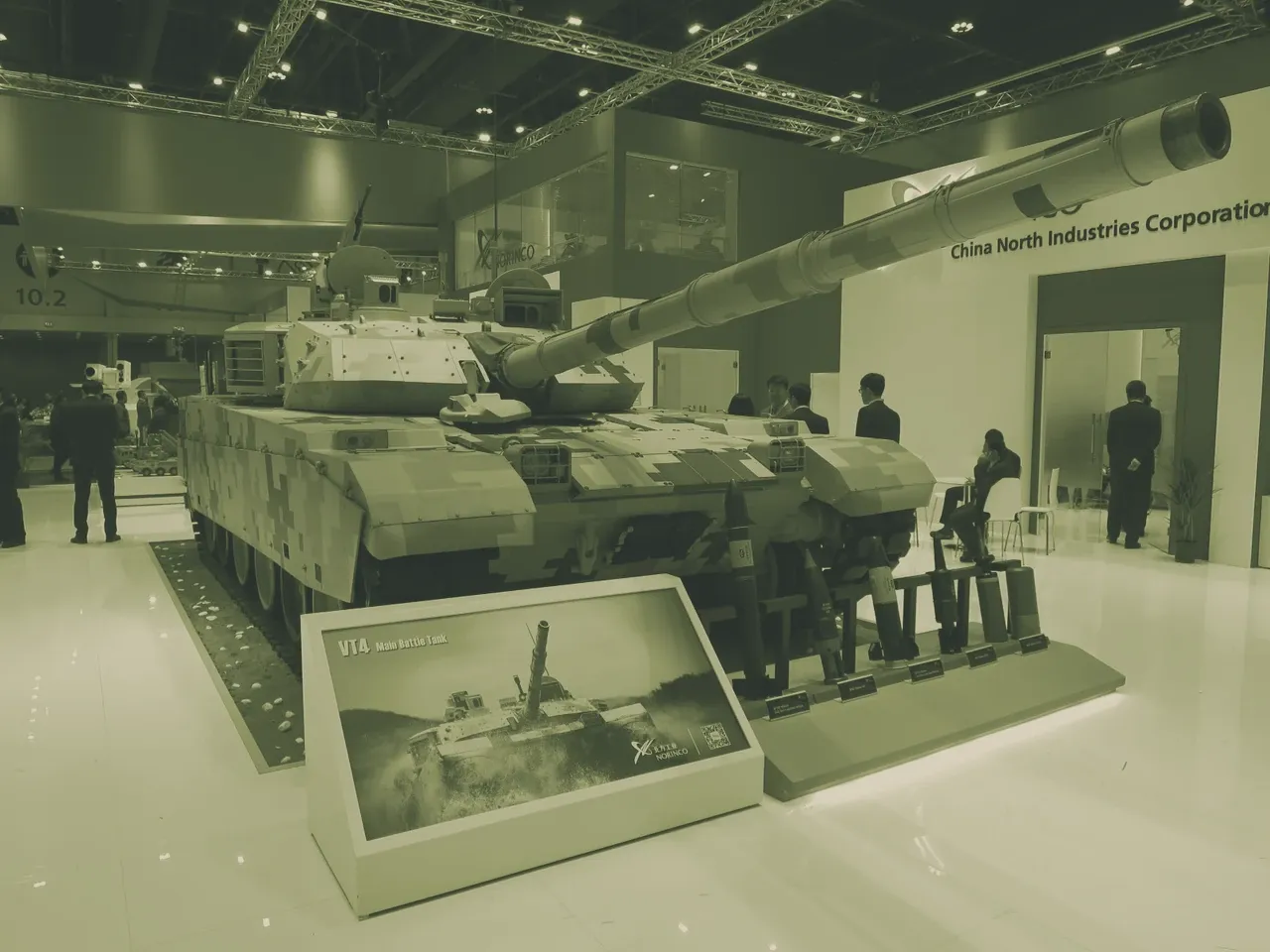
VT-4
FIG.01 · China Image - VT-4. Photo by Mztourist, CC BY-SA 4.0, via Wikimedia Commons.
China's premier export main battle tank, the NORINCO VT-4 — a 52-tonne, 125 mm smoothbore design with a hard-kill active protection system, customised for operators on three continents, yet never fielded by the PLA itself.

Overview

The VT-4 — originally designated MBT-3000 — is a third-generation main battle tank developed by China North Industries Corporation (NORINCO) exclusively for export. Unlike the PLA’s in-house Type 99A and Type 96B, the VT-4 carries no domestic “Type” or “ZTZ” number; it is not in service with the People’s Liberation Army. Three confirmed export operators — Thailand, Pakistan and Nigeria — field the tank, making it the most advanced Chinese-origin MBT available on the international market. The design matches a 125 mm autoloader-fed main gun, composite armour and an integrated GL-5 hard-kill active protection system to the mobility of a locally produced 1,200 hp powertrain.

Development

NORINCO first showed a scaled model of the MBT-3000 at Eurosatory 2012; the upgraded VT-4 was publicly unveiled at the 2014 Zhuhai Airshow, where it was marketed as a successor to the earlier MBT-2000 / VT-1 line, according to Army Technology. The tank was tailored to the requirements of export customers who wanted NATO-standard ergonomics, a loader-less three-man crew, air conditioning and a digital battlefield management system absent from baseline Chinese domestic designs.

Thailand became the launch customer, signing a first contract for 28 vehicles in 2016 that totalled approximately US$147 million — giving a per-unit floor of about US$5.25 million with initial support. Deliveries began in October 2017 and the Royal Thai Army subsequently ordered two further batches of 10 and 14 tanks in 2017 and 2019, the latter valued at roughly 2.3 billion baht (≈US$75.9 million) Defense News. Pakistan selected the VT-4 in 2019, receiving the first two examples in April 2020 and reportedly building a fleet of more than 40; Nigeria acquired a small quantity — around six — from 2019 onward.

Design & capabilities

The VT-4 uses a classic three-man crew layout with a bustle-mounted carousel autoloader that feeds a 125 mm smoothbore gun, a derivative of the ZPT-98 family and broadly patterned after the Russian 2A46M. The autoloader holds 22 ready rounds, with a total load of about 38, and the gun can fire APFSDS, HEAT, HE-frag and a laser-beam-riding anti-tank guided missile through the tube out to approximately 5 km. A remotely controlled weapon station carrying a 12.7 mm heavy machine-gun and a coaxial 7.62 mm weapon complete the armament set US Army Worldwide Equipment Guide.

Protection layers combine all-welded steel hull and turret with composite modules on the frontal arc, wedge-shaped turret appliqué armour and optional explosive reactive armour blocks. The defining feature of the VT-4’s survivability suite is the GL-5 hard-kill active protection system, a roof-mounted set of four fire-control radars that detect incoming threats at roughly 100 m and launch paired interceptor rockets to defeat them. Laser warning receivers, smoke dischargers and an NBC over-pressure system reinforce the defensive fit Military Factory.

Motive power comes from a NORINCO-developed turbo-diesel engine developing 1,200 hp (some sources cite up to 1,300 hp), coupled to a Ch1000B automatic transmission with hydro-mechanical drive and torsion-bar suspension. The combination yields a power-to-weight ratio of roughly 23 hp/t, a governed road speed of 70 km/h and an operational range on internal fuel of around 500 km.

Variants

  • VT-4 baseline (MBT-3000): The production vehicle fielded by Thailand, Pakistan and Nigeria with the GL-5 APS, laser warning and 1,200 hp powerpack.
  • VT-4A1: An upgraded sub-variant exhibited by NORINCO that adds a GL-6-class hard-kill APS, a dedicated counter-drone jammer and a tethered micro-drone for organic surveillance. No export orders have been confirmed for the A1 configuration.
  • Predecessor line: The VT-4 succeeds the MBT-2000 / VT-1, a T-72-derived design that used a Ukrainian 6TD-2 diesel and spawned Pakistan’s co-produced Al-Khalid (∼320 fielded). The VT-4 is a distinct, more advanced platform, not a simple evolution of the Al-Khalid.

Combat record / operational use

The VT-4 has yet to see high-intensity combat. Thailand has conducted extensive field trials and unit-level training with its fleet since late 2018, focusing on the tropical operating environment of the Royal Thai Army’s heavy brigades, as detailed by Asian Military Review. Pakistan’s introduction of the type into its armoured corps represents the largest single VT-4 user, but the vehicles have not been committed to operations beyond border-area security posturing. Nigeria’s small batch has been employed in a counter-insurgency and presence role, although without the large-scale armoured clashes that would validate the tank’s fire-control and protection suite under duress. Because no PLA unit operates the VT-4, battlefield feedback cannot be drawn from Chinese service experience.

Advantages

  • Early-generation hard-kill APS integrated at a moderate price point, a feature absent from many competing export tanks.
  • 125 mm gun-launched anti-tank guided missile gives a reach advantage (∼5 km) against armour and low-flying helicopters.
  • Weight of ∼52 t keeps the tank more deployable than heavy Western MBTs (60–70 t) while still carrying a full protection package.
  • Air-conditioned, ergonomic turret compatible with customer-demanded subsystems not found in baseline PLA tanks.
  • Competitive unit cost — roughly US$4–5 million with initial spares and support — significantly undercuts main-stream Western MBT export prices.

Drawbacks / limitations

  • No validated combat record; the GL-5 APS and overall survivability have not been tested in a peer-conflict environment.
  • Dependence on NORINCO for ammunition and complex electronic sub-systems can create logistical bottlenecks for operators accustomed to NATO or Russian supply chains.
  • Autoloader carousel sits in the crew compartment, a design feature that in the Russia-Ukraine war has shown severe survivability consequences for analogous Russian tanks.
  • Absence from PLA service means the manufacturer cannot rapidly iterate from institutional combat experience; upgrades rely on export-user feedback and simulated data.
  • The VT-4’s powertrain, though modern, has not been publicly stress-tested across large fleet operations over years; long-term reliability data remain sparse.

Counterparts

Outlook

The VT-4 is the most sophisticated Chinese-origin MBT actively marketed abroad, and its presence in three operators — especially Pakistan’s large order — secures a production line that NORINCO can sustain for years. Further sales are possible in Africa and Southeast Asia as budgets and doctrine align with the tank’s balance of cost and capability. However, the tank’s long-term trajectory is constrained by its lack of PLA adoption, the uncertain reputation of Chinese active-protection systems under fire, and the global shift toward a heavier, APS-ubiquitous tank standard that the baseline VT-4 does not fully meet. The VT-4A1 upgrade package signals NORINCO’s intent to close that gap, but no customer has yet committed to it.

Key specifications

Spec Value
Crew 3 (autoloader)
Combat weight ~52 t
Length / width / height ~10.1 m (est.) / ~3.4 m (est.) / ~2.4 m (est.)
Main armament 125 mm smoothbore (ZPT-98A family) with autoloader; APFSDS, HEAT, HE-frag, gun-launched ATGM
Secondary armament 1× 12.7 mm remote weapon station; 1× 7.62 mm coaxial machine gun
Armor & protection Welded steel hull & turret with composite armour, optional ERA; GL-5 hard-kill APS, laser warning, smoke, NBC
Engine & power NORINCO turbo-diesel, ~1,200 hp (895 kW)
Power-to-weight ~23 hp/t
Road / cross-country speed 70 km/h (road) / ~50 km/h (cross-country)
Operational range ~500 km (road)

Sources

  1. Army Technology — VT4 (MBT-3000) Main Battle Tank https://www.army-technology.com/projects/vt4-mbt-3000-main-battle-tank/
  2. US Army Worldwide Equipment Guide (ODIN) — VT4 (MBT-3000) https://odin.t2com.army.mil/WEG/Asset/54ecb36b485994e33784d87bd153415b
  3. Military Factory — NORINCO VT-4 (MBT-3000) https://www.militaryfactory.com/armor/detail.php?armor_id=624
  4. Asian Military Review — Chinese armour boosts Royal Thai Army firepower https://www.asianmilitaryreview.com/2017/12/chinese-armour-boosts-royal-thai-army-firepower/
  5. Defense News — Thailand to buy more Chinese tanks, reportedly for $58M https://www.defensenews.com/land/2017/04/04/thailand-to-buy-more-chinese-tanks-reportedly-for-58m/
  6. Military Watch Magazine — How Capable Are Pakistan’s New VT-4 Battle Tanks? https://militarywatchmagazine.com/article/how-capable-are-pakistan-s-new-vt-4-battle-tanks-why-new-chinese-supplied-armour-could-be-a-game-changer
FIELD DISPATCH · WEEKLY

BattlePolicy Weekly — free.

Defense tech, startups, and security — weekly. No paywall.

Related
China · Air Defense · taiwan · interceptors · patriot

China is building air-defense mass opposite Taiwan while America spends its own

Beijing fielded the HQ-16F, a Patriot-class mobile air-defense missile, opposite Taiwan in the same weeks the US burned through the interceptors it would need to defend the island. The contest is magazine depth, not exquisite platforms.

China · Air Defense · taiwan · interceptors · patriot
China · Land · grenade-launcher · precision · sniper · 35mm · 40mm · norinco

QLU-11

China's semi-automatic precision grenade launcher, fielded in 35mm for the PLA and 40mm for export — delivering airburst rounds through a window at 600 m.

China · Land · grenade-launcher · precision · sniper · 35mm · 40mm · norinco