WZ-7 Soaring Dragon
China's tandem-wing HALE ISR UAV — a high-altitude strategic reconnaissance platform frequently compared to the RQ-4 Global Hawk, in PLAAF and naval service since 2018.
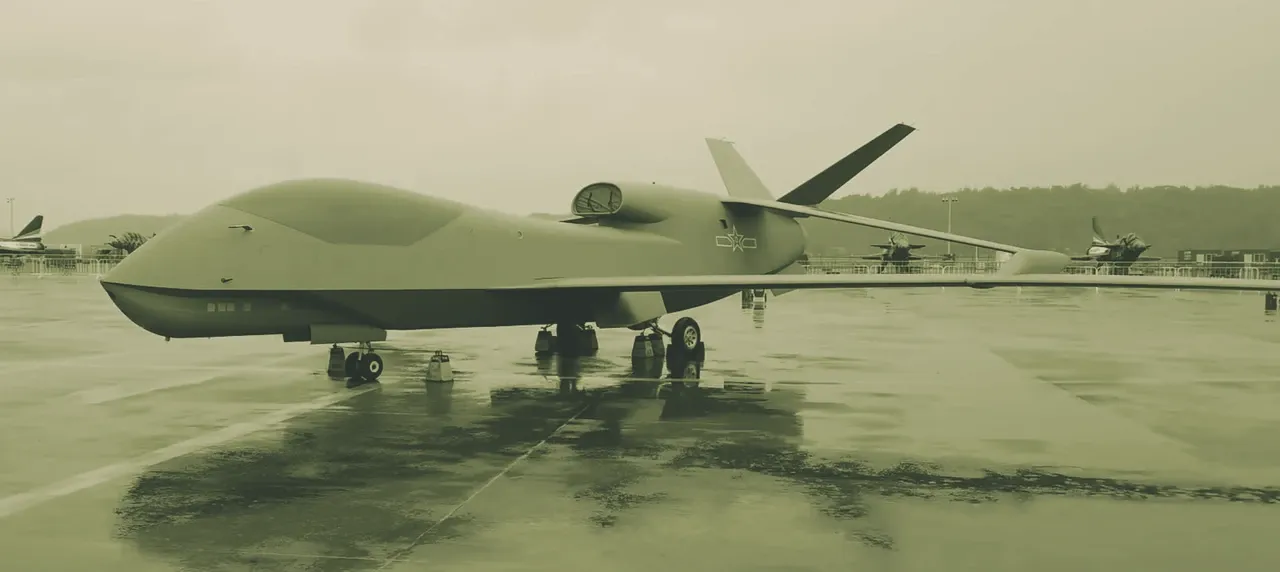
China's high-altitude long-endurance strategic reconnaissance unmanned aerial vehicle — a tandem joined-wing design in service with the PLAAF since 2018, and a naval variant for maritime surveillance since 2023.
Overview
The WZ-7 Soaring Dragon (Xianglong) is an unarmed high-altitude long-endurance (HALE) intelligence, surveillance, and reconnaissance (ISR) unmanned aerial vehicle (UAV) designed by Chengdu Aircraft Design Institute and manufactured by Guizhou Aircraft under AVIC. Its distinctive tandem joined-wing configuration and single-turbojet engine set it apart from most reconnaissance drones. The WZ-7 entered People’s Liberation Army Air Force (PLAAF) service in 2018, and a naval variant for the PLA Navy Air Force (PLANAF) was unveiled in 2023. Estimated total fleet strength stands at around 20 airframes, evenly split between the two services.
Development
The WZ-7 program emerged in the late 2000s, with first flight achieved in 2013, as recorded by Wikipedia. The design was led by Chengdu ADI, which conceived the joined-wing layout to combine high-speed, high-altitude performance with good endurance. Guizhou Aircraft, an AVIC subsidiary, handled series production. The PLAAF accepted the system into service in 2018. In March 2023, a naval derivative was publicly revealed, adapted for maritime wide-area surveillance and over-the-horizon targeting, according to Naval News.
Design & capabilities
The WZ-7 is built around a central fuselage with forward canards, a swept main wing, and a rear tailplane that connects to the main wingtips to form a rigid diamond-like joined-wing structure. Power is provided by a single unidentified turbojet, enabling a cruise speed of roughly 750 km/h. The airframe has a length of about 14.3 m, a wingspan of approximately 24.9–25 m, and a maximum take-off weight of around 7,500 kg — figures consolidated by GlobalMilitary.net.
The payload of approximately 650 kg comprises an electro-optical/infrared turret, a synthetic-aperture radar (SAR) for ground and maritime moving-target indication, and signals-intelligence (SIGINT) receivers. The drone carries no weapons. Controllable via line-of-sight and satellite datalinks, the WZ-7 can be flown in pre-programmed autonomous mode or supervised by ground operators. Its endurance is commonly cited as around 10 hours at cruise altitude, though some analysts suggest the design could extend that figure. The operational ceiling is approximately 18,000 m, placing it in a band difficult for most fighter aircraft to engage.
Variants
- PLAAF land-based WZ-7: the baseline high-altitude strategic reconnaissance configuration, primarily employed for broad-area surveillance around China’s periphery.
- PLANAF naval variant: unveiled in 2023 and tailored for maritime ISR and long-range anti-ship targeting cueing, as reported by Naval News. It likely incorporates enhanced SAR modes and dedicated ELINT sensors for naval tasking.
Combat record / operational use
The WZ-7 has no combat record. Its operational significance lies in persistent peacetime strategic reconnaissance along contested maritime boundaries. The drone makes routine ISR orbits over the East and South China Seas, and frequently monitors Taiwan’s air and sea approaches. In March 2024, the WZ-7 conducted its first known flight over the Sea of Japan, an operation that underscored its reach and the PLA’s expanding intelligence-collection envelope. In a maritime configuration, the system also provides the PLAN with over-the-horizon radar imagery for anti-ship cruise-missile targeting.
Advantages
- High-altitude persistence at ~18,000 m enables safe stand-off surveillance above most tactical air defenses.
- Long range (~7,000 km ferry) and satellite connectivity allow sorties far from home bases.
- Unarmed design simplifies peacetime overflight rules and reduces political risk of shoot-down.
- Dual-service utility across PLAAF and PLANAF offers cost-sharing and doctrinal flexibility.
- Advanced sensor suite — EO/IR, SAR, SIGINT — provides multi-intelligence coverage without an additional crewed aircraft.
Drawbacks / limitations
- Unarmed – cannot respond to interceptor threats; survival in contested airspace depends entirely on stand-off distance.
- Endurance (~10 h) is a fraction of a Global Hawk’s (>30 h), constraining area persistence.
- Small fleet (~20 airframes) limits the number of concurrent operational orbits.
- No combat record leaves real-world survivability and sensor performance under electronic attack unproven.
Counterparts
- RQ-4 Global Hawk (USA)
- Orlan-10 (Russia)
While the Global Hawk is the closest analog in class and mission, the Orlan-10 illustrates how even tactical-level ISR drones can be crucial tools — albeit at a totally different scale and price point.
Outlook
The WZ-7 is likely to grow in numbers and capability as the PLA continues to invest in long-range ISR to support anti-access/area-denial strategy. Sensor upgrades, integration with the J-20 and naval strike networks, and possible export offerings (though none have been reported) are plausible near-term developments. Its peacetime operational tempo is expected to rise in step with China’s expanding maritime claims.
Key specifications
| Spec | Value |
|---|---|
| Type | Single-turbojet HALE ISR UAV |
| Endurance | ~10 h (est.; may be longer) |
| Range | ~7,000 km ferry; ~2,000 km combat |
| Cruise / max speed | ~750 km/h (cruise); max not publicly established |
| Payload | ~650 kg (EO/IR + SAR + SIGINT); no weapons |
| Datalink / control | LOS + SATCOM |
| Autonomy level | Pre-programmed / supervised HALE |
| Dimensions / MTOW | Length ~14.3 m · wingspan ~24.9–25 m · MTOW ~7,500 kg |
| Launch & recovery | Runway |
Sources
- Guizhou WZ-7 Soaring Dragon — Wikipedia — https://en.wikipedia.org/wiki/Guizhou_WZ-7_Soaring_Dragon
- WZ-7 Soaring Dragon: Specs & Operators — GlobalMilitary.net — https://www.globalmilitary.net/aircraft/wz-7-soaring-dragon/
- China Unveils Naval Variant of WZ-7 Recon Drone — Naval News — https://www.navalnews.com/naval-news/2023/03/china-unveils-naval-variant-of-wz-7-recon-drone/
- First Known Chinese WZ-7 High-Altitude Drone Flight Over Sea of Japan — The War Zone — https://www.twz.com/air/first-known-chinese-wz-7-high-altitude-drone-flight-over-sea-of-japan
- WZ-7 — Mitchell Institute — https://www.mitchellaerospacepower.org/weapons/wz-7/