GRID-REF 37°47′N 122°25′W
DISPATCH 02/26 · 9 Jun 2026
BATTLEPOLICY
Startup to front line. Strategy to consequence.
Lexicon · China

Yaogan series

China's expansive military ISR satellite constellation combining optical, radar, and signals intelligence with a NOSS-style naval-surveillance arm to form the space backbone of the PLA's anti-ship missile kill chain.
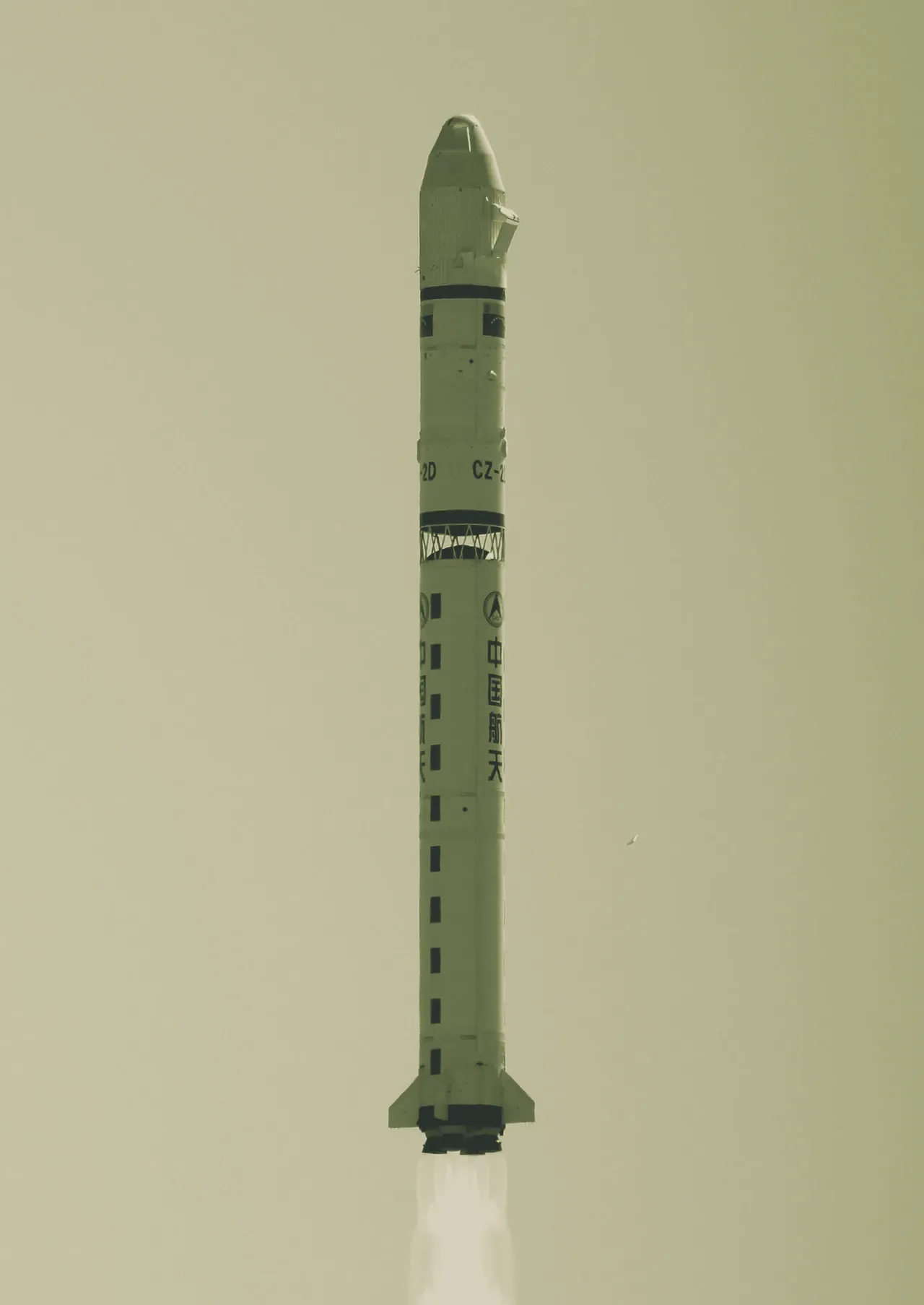
Yaogan series
FIG.01 · China Image - A Long March rocket launching a Yaogan satellite. Photo by Cristóbal Alvarado Minic, CC BY 2.0, via Wikimedia Commons.
China's expansive military ISR satellite constellation — optical, SAR, and ELINT triplets that form the space backbone of the PLA's anti-ship missile kill chain across the Western Pacific.

Overview

The Yaogan series is the People’s Liberation Army’s principal space-based intelligence, surveillance, and reconnaissance (ISR) system, blending electro-optical (EO) imaging, synthetic-aperture radar (SAR), and signals-intelligence payloads into one proliferated low-Earth-orbit constellation. Its most distinctive element is a set of co-orbiting ELINT triplets that mirror the US Naval Ocean Surveillance System (NOSS), designed to detect, identify, and geolocate surface vessels by their radio-frequency emissions. Open-source orbit trackers catalogue approximately 179 active Yaogan satellites as of late 2025, according to satellitemap.space, and the broader Chinese ISR architecture — which includes dedicated military comsats and experimental platforms — has grown to over 510 satellites per the US Department of Defense, making it the fastest-expanding reconnaissance fleet in the world.

Development

The program’s first satellite, Yaogan-1, lifted off on 26 April 2006, and the constellation has since grown through a sustained launch cadence that has logged 149 successful missions with a single failure by 2026, documented in the Wikipedia compilation of public Chinese space data. The early years saw a mix of optical and SAR satellites, while the naval-surveillance arm debuted in March 2010 with the first JB-8/Yaogan-9 series triplet. Through the 2010s and early 2020s, CASC-built spacecraft — assembled at the China Academy of Space Technology (CAST) and the Shanghai Academy of Spaceflight Technology (SAST) — filled out the Jianbing (“JB”) family, from the JB-5/-6 optical mappers to the JB-7/-10 SAR platforms. The most recent publicly noted launch, Yaogan-50-01 in January 2026, was highlighted by the U.S. Space Force as evidence of the constellation’s relentless expansion.

Design & capabilities

The Yaogan series is built around three complementary sensor types. EO satellites, likely descended from the Jianbing-6 and Jianbing-9 lines, are thought to deliver imagery at resolutions of about 1 m or better, a capability described by the Manohar Parrikar IDSA in its assessment of China’s space-based surveillance. The SAR family (Jianbing-7/-10/-12) supplies all-weather, day/night coverage independent of cloud and darkness. The naval-surveillance triplets, designated Jianbing-8 and often referred to as the Yaogan-30 series, operate in three orbital planes inclined at roughly 63° and employ formation-flying sub-satellites that measure the time and angle difference of arrival of shipborne emitters, a technique described by GlobalSecurity.org. Together these payloads allow near-persistent revisit over the Western Pacific, furnishing the PLA with a multi-source picture that fuses imagery, radar change detection, and emitter fingerprints into a targeting-quality track.

Variants

Designations are inferred from Western analysis of launch sequences and orbital behaviour, not confirmed by Beijing. The main Jianbing classes include:

  • JB-5 — early optical reconnaissance.
  • JB-6 — medium-resolution EO on the CAST2000 bus.
  • JB-7 — first-generation SAR.
  • JB-8 — the ELINT/naval-surveillance triplets (Yaogan-30 series).
  • JB-9 — high-resolution optical mapping at roughly 1,200 km altitude.
  • JB-10 — second-generation SAR.
  • JB-11 — improved EO.
  • JB-12 — third-generation SAR.

Later Yaogan satellites bearing sequential numbers (e.g., Yaogan-35, Yaogan-40) are believed to be further iterations, sometimes mixing trios and single-launch platforms, while the recent Yaogan-50-01 points to a continuing expansion of the nomenclature.

Combat record / operational use

No Yaogan satellite has been employed in a kinetic conflict, but its operational role within the PLA’s targeting architecture is well attested by open-source analysis. The constellation is the space backbone of China’s maritime “kill chain”: the JB-8 ELINT triplets geolocate emitting warships, EO and SAR satellites contribute imagery for identification and battle-damage assessment, and the fused products feed into the command-and-control nodes that cue the DF-21D and DF-26 anti-ship ballistic missiles, extending the PLA’s maritime reach out to the Second Island Chain. Small Wars Journal has detailed this sensor-to-shooter pipeline, noting that the constellation’s rapid refresh rate is central to the credibility of China’s anti-access/area-denial posture. The system is an integral part of a broader ISR fleet that the Pentagon, as reported by SatNews, has assessed at more than 510 satellites, a number that underscores the PLA’s drive toward what it terms “informatized” warfare.

Advantages

  • Multi-sensor fusion (optical, SAR, ELINT) provides all-weather, day/night surveillance.
  • NOSS-style triplets enable passive geolocation of emitting surface vessels without active radar, preserving surprise.
  • Near-persistent coverage of key Western Pacific sea lanes supports continuous tracking of carrier strike groups.
  • Directly feeds the PLA’s anti-ship ballistic-missile kill chain, compressing the sensor-to-shooter timeline.
  • Rapid replacement and expansion cadence allows the architecture to recover quickly from losses and to surge capacity.
  • Official characterisation as civil “remote sensing” creates ambiguity that complicates diplomatic and legal countermeasures.

Drawbacks / limitations

  • All satellites operate in low Earth orbit, inherently vulnerable to debris, anti-satellite weapons, and other counterspace threats.
  • Heavy reliance on a small number of Chinese ground stations limits true global, real-time tasking.
  • No publicly acknowledged onboard defensive measures or manoeuvre capabilities, making them predictable targets once orbital elements are published.
  • Open-source tracking allows adversaries to forecast coverage gaps and posture to evade detection.
  • The “dual-use” cover is widely dismissed; the transparency of the constellation fuels allied counterspace planning, as argued in Small Wars Journal.

Counterparts

Outlook

The Yaogan constellation shows no sign of slowing. Each year brings new launches, more capable sensors, and tighter integration with the PLA’s growing inventory of long-range precision-strike weapons. The sheer number of satellites — part of a 510-plus ISR fleet — signals an intent to build resilience through proliferation. As China continues to field hypersonic glide vehicles and anti-ship ballistic missiles that rely on precise, timely targeting, the Yaogan series will remain the indispensable space layer of an informatized combat network that the US Department of Defense considers a paramount challenge.

Key specifications

Spec Value
Type / function Multi-mission military ISR constellation (EO + SAR + ELINT/NOSS triplets)
Frequency band(s) / orbit Low Earth orbit; naval-ELINT triplets in ~3 orbital planes inclined ~63°; EO/SAR classes at varying LEO altitudes (JB-9 mapping ~1,200 km); sensor RF bands not publicly disclosed
Coverage / effective range Near-persistent revisit over the Western Pacific via formation-flying triplets and mixed sensor types; constellation expansion enables global coverage
Host platform CAST2000 and other satellite buses (JB-8 ELINT ~2,700 kg; SAR classes ~2,700 kg)
Primary effect Detection, classification, geolocation and tracking of naval/ground targets; imagery + signals fusion for targeting (not a jamming or kinetic effect)
Key subsystems EO imagers (~1 m-class on some classes); side-looking SAR; passive ELINT antennas on co-orbiting sub-satellite triplets

Sources

  1. Wikipedia — “Yaogan.” https://en.wikipedia.org/wiki/Yaogan
  2. U.S. Space Force — “Space Threat Fact Sheet.” https://www.spaceforce.mil/About-Us/Fact-Sheets/Fact-Sheet-Display/Article/4297159/space-threat-fact-sheet/
  3. GlobalSecurity.org — “Yaogan Naval Ocean Surveillance Satellites.” https://www.globalsecurity.org/space/world/china/yaogan-noss.htm
  4. Manohar Parrikar IDSA — “China’s Space-Based Surveillance Capabilities.” https://idsa.in/publisher/issuebrief/chinas-space-based-surveillance-capabilities
  5. Small Wars Journal — “Space-Guided Supremacy: How China’s Satellite Systems Strengthen its Missile and Hypersonic Forces.” https://smallwarsjournal.com/2025/11/25/space-guided-supremacy-china-satellite-missile-hypersonic/
  6. satellitemap.space — “Find Yaogan Satellites — Track 179 Live in 3D.” https://satellitemap.space/constellation/yaogan
  7. SatNews — “DoD Report: China’s ISR Fleet Swells to 510+ Satellites, Informatized Warfare Accelerates.” https://news.satnews.com/2025/12/24/dod-report-chinas-isr-fleet-swells-to-510-satellites-informatized-warfare-accelerates/
FIELD DISPATCH · WEEKLY

BattlePolicy Weekly — free.

Defense tech, startups, and security — weekly. No paywall.

Related
China · Air Defense · taiwan · interceptors · patriot

China is building air-defense mass opposite Taiwan while America spends its own

Beijing fielded the HQ-16F, a Patriot-class mobile air-defense missile, opposite Taiwan in the same weeks the US burned through the interceptors it would need to defend the island. The contest is magazine depth, not exquisite platforms.

China · Air Defense · taiwan · interceptors · patriot
China · Land · grenade-launcher · precision · sniper · 35mm · 40mm · norinco

QLU-11

China's semi-automatic precision grenade launcher, fielded in 35mm for the PLA and 40mm for export — delivering airburst rounds through a window at 600 m.

China · Land · grenade-launcher · precision · sniper · 35mm · 40mm · norinco