An American company is mass-producing Ukraine's sea drone. It calls the design its own.
Red Cat put its V7 unmanned boat into full-rate production days before Ukrainian drones reached Russia's Baltic Fleet at Kronstadt. The two events describe one reversal: the combat-proven Ukrainian sea drone has become a Western product line.
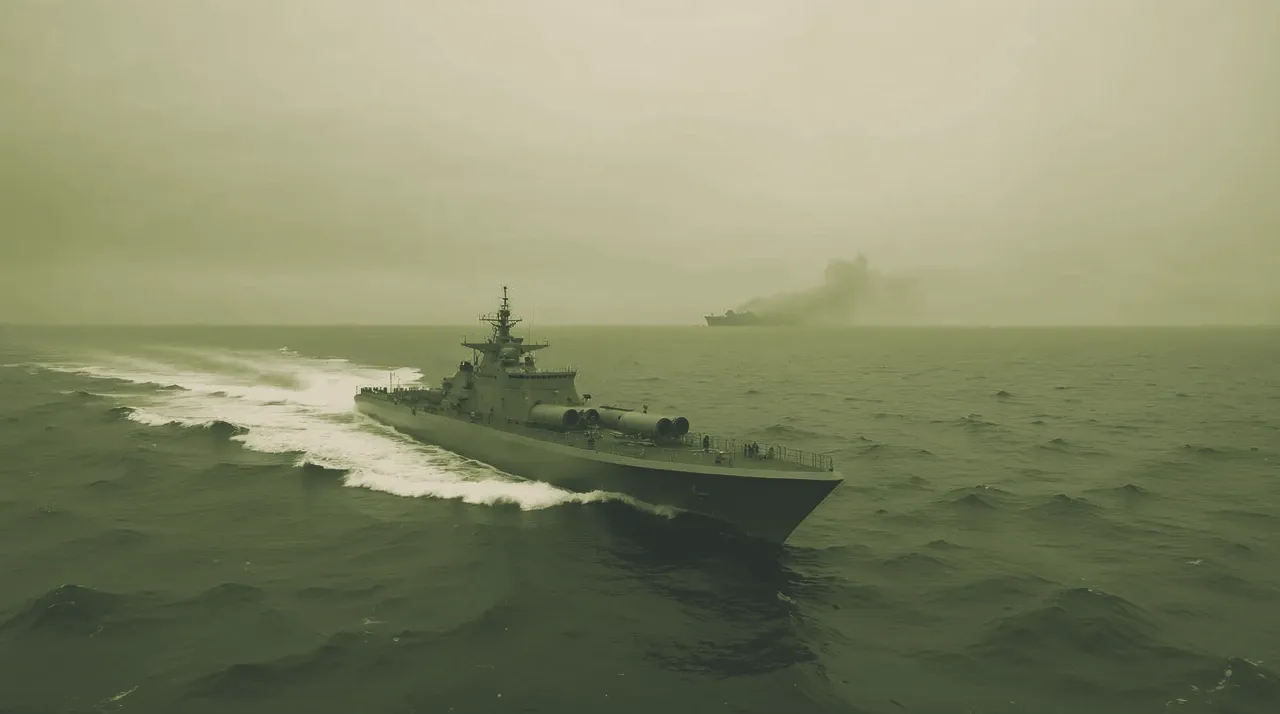
Red Cat put its V7 unmanned boat into full-rate production days before Ukrainian drones reached Russia's Baltic Fleet at Kronstadt. The two events describe one reversal: the combat-proven Ukrainian sea drone has become a Western product line.
On May 29, the American firm Red Cat Holdings announced full-rate production of a maritime drone it calls the Variant 7, built by its Blue Ops subsidiary and credited to that subsidiary's own engineers as a system designed, built, and assembled in the United States, The Defense Post noted. Red Cat began that same boat in May 2025 as a partnership with the Ukrainian maker of the Magura V7, the sea drone that has spent two years sinking Russian warships, according to Defense Express. The specifications Red Cat now markets, a seven-meter hull, a mission set spanning deep strike, interdiction, anti-ship warfare and surveillance, and a modular payload bay, match the Magura V7 precisely, the same outlet found. Ukraine built the weapon first. The American defense industry now wants to build it too.
From a partnership to "their own development"
When Red Cat entered the maritime market in May 2025, it described its partner in unmistakable terms: a company whose drones had logged more than 10,000 hours in live combat and conducted "dozens of successful kinetic engagements against enemy assets, more than any navy since World War II," language that pointed straight at Ukraine's intelligence-affiliated Magura builder, Euromaidan Press wrote. By the May 2026 production announcement, the public materials had changed. Blue Ops president Barry Hinckley described the V7 as engineered for mass production and built to U.S. national security standards, with the design credited to his engineers, Euromaidan Press detailed. Ukrainian analysts at Defense Express called the result a copy: the same seven-meter hull, mission profile and modular payload bay, now sold as an American original. The relabeling is doing real work, because a "designed in the U.S." stamp is what lets American and allied buyers purchase the boat at all.
A $273,000 boat that sinks warships and downs jets
What Red Cat copied is the most successful naval drone of the war. The Magura is a class of unmanned surface vessels run by Ukraine's Main Directorate of Intelligence, built by a four-engineer team that the Security Service tasked in May 2022 with doing "something about the enemy fleet," the naval researcher H.I. Sutton told Naval News in an account relayed by Militarnyi. The current V5 costs about $273,000, runs 5.5 meters, and carries a 300-kilogram warhead to a range near 800 kilometers, per Wikipedia's compilation of Ukrainian and Western sourcing; the larger V7 stretches to 7.2 meters and trades part of that warhead for two AIM-9 Sidewinder missiles, as Wikipedia and USNI Proceedings both note.
The combat log is why the design matters. In February 2024, Magura V5 drones became the first naval drones to sink an enemy warship in combat, destroying the corvette Ivanovets and the landing ship Tsezar Kunikov, USNI Proceedings wrote. Within their first public year the V5s reportedly destroyed eight Russian warships and damaged six more, the magazine noted, causing over $500 million in damage; Sutton's tally via Militarnyi put the count at 17 naval targets or more. On December 31, 2024, a Magura firing a modified R-73 missile downed a Russian Mi-8 helicopter, the first aircraft killed by a naval drone, per Wikipedia. Then on May 2, 2025, west of Novorossiysk, V7 drones firing Sidewinders shot down two Su-30 fighters, jets valued near $50 million each, per USNI Proceedings, the Atlantic Council and Wikipedia. A boat costing less than a third of a million dollars had killed aircraft worth a hundred million.
From Sevastopol to Kronstadt
That asymmetry rewrote the Black Sea. Using Magura drones alongside French and British cruise missiles, Ukraine has damaged or destroyed around a third of Russia's Black Sea Fleet and pushed the survivors out of occupied Crimea to Novorossiysk, in the sea's far corner, per the Atlantic Council and The Maritime Executive. By spring 2024 Britain's Defense Ministry called the fleet "functionally inactive," the Atlantic Council noted. Russia adapted by leaning on its other fleets, the Baltic among them, to escort the shadow tankers that carry sanctioned oil, Ukraine's Unmanned Systems Forces said.
On June 3, that workaround failed too. Ukrainian drones reached Kronstadt, the Baltic Fleet's historic base on an island 18 miles from St. Petersburg and roughly 1,100 kilometers from the Ukrainian border, and set fire to the missile corvette Boikiy in dry dock, The War Zone and France 24 wrote. The Boikiy had escorted shadow-fleet tankers through the English Channel, Unmanned Systems Forces commander Robert Brovdi said. These were long-range one-way attack drones rather than Magura sea boats, but the maritime lesson held: The War Zone called it likely the first strike of its kind on the Baltic Fleet and concluded that even Russia's northern refuge is no longer beyond Kyiv's reach. The fleet Moscow repositioned to escape Ukrainian drones had been found by Ukrainian drones.
The battlefield and the startup story — free in your inbox every week. No paywall.
Subscribe Free →The Kronstadt hit fits a pattern. Defence Blog noted the same operation that reached the corvette had earlier reached the Shagol airfield in Chelyabinsk in April 2026, some 1,700 kilometers from the front, and read the June 3 strike as Ukraine systematically proving that distance is no longer a sanctuary. The corvette is also a Steregushchiy-class ship of about 2,200 tons carrying Kh-35U anti-ship missiles, Defence Blog added, a genuine combatant rather than an auxiliary. Whether the fire crippled it or merely scorched it, the message to Baltic Fleet commanders was that their warships are not safe at berth.
The economics: $750,000 a hull, and a 300,000-drone bet
The same design is now a business, and the price changed on the way across the Atlantic. Red Cat has sized its Georgia plant for hundreds of V7 hulls a year at $750,000 to $1.5 million each, the analysts at Simply Wall St wrote on Yahoo Finance, two to five times what the Ukrainian boat costs. The company's revenue jumped 869 percent year-on-year to $15.5 million last quarter, helped by a Japanese order, ad-hoc-news noted, and its shares have risen about 133 percent over twelve months. Driving the run is Washington. The Pentagon's Office of Strategic Capital is weighing loans and even direct equity stakes in domestic drone makers, per ad-hoc-news, citing a Wall Street Journal account, as part of a "Drone Dominance" push to buy as many as 300,000 low-cost attack drones by 2027. The same report put the FY2027 budget's allocation for autonomous systems above $50 billion.
That buildup is aimed largely at China. An FCC import ban has already squeezed Chinese drones out of the American market, ad-hoc-news wrote, and the stated point of Drone Dominance is to cut reliance on Chinese technology and stand up a domestic supply chain. A Ukrainian design fits that brief well. It comes from an ally rather than a strategic rival, and unlike most paper concepts it has already sunk ships, which is the combination American buyers have struggled to source at home.
Red Cat is not the only firm working from the Ukrainian design book. The U.S. Navy opened a medium unmanned surface vessel marketplace in April and named seven companies for at-sea testing, the startup Saronic among them, Breaking Defense noted; Saronic built its first Marauder USV in under a year. Canada has begun producing Ukrainian drones under a new venture, The Defense Post detailed. Poland has unveiled its own answers to the Magura and the Sea Baby, the SK@RP and StormRider, per Defense Express. The design lineage in each case runs back to Kyiv. The factories are going up in the United States, Canada and Poland.
Who owns a combat-proven design
For decades, military technology moved one way, from Western primes outward to the states that bought from them. Ukraine inverted that flow under combat conditions, and Western industry is now absorbing the result without always crediting it. Red Cat's "designed in the U.S." label is partly a procurement requirement, since allied buyers need a domestic supplier and a clean compliance trail. It is also a claim on the value of a design that someone else proved under fire. The awkward part for Kyiv is that the country fielding the war's most tested naval drone may earn little from the market it opened. Its drone-sharing deal with Washington remains stuck on the American side even as parallel agreements with Europe and the Gulf advance, Euromaidan Press noted.
What to watch
- Price. Red Cat's $750,000-to-$1.5 million range, per Simply Wall St, sits far above the Ukrainian $273,000. If U.S.-built copies stay there, the affordable mass that made the Magura matter will not survive the crossing to a Western industrial base.
- Orders, not slogans. The Pentagon's June tender and the FY2027 budget will show whether the 300,000-drone ambition turns into signed contracts.
- Credit. No Western program has yet named, licensed or paid the Ukrainian builders. If that holds, "their own development" becomes the standard way the war's hardest-won designs change hands.
Frequently Asked Questions
What did Red Cat actually announce?
Red Cat Holdings said on May 29, 2026 that its Blue Ops subsidiary had begun full-rate production of the Variant 7 (V7) unmanned surface vessel in the United States, describing it as designed, built and assembled domestically, according to The Defense Post and Euromaidan Press.
Is the V7 really a copy of Ukraine's Magura V7?
Red Cat began the V7 in May 2025 as a partnership with the maker of Ukraine's Magura V7 and now credits the design to its own engineers, Euromaidan Press wrote. Defense Express analysts call it a copy, noting the seven-meter hull, mission profile and modular payload bay match the Magura V7 precisely.
What has the Magura sea drone done in combat?
Magura V5 drones became the first naval drones to sink a warship in combat in February 2024 and reportedly destroyed eight Russian warships in their first public year, per USNI Proceedings. In May 2025, Magura V7 drones firing AIM-9 Sidewinder missiles shot down two Russian Su-30 fighters, per USNI Proceedings and the Atlantic Council.
What happened at Kronstadt on June 3?
Ukrainian long-range drones reached the Baltic Fleet base at Kronstadt, about 1,100 kilometers from Ukraine, and set fire to the missile corvette Boikiy in dry dock, as The War Zone and France 24 detailed. The War Zone called it likely the first strike of its kind against the Baltic Fleet.
How much does the American version cost compared with the original?
Red Cat has sized its Georgia plant for hundreds of V7 hulls a year at $750,000 to $1.5 million each, the analysts at Simply Wall St wrote on Yahoo Finance. Ukraine's Magura V5 costs about $273,000, per Wikipedia's compilation of sources, making the U.S. boat roughly two to five times pricier.
Why is the U.S. buying Ukrainian-style sea drones now?
The Pentagon's Office of Strategic Capital is weighing loans and equity in domestic drone makers under a "Drone Dominance" plan to buy up to 300,000 low-cost attack drones by 2027, per ad-hoc-news, citing a Wall Street Journal account. The U.S. Navy has also opened a medium unmanned surface vessel marketplace, Breaking Defense noted.
AI-generated summary, reviewed by an editor. More on our AI guidelines.

Marcus Schuler
Marcus Schuler edits BattlePolicy, a daily defense-technology brief connecting the companies and capabilities behind modern war to the contest among Europe, the US, Russia, and China.