Bullfrog
An AI-driven robotic gun that shoots drones out of the sky with ordinary bullets — the "magazine-deep, ten-dollar-a-kill" answer to FPV and swarm attacks. Computer vision lays the gun; a human pulls the trigger. Fielded with the US Army and Navy and now valued at $2.2 billion.
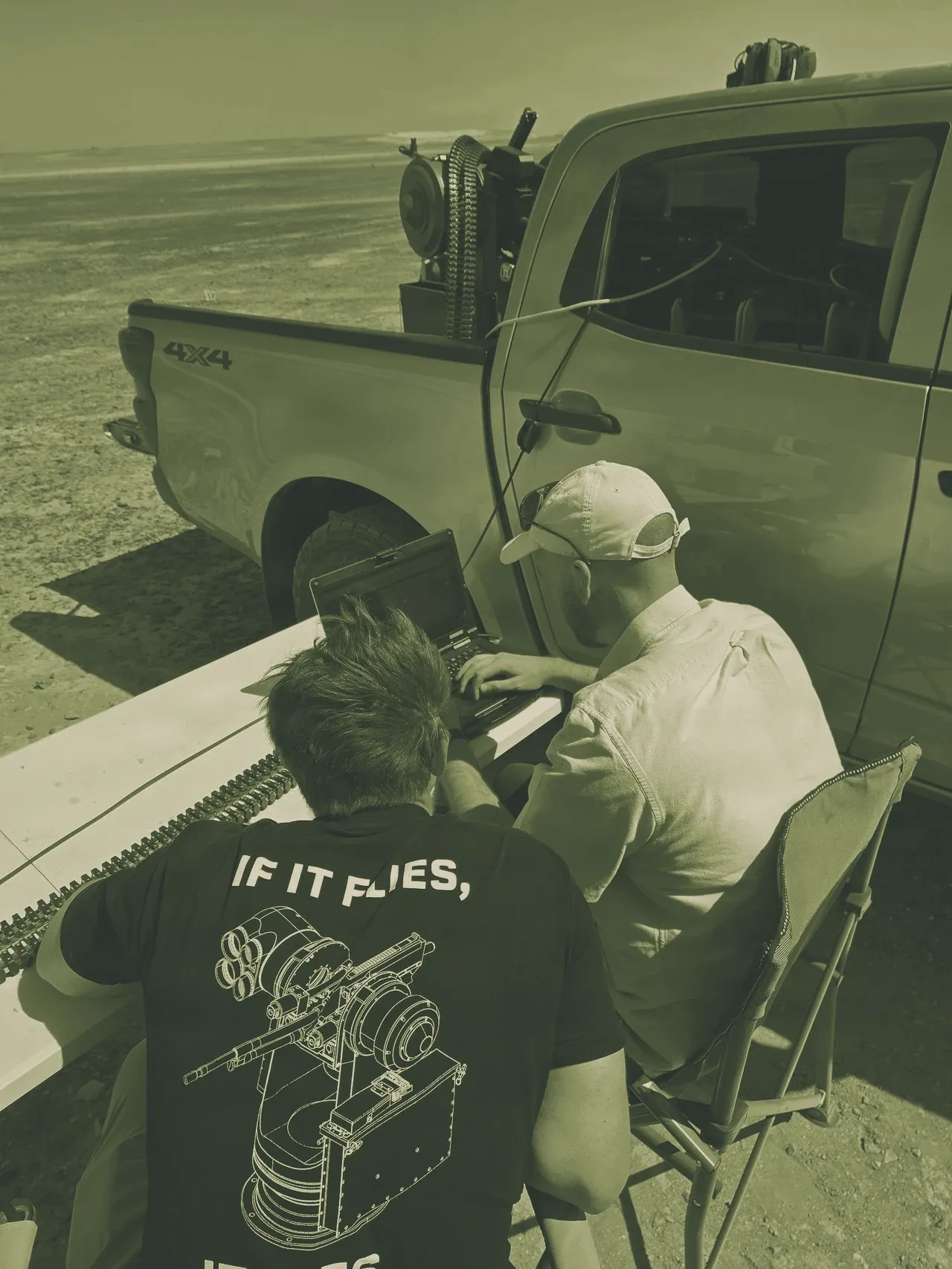
An AI-driven autonomous robotic gun that detects, tracks and shoots small drones out of the sky using ordinary small-arms ammunition. It is the "gun-based, magazine-deep, cheap-per-kill" answer to the FPV and swarm threat — turning the drone-war economics around so a defender spends bullets, not million-dollar interceptors, to kill a hundred-dollar drone. Computer vision lays the gun; a human gives the command to fire.
Overview
The Bullfrog, built by Allen Control Systems (ACS), is a stabilized, motorized gun turret wrapped around a service-standard weapon and driven by AI fire-control: machine-vision software autonomously detects, identifies, tracks and lays the gun onto a small drone, and a human operator gives the command to fire (a human-in-the-loop design). Its whole premise is economic. Cheap one-way attack drones and swarms have made missile-based air defense unaffordable — firing a million-dollar interceptor at a $500 quadcopter is a losing trade — so the Bullfrog answers mass with mass of its own: standard bullets, fired with machine precision at a claimed cost-per-kill of around $10. It is the "every movement answered" denial layer of the transparent-battlefield thesis — the system that turns seen into dead without breaking the bank.
Development
ACS was founded in 2022 in Austin, Texas, by two former US Navy nuclear-reactor engineers, Steven Simoni and Luke Allen, with Mike Wior — the founders having previously built the restaurant robot company Bbot, sold to DoorDash in 2022. The Bullfrog was pitched explicitly at the lesson of Ukraine and the Middle East: that drones had inverted the cost of air defense. The company moved fast from a $12 million seed round in 2024 to a $200 million Series B at a $2.2 billion post-money valuation in 2026, led by Smash Capital — one of the fastest-rising counter-drone startups to win Pentagon attention.
Design & capabilities
The base Bullfrog mates an M240 7.62×51mm machine gun to a precision robotic mount and an AI fire-control stack. Sensing is deliberately passive — electro-optical/infrared cameras plus a laser rangefinder, with no radar or RF emission — so the system does not announce itself or jam friendly electronics. ACS's published figures for the M240 variant are an 850-round-per-minute rate of fire, sub-1-MOA precision, an ~800 m maximum effective range, an ability to engage Group 1-3 (small) drones, and the ~$10-per-kill ammunition economics, in a mount weighing roughly 300 lb without ammunition. (Two honest caveats: those are vendor figures, repeated by trade press but not independently range-tested; and "up to Group 3" is aspirational against the real envelope of an 800 m gun. There is also no published full-cycle reaction time — only qualitative claims.) The autonomy automates the hard part — finding and tracking a fast, small, erratic target — while keeping a human on the trigger.
Variants
The Bullfrog is offered around different service-common weapons rather than as distinct models: the M240 (7.62mm) baseline, plus configurations built around the M2 .50-calibre machine gun, the M134 7.62mm minigun, and the M230 30mm chain cannon — letting a customer trade range, lethality and ammunition supply. The robotic-mount and AI-fire-control core is common across them.
Combat record / operational use
The Bullfrog has moved into US service rather than a single named battle: it has been fielded with the US Army and US Navy, and ACS has won a JIATF-401 relationship and a US Special Operations Command effort to put robotic gun turrets on boats, plus an Army Applications Laboratory contract to integrate the system on combat vehicles. The company reports a 100% engagement result at the Army's T-REX 26-1 demonstration — a vendor/test claim, not independent combat data. It is also a partner in the Red Cat Futures Initiative.
Advantages
- Cheap-per-kill — bullets, not interceptor missiles, against a swarm of cheap drones.
- Magazine-deep — sustained fire to handle volume, unlike a few-shot missile launcher.
- Passive and emission-free — EO/IR + laser, no radar/RF to jam or be detected.
- Machine precision — AI tracking solves the hard problem of hitting a small, agile target.
Drawbacks / limitations
- Short reach — a gun's ~800 m envelope is far less than missile or directed-energy air defense; it is a last-ditch/point-defense layer.
- Ceiling and slant-range limits — guns struggle against higher or faster threats; "up to Group 3" is optimistic.
- Ammunition and barrel limits — sustained swarm engagements consume ammo and wear barrels.
- Unvalidated vendor specs — most performance figures are ACS claims, not independent range data.
Counterparts
The Bullfrog sits in a crowded gun-and-effector counter-UAS field: Smartshooter's SMASH fire-control optics, Anduril's counter-UAS line, and gun-based systems like Rheinmetall's Skyranger 30 (a far larger vehicle-mounted 30mm system). It also complements, rather than replaces, directed-energy approaches such as Epirus's high-power microwave. Bullfrog's distinction is doing autonomous gun-laying on a comparatively cheap, service-standard weapon at a ~$10-per-kill price point.
Outlook
The Bullfrog rides a clear strategic wave: as cheap drones make traditional air defense uneconomical, layered, attritable, gun-based counters become essential — and the $2.2 billion valuation is the market pricing that in. The questions to watch: whether independent testing confirms the vendor performance numbers (especially the upper end of the target envelope), how the human-in-the-loop fire-control holds up against true saturation swarms, and whether ACS can scale manufacturing fast enough to matter — the explicit purpose of the 2026 Series B.
Key specifications
| Spec | Value |
|---|---|
| Type | AI-driven autonomous robotic gun / remote weapon station (counter-UAS) |
| Armament | NATO 7.62×51mm (M240 baseline); options: M2 .50-cal, M134 minigun, M230 30mm |
| Rate of fire | ~850 rds/min (M240, ACS figure) |
| Engagement range | ~800 m max effective (M240) |
| Target set | Group 1-3 small UAS / FPV / swarms |
| Fire control / sensors | AI computer vision + passive EO/IR cameras + laser rangefinder (no radar/RF) |
| Autonomy | Autonomous detect / ID / track / lay; human commands fire (human-in-the-loop) |
| Accuracy | <1 MOA (ACS claim) |
| Cost per kill | ~$10 (ammunition; ACS claim) |
| Mobility | Fixed, vehicle- or boat-mounted turret; ~300 lb (less ammo) |
Sources
- Allen Control Systems raises $200M Series B at a $2.2B valuation — Business Wire
- Bullfrog M240 — Allen Control Systems
- Announcing our $12M seed round — Allen Control Systems
- ACS raises $200M for autonomous weapons stations — The Robot Report
- Bullfrog weapon system and the US Army — The Defense Post
- Counter-drone developer ACS raises $200 million — Defense Daily
- ACS raises $200M to scale Bullfrog C-UAS production — Unmanned Airspace
- US special operators are getting a drone-killing robot — The National Interest
- How a Silicon Valley 'warlord' got the Pentagon's attention — Reuters
- US SOF to equip boats with AI robotic turrets — Militarnyi
- Austin's Allen Control Systems builds an AI-powered drone killer — CBS Austin
- The US military's robot drone guns — WIRED
- Smartshooter SMASH anti-drone fire control — The Defense Post
🔒 The Analyst Section on Bullfrog is for BattlePolicy Pro members. Below the line: procurement and contract history, the suppliers and companies behind the system, our head-to-head analyst view of the systems it actually competes with, and the BattlePolicy assessment note. Unlock the full file with BattlePolicy Pro →