Chinese firm Star-Navi sells a spray-on radar coating for drones by the kilogram
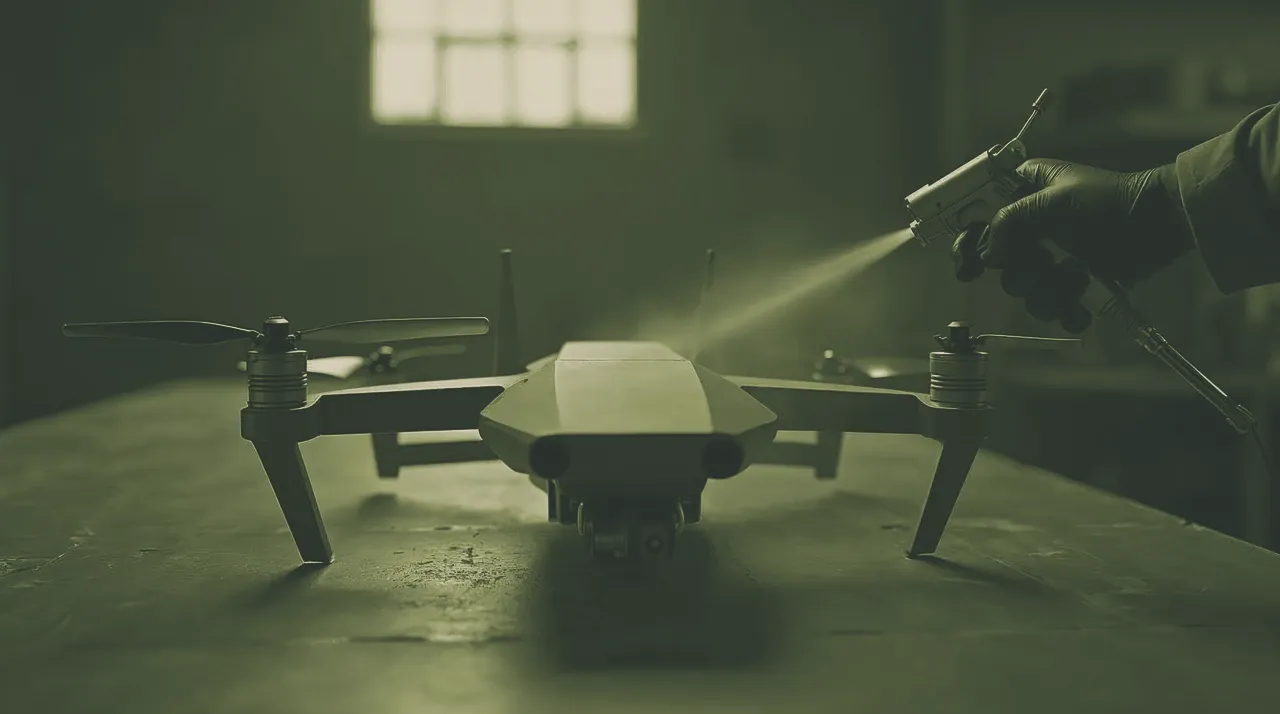
Shenzhen-based Star-Navi sells the sprayable XRAM-C coatings in 1, 5 and 10 kilogram containers, Defence Blog reported, putting a modest radar-evasion gain within reach of cheap drones.
Star-Navi, a Shenzhen company, has begun selling spray-on radar-absorbing coatings for drones, a line it calls the XRAM-C Series, Defence Blog reported. The material works by soaking up a radar pulse and shedding it as heat instead of bouncing it back, the company says, which trims a drone's radar cross-section and gives air-defense radars less to lock onto.
The battlefield and the startup story — free in your inbox every week. No paywall.
Subscribe Free →Three versions cover different radar bands, with the C105 aimed at X- and Ku-band, the C112 at S- and C-band, and the C113B sold as wideband. Coat a surface in a layer of 0.40 to 0.60 millimeters, Star-Navi says, and the radar return falls by 3 to 3.5 decibels, roughly half the signal power, for under 1.1 kilograms of added weight per square meter. The maker also rates the finish to 250 degrees Celsius and claims it came through 2,000 hours of salt spray, offered as proof it can coat ships and coastal gear.
The claimed reduction is small next to established stealth coatings. Tom's Hardware wrote that typical radar-absorbing materials cut the return by 20 to 30 decibels, and a Turkish startup's basalt-based spray claims far more. At 3 decibels, the XRAM-C coating offers a marginal gain. But Star-Navi sells it off the shelf in 1, 5 and 10 kilogram containers, and the company says no specialized factory is needed to apply it.
The likeliest use is on the cheap drones both Russia and Ukraine field in large numbers. One-way attack and reconnaissance airframes are produced and expended at scale. A sprayable coating could be applied across those fleets cheaply, and a small cut in detection range, repeated across thousands of airframes, would complicate the radar picture for air defenses on either side.
The performance figures come from Star-Navi, per Defence Blog. None have been independently verified.
What to watch: whether XRAM-C coatings appear on drones recovered in Ukraine, which would be the first independent test of the claims outside the company's lab.

Marcus Schuler
Marcus Schuler edits BattlePolicy, a daily defense-technology brief connecting the companies and capabilities behind modern war to the contest among Europe, the US, Russia, and China.