Delilah
Israel's air-launched turbojet loitering cruise missile — man-in-the-loop precision and multi-platform flexibility from F-16s to PULS MLRS. Combat-proven since the 2006 Lebanon War, and used to suppress Iranian air defences in the 2026 Iran campaign.
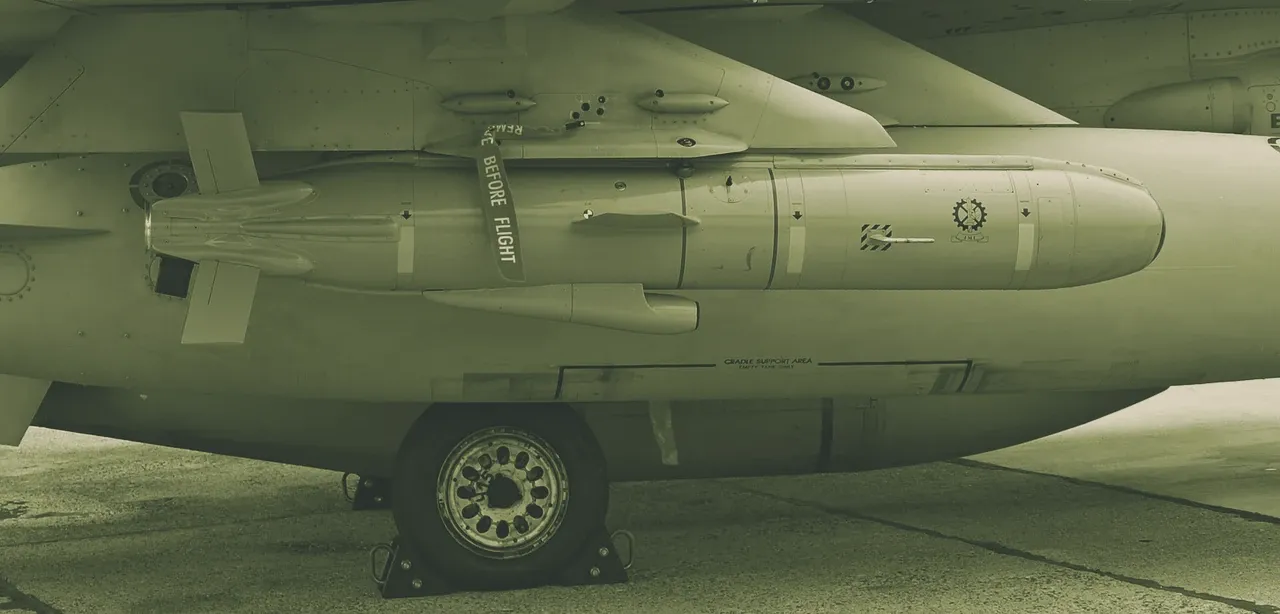
Israel’s turbojet-powered loitering cruise missile — a standoff weapon that combines man-in-the-loop terminal guidance with multi-platform versatility, and has been battle-tested from Lebanon (2006) through the 2026 Iran war.
Overview
The Delilah is a subsonic, air-launched loitering cruise missile developed by Israel Military Industries (IMI) and now produced by Elbit Systems. Originally adapted from a 1980s anti-radiation drone, the weapon evolved into a precision offensive missile in the 1990s and entered Israeli Air Force service around 1995. Its defining feature is a man-in-the-loop datalink that lets a remote weapon systems officer observe the target in real time through the missile’s infrared seeker, then confirm, abort, or redirect the strike. This ability, combined with a 250-km range, a small but exceptionally accurate warhead, and compatibility with fighter aircraft, helicopters, ground-launched canisters (PULS MLRS), and shipboard mounts, makes Delilah a uniquely flexible asset in Israel’s arsenal.
Development
The Delilah lineage began in the 1980s as an anti-radiation attack drone based on the U.S. MQM-74 Chukar aerial target, designed to detect SAM radars. By the mid-1990s, IMI had transformed the concept into an offensive strike missile with a turbojet sustainer, INS/GPS midcourse guidance, and a CCD/IIR terminal seeker, and the weapon reached operational status with the IAF around 1995, according to Wikipedia and CSIS Missile Threat. The ground-launched variant, Delilah-GL, was first publicly acknowledged in 2004, marking Israel’s first known ground-launched cruise missile. In November 2018, IMI was acquired by Elbit Systems, and Delilah production, refinement, and export marketing shifted to Elbit’s Land division. As of mid-2025, Elbit confirmed it is developing next-generation Delilah versions with extended range and expanded warhead choices for the export market, as reported by Militär Aktuell.
Design & capabilities
Delilah is a 2.71-m-long, 187-kg missile with a 1.15-m wingspan, powered by the BS-175 turbojet engine. It cruises at Mach 0.3–0.7 and performs a terminal dive at up to Mach 0.85. Midcourse navigation relies on an INS/GPS autopilot; in the terminal phase a dual-channel CCD and imaging infrared (IIR) seeker feeds live video back to the launch aircraft or a ground station via a secure datalink, enabling man-in-the-loop control — a capability that most Western cruise missiles, such as JASSM, do not offer. Accuracy is stated as a 1-m circular error probable (CEP), a manufacturer claim cited by Wikipedia. The warhead is a conventional high-explosive type, with open-source evidence pointing to 30 kg, though some secondary sources suggest up to 54 kg in certain configurations; Elbit has not publicly resolved the discrepancy, according to the War Thunder forum compilation. The missile’s 250-km range is consistent across all variants, including the ground-launched canisterised version that rides two-per-pod on the Elbit PULS multiple rocket launcher.
Variants
- Delilah-AL (Air-Launched): Baseline variant for F-16C/D and formerly F-4E fighters; turbojet sustain, man-in-the-loop CCD/IIR terminal seeker.
- Delilah-GL (Ground-Launched): Canisterised version with a solid-fuel booster for ejection from PULS MLRS pods; transition to turbojet cruise, same range and seeker.
- Delilah-HL (Helicopter-Launched): Adapted for UH-60 Blackhawk and SH-60/MH-60 Seahawk families.
- Delilah-SL (Sea/Ship-Launched): Shipboard configuration; specific naval integration details remain unpublicised.
- Next-generation (in development): Elbit announced in 2025 that it is producing state-of-the-art Delilah versions with “more range and warhead choices” for export customers.
Combat record / operational use
Delilah’s first combat use occurred during the 2006 Second Lebanon War, when an IAF F-16D fired the missile at a convoy suspected of moving weapons from Syria to Hezbollah, a strike recorded by CSIS Missile Threat. On 10 May 2018, Israel employed Delilahs against Syrian and Iranian air-defence targets — including SA-5, SA-22, and SA-2 SAM systems — after an Iranian rocket salvo toward the Golan Heights; the IAF released video of a Delilah destroying a Pantsir-S1 radar-fire control unit (reported by MilitaryLeak). Delilah was also used in subsequent Syrian strikes against Iranian and Hezbollah positions. In the 2026 Iran war (Operation Roaring Lion / Rising Lion, February–June 2026), the missile was employed as part of a large-scale IAF suppression of enemy air defences, with over 3,000 U.S.–Israeli munitions consumed in the first 36 hours, according to Foreign Policy, and a review of the campaign’s opening days by HRANA specifically mentions continued use of Delilah.
Advantages
- Man-in-the-loop abort/retask allows a remote controller to validate, divert, or cancel the strike in real time — a discriminator against fire-and-forget cruise missiles.
- 1 m CEP (manufacturer claim) enables precision strikes on small, high-value aim points even with a modest warhead.
- Multi-platform versatility spans fighters, helicopters, ground launchers (PULS MLRS), and naval ships, unifying logistics.
- Turbojet loiter capability confers flexible attack profiles and multiple approach headings that solid-rocket competitors lack.
- Three decades of combat use across Lebanon, Syria, and Iran have proven integration, maturity, and Israel’s deep institutional comfort with the weapon.
Drawbacks / limitations
- Small warhead: publicly documented at 30 kg (possibly 54 kg in some configurations), limiting effectiveness against hardened targets or large area-effect requirements; the exact warhead mass remains unverified.
- Datalink dependency: man-in-the-loop control requires a sustained, jam-resistant link; adversary electronic warfare could degrade or deny the retasking capability.
- Subsonic speed (cruise Mach 0.3–0.7) extends time-over-target and makes Delilah more susceptible to short-range air defences, MANPADS, and gun systems than supersonic missiles.
- Export record is thin: despite decades in service, no foreign operator is publicly confirmed; the impact of Israeli policy secrecy on foreign sales is widely suspected.
Counterparts
- Storm Shadow (NATO)
- Kh-101 (Russia)
Outlook
Delilah’s 30-year pedigree and repeated combat use give Elbit a proven product, but the loitering-missile niche is increasingly crowded. The combination of 250-km turbojet range, 1-m precision, man-in-the-loop control, and multi-platform carriage remains unique, yet younger one-way-attack drones can undercut Delilah on unit cost. Elbit’s 2025 next-generation development — with longer range and larger warheads — directly targets the stand-off cruise-missile export market. India’s reported interest, the potential to field Delilah on Serbian PULS launchers, and Morocco’s earlier enquiries offer credible near-term export pathways, though political headwinds and competition from European and U.S. alternatives will shape the outcome.
Key specifications
| Spec | Value |
|---|---|
| Type | Subsonic loitering cruise missile with man-in-the-loop terminal guidance |
| Range | 250 km |
| Speed (Mach / km·/s) | Cruise Mach 0.3–0.7; terminal dive Mach 0.85 |
| Warhead (type & weight) | Conventional HE; 30 kg (open-source, manufacturer unverified) |
| Guidance | Midcourse INS/GPS; terminal CCD + IIR with man-in-the-loop datalink |
| Accuracy (CEP) | 1 m (manufacturer claim) |
| Launch platform(s) | F-16C/D (primary); F-4E (historical); UH-60/SH-60/MH-60 helicopters; PULS MLRS (ground-launched canister); naval vessels (SL) |
| Propulsion | BS-175 turbojet (GL adds solid-fuel booster) |
| Length / diameter / launch weight | 2.71 m / 0.33 m / 187 kg |
Sources
- Wikipedia — Delilah (missile). https://en.wikipedia.org/wiki/Delilah_%28missile%29
- CSIS Missile Threat — Delilah. https://missilethreat.csis.org/missile/delilah/
- MilitaryLeak — Delilah Air-Launched Advanced Stand-off Missiles. https://militaryleak.com/2020/08/31/delilah-air-launched-advanced-stand-off-missiles/
- Militär Aktuell — Elbit makes Cruise Missile Delilah more versatile. https://militaeraktuell.at/en/elbit-makes-cruise-missile-delilah-more-versatile/
- Elbit Systems — Delilah product page. https://www.elbitsystems.com/air-space/air-surface-munitions/missiles-rockets/delilah
- MilitaryLeak — Morocco to Purchase Israeli-made Delilah Short-range Cruise Missile. https://militaryleak.com/2023/07/06/morocco-to-purchase-israeli-made-delilah-short-range-cruise-missile/
- Wikipedia — PULS (multiple rocket launcher). https://en.wikipedia.org/wiki/PULS_%28multiple_rocket_launcher%29
- War Thunder Forum — IMI Delilah: Israel’s Air-to-Surface Cruise Missile (specs compilation). https://forum.warthunder.com/t/imi-delilah-israels-air-to-surface-cruise-missile/310503
- HRANA — The Fifth Day of Israeli Attacks on Iran. https://www.en-hrana.org/the-fifth-day-of-israeli-attacks-on-iran-a-review-of-the-incidents/
- Foreign Policy — The First 36 Hours of War Consumed Over 3,000 U.S.-Israeli Munitions. https://foreignpolicy.com/2026/03/05/iran-war-munitions-critical-minerals/