GRID-REF 37°47′N 122°25′W
DISPATCH 02/26 · 12 Jun 2026
BATTLEPOLICY
Startup to front line. Strategy to consequence.
Lexicon · China

DF-21D

China's pioneering land-based anti-ship ballistic missile — the "carrier killer" that forced the U.S. Navy to rethink its force structure, holding aircraft carriers at risk out to 1,500 km.
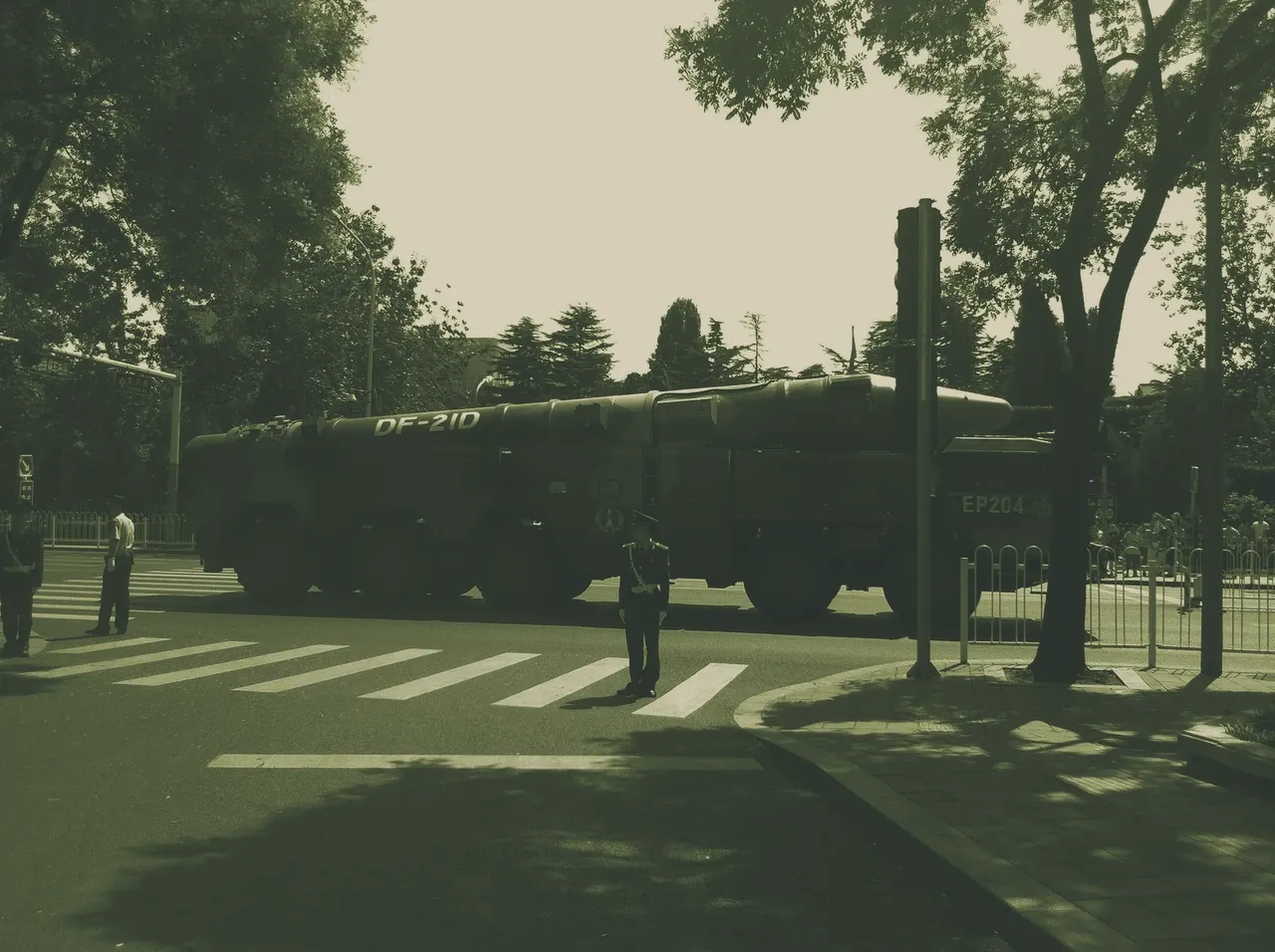
DF-21D
FIG.01 · China Image - DF-21D anti-ship ballistic missiles on parade. Photo by IceUnshattered, CC BY-SA 4.0, via Wikimedia Commons.
China's original "carrier killer" — a road-mobile, medium-range ballistic missile with a maneuverable reentry vehicle, purpose-built to deny access to large warships by holding them at risk far from the Chinese coast.

Overview

The DF-21D (Dong Feng-21D, NATO designation CSS-5 Mod 5) is the world’s first operational anti-ship ballistic missile (ASBM) — a conventional, solid-fuel, two-stage road-mobile missile that uses a terminal maneuvering reentry vehicle (MaRV) to strike moving surface ships at ranges of roughly 1,450–1,550 km. Entering service around 2006, it became the signature component of China’s anti-access/area-denial (A2/AD) posture, explicitly intended to push U.S. aircraft carrier strike groups out of striking range of the Chinese mainland. Its existence compelled Western navies to invest heavily in distributed operations, long-range anti-ship weapons, and layered missile defense.

Development

The DF-21D stems from the broader DF-21 solid-fuel ballistic missile family, whose origins trace to the late 1960s when China first transitioned from liquid-fueled designs. The baseline DF-21 first flew in 1985 and achieved service in 1991, followed by improved nuclear (DF-21A), conventional land-attack (DF-21C), and further nuclear (DF-21E) variants, according to CSIS Missile Threat and Wikipedia. The anti-ship “D” model emerged from a parallel effort to mate the proven two-stage airframe with a biconic, finned MaRV and a terminal seeker capable of discriminating a moving target at sea; the concept likely underwent first flight tests around 2005–06. CSIS assesses the DF-21D entered service about 2006, and the U.S. Department of Defense judged an early operational capability to have been reached by 2010. The missile was first shown publicly during a 3 September 2015 military parade.

Design & capabilities

The DF-21D is a two-stage solid-propellant missile, launched from a wheeled transporter-erector-launcher (TEL) that confers road mobility and, reportedly, a rapid field-reload capability. Its defining feature is the maneuverable reentry vehicle, equipped with an active terminal seeker that scans for moving ships during the final dive. Inertial guidance steers the vehicle to the target area, where the MaRV executes a high-angle, hypersonic terminal phase — estimated at about Mach 10 — that drastically compresses a defender’s reaction time.

The conventional unitary warhead is estimated at approximately 600 kg, while the missile’s overall length, diameter, and launch mass are roughly 10.7 m, 1.4 m, and 14,700 kg (all family estimates). Accuracy, though never officially confirmed, is placed at a circular error probable (CEP) of about 20 meters by CSIS, which would make the weapon a single-ship killer rather than an area-denial tool. The kill chain depends on external cueing from China’s expanding satellite network (Yaogan/Jianbing synthetic-aperture-radar and electro-optical constellations) and over-the-horizon radars, and sustained investment in targeting infrastructure is evident in satellite imagery of full-scale moving ship targets at desert test ranges, as documented by The War Zone.

Variants

The DF-21 family includes:

  • DF-21 (CSS-5 Mod 1) — nuclear, entered service 1991
  • DF-21A (Mod 2) — nuclear, 1996
  • DF-21C (Mod 4) — conventional land-attack, 2006; no longer brigaded per the 2024 DoD China Military Power Report
  • DF-21D (Mod 5) — anti-ship, ~2006
  • DF-21E (Mod 6) — nuclear, ~2016

Longer-range successors carry the anti-ship role forward: the DF-26B (~4,000 km) and the DF-27 (5,000–8,000 km), the latter assessed as operational by the 2025 China Military Power Report. The 2024 report notes that DF-26 units are progressively replacing the DF-21 in the PLA Rocket Force.

Combat record / operational use

The DF-21D has never been used in combat. Its operational narrative is built on testing milestones and strategic signaling. In 2013 it was tested against a carrier-sized land target. The first known live-fire salvo came in July 2019, when six missiles were fired into the South China Sea north of the Spratlys. The most prominent event occurred on 26 August 2020: amid a U.S. carrier presence and a U-2 overflight dispute, the Pentagon confirmed that China launched four medium-range ballistic missiles — a DF-21D from Zhejiang and a DF-26B from Qinghai — into a pre-announced zone between Hainan and the Paracels. A retired PLA officer, Wang Xiangsui, later claimed the missiles “hit a vessel sailing south of the Paracel Islands” while it was moving, but Beijing never officially confirmed the result, and The Diplomat noted the test zone had been published five days in advance, suggesting a planned demonstration rather than a spontaneous warning.

Supporting infrastructure, including full-scale moving ship targets in the Taklamakan Desert, indicates a sustained and serious targeting-development effort, as analyzed by The War Zone. U.S. commanders treat the threat as real: in 2021, a Navy intelligence chief acknowledged China could “keep pouring money” into ASBMs that impose asymmetric costs on the defender, a point reported by USNI News. The doctrinal response — distributed maritime operations, expeditionary anti-ship missiles, and the Guam defense build-up — is detailed in CIMSEC.

Advantages

  • World-first ASBM capability: First operational land-based ballistic missile designed to hit a maneuvering aircraft carrier, achieving terminal speeds around Mach 10 and a near-vertical dive that challenges all but the most capable shipboard defenses.
  • Range asymmetry: At ~1,500 km, it outranges the unrefueled strike radius of a carrier air wing, forcing U.S. carriers to either accept greater risk or withdraw beyond effective combat range.
  • MaRV with terminal seeker: The maneuverable reentry vehicle and an estimated CEP of ~20 m give the DF-21D a credible single-ship hit probability, not merely an area saturation weapon.
  • Operational mobility: Solid fuel and TEL basing allow rapid launch cycles and difficult pre-launch targeting, as highlighted by CSIS.
  • Cost imposition: A U.S. intelligence chief noted China can “keep pouring money” into relatively cheap ASBMs, forcing far costlier defensive investments in missile defense ships, Guam fortification, and fleet dispersal, according to USNI News.

Drawbacks / limitations

  • Fragile kill chain: Locating and tracking a maneuvering ship at 1,500 km requires persistent satellite and over-the-horizon radar coverage; CSIS notes it is unclear how effectively, or at what ranges, the DF-21D can actually hit a moving vessel in contested conditions.
  • Unconfirmed combat test: No official, publicly disclosed live-fire test against a moving ship has been confirmed; the 2020 claim came from a retired academic, not the Chinese government, and even U.S. Navy intelligence in 2021 declined to call the system “fully fielded,” as reported by USNI News.
  • Never combat-proven: The missile’s real-world effectiveness remains speculative; all key performance figures are external estimates, with inventory numbers ranging from 50 to 200 according to CSIS.
  • Superseded in family: With the DF-26B and DF-27 now entering service, the DF-21D occupies only the first-island-chain layer of a much longer-range A2/AD system; the 2024 DoD China Military Power Report shows DF-26 units replacing DF-21 brigades.

Counterparts

Outlook

The DF-21D’s lasting significance is that it proved the ASBM concept and forced the U.S. Navy to adapt operationally and institutionally. Its design DNA now flows through the longer-range DF-26B and the intercontinental DF-27, which the 2025 Pentagon report assesses can target ships 5,000–8,000 km away. Within a layered, massed-fires scheme that CIMSEC identifies as one of China’s most important asymmetric advantages, the DF-21D will remain a short-leg, first-island-chain layer while its successors extend the engagement zone. U.S. investments in distributed lethality and integrated air and missile defense are direct counters to the entire ASBM family the DF-21D founded.

Key specifications

Spec Value
Type Road-mobile medium-range anti-ship ballistic missile (ASBM)
Range ~1,450–1,550 km (est.)
Speed (Mach / km·s⁻¹) ~Mach 10 (est.)
Warhead (type & weight) Conventional unitary, ~600 kg (est.)
Guidance Inertial mid-course + terminal (assessed active seeker on MaRV)
Accuracy (CEP) ~20 m (est., CSIS)
Launch platform(s) Wheeled TEL (road-mobile), rapid reload; air-launched variant reported (CH-AS-X-13)
Propulsion Two-stage solid propellant
Length / diameter / launch weight ~10.7 m / ~1.4 m / ~14,700 kg (family est.)

Sources

  1. CSIS Missile Threat — DF-21 (CSS-5). https://missilethreat.csis.org/missile/df-21/
  2. CSIS Missile Threat — China Launches Antiship Ballistic Missiles in Test. https://missilethreat.csis.org/china-launches-antiship-ballistic-missiles-in-test/
  3. The Diplomat — Chinese Ballistic Missiles Fired Into South China Sea Claimed to Hit Target Ship. https://thediplomat.com/2020/11/chinese-ballistic-missiles-fired-into-south-china-sea-claimed-to-hit-target-ship/
  4. Wikipedia — DF-21. https://en.wikipedia.org/wiki/DF-21
  5. Federation of American Scientists — The 2024 DOD China Military Power Report. https://fas.org/publication/the-2024-dod-china-military-power-report/
  6. CSIS Missile Threat — DF-26. https://missilethreat.csis.org/missile/dong-feng-26-df-26/
  7. USNI News — U.S. Admiral: China Can ‘Keep Pouring Money’ Into Anti-Ship Ballistic Missiles. https://news.usni.org/2021/01/27/u-s-admiral-china-can-keep-pouring-money-into-anti-ship-ballistic-missiles
  8. The War Zone — China’s Giant Moving Warship Target In The Desert Shows How Seriously It’s Taking The Naval Arms Race. https://www.twz.com/43046/chinas-giant-moving-warship-target-in-the-desert-shows-how-seriously-its-taking-the-naval-arms-race
  9. USNI News — Chinese Forces Fielding Intercontinental Anti-Ship Ballistic Missiles Capable of Reaching U.S. West Coast, Pentagon Says. https://news.usni.org/2025/12/26/chinese-forces-fielding-intercontinental-anti-ship-ballistic-missiles-capable-of-reaching-u-s-west-coast-pentagon-says
  10. CIMSEC — Fighting DMO, Pt. 8: China’s Anti-Ship Firepower and Mass Firing Schemes. https://cimsec.org/fighting-dmo-pt-8-chinas-anti-ship-firepower-and-mass-firing-schemes/
FIELD DISPATCH · WEEKLY

BattlePolicy Weekly — free.

Defense tech, startups, and security — weekly. No paywall.

Related
China · Air · sixth-generation · stealth · prototype · trijet · cacPro

Chengdu J-36

China's tailless, trijet sixth-generation heavy stealth fighter prototype — a program accelerating faster than expected, challenging US NGAD timelines and upending assumptions about the future of air combat.

China · Air · sixth-generation · stealth · prototype · trijet · cac
China · Sea · amphibious · drone-carrier · emals · uav · catobarPro

Type 076 Sichuan

The PLAN's next-generation amphibious assault ship and the world's first purpose-built drone carrier — combining a full-length flight deck, electromagnetic catapult, arresting gear, and a floodable well deck for a hybrid amphibious/UCAV strike capability.

China · Sea · amphibious · drone-carrier · emals · uav · catobar
China · drones · ucav · stealth · flying-wing · loyal-wingman · mum-tPro

GJ-11 Sharp Sword

China's first operational stealth flying-wing unmanned combat aerial vehicle — a penetrating strike and ISR platform that demonstrated manned-unmanned teaming with J-20 fighters and is evolving into a carrier-capable naval derivative.

China · drones · ucav · stealth · flying-wing · loyal-wingman · mum-t