DF-26
China's road-mobile, dual‑capable intermediate‑range ballistic missile — able to strike land targets out to Guam and, in its DF‑26B variant, engage moving ships at sea.
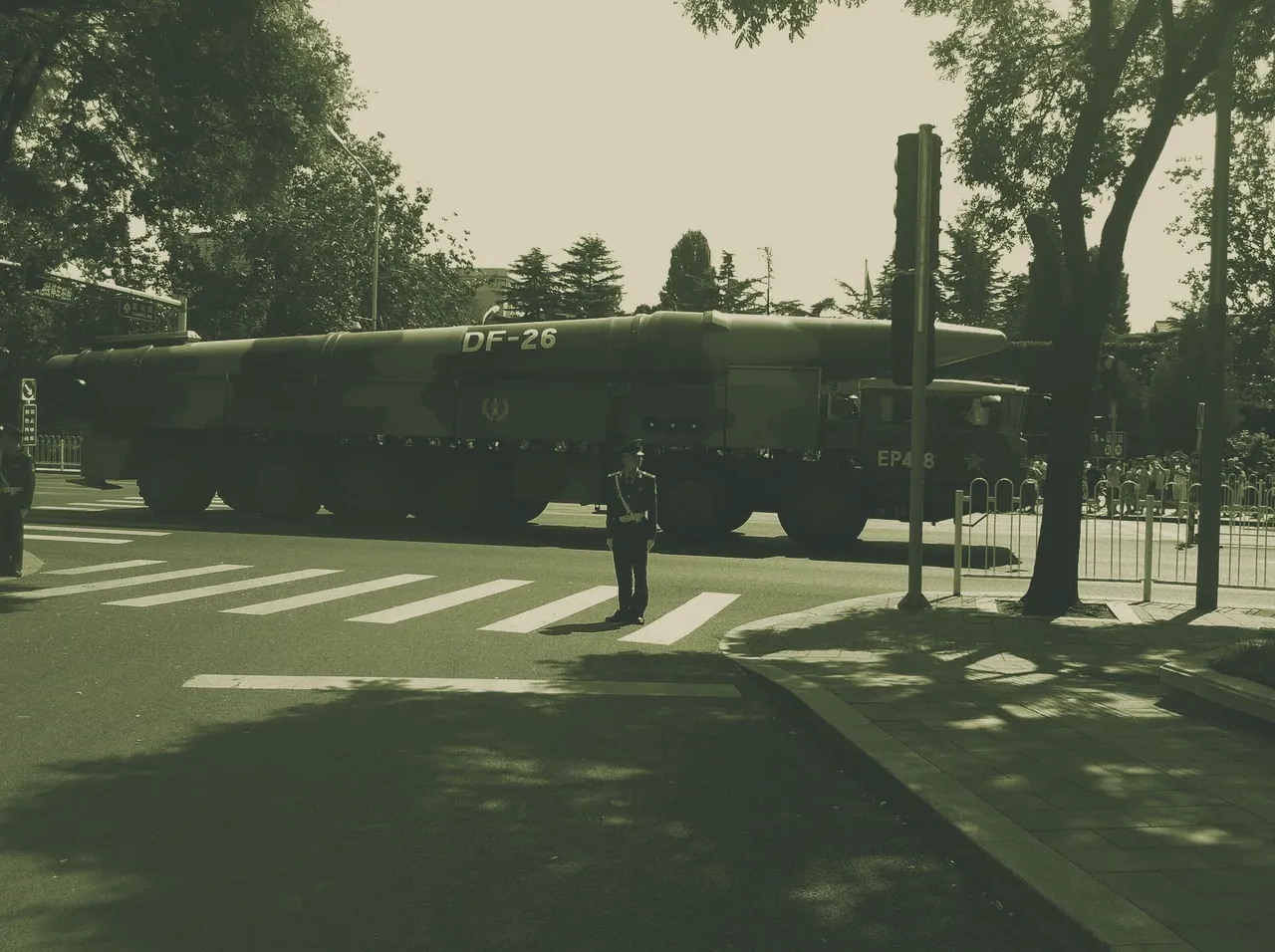
China's road-mobile, dual-capable intermediate-range ballistic missile — designed to hold US bases in the Western Pacific at risk and, in its anti-ship variant, to challenge carrier strike groups far from shore.
Overview
The DF-26 (Dong Feng-26, US DoD designation CH-SS-18) is a two-stage, solid-propellant intermediate-range ballistic missile fielded by the PLA Rocket Force. It is China’s first nuclear-armed system able to conduct precision strikes, a milestone highlighted by the US Defense Intelligence Agency, and its modular payload concept allows a single missile type to carry either nuclear or conventional warheads in a biconic maneuvering reentry vehicle The Washington Times. The range — estimated by the Center for Strategic and International Studies at roughly 4,000 km, with Chinese sources claiming more than 5,000 km — puts the US territory of Guam, major bases in Japan, and large areas of the Western Pacific within reach CSIS Missile Threat. An anti-ship variant, the DF-26B, expands the family into the anti-access/area-denial role that had previously been the preserve of the shorter-ranged DF-21D.
Development
The DF-26 first broke cover during the 1 September 2015 victory parade in Beijing. Fielding began in 2016, and the first operational brigade was publicly reported in 2018. China’s aerospace prime contractor CASC is the lead manufacturer. By 2020 the Rocket Force was assessed to operate roughly 80–100 DF-26 launchers CSIS Missile Threat, though total IRBM launchers across the force were estimated between 200 and 350. The weapon’s development reflects a deliberate Chinese effort to field a survivable, road-mobile IRBM that can hold fixed and mobile targets at risk across the Second Island Chain.
Design & capabilities
The DF-26 is carried on an HTF5680 wheeled transporter-erector-launcher, giving it the mobility needed to disperse and complicate pre-launch targeting. A two-stage solid rocket motor pushes the missile onto a ballistic trajectory; the reentry vehicle then performs hypersonic terminal maneuvers. Open-source descriptions of the guidance suite remain sparse — CSIS labels the system’s guidance simply as “unknown” — though the anti-ship DF-26B is widely assessed to integrate an active radar terminal seeker for moving-target engagement.
Warhead payload is placed at 1,200–1,800 kg, suitable for a nuclear device or a large conventional unitary warhead. The biconic maneuvering RV gives the missile a degree of terminal agility that complicates point-defense intercepts. Accuracy for the land-attack version is estimated by CSIS analysts at a CEP of ~150–450 m, a figure that makes the DF-26 effective against area targets such as airfields, logistical nodes, and port facilities, but leaves hard and deeply buried targets less vulnerable unless it employs a nuclear payload.
Variants
- DF-26 – baseline land-attack IRBM, configurable with nuclear or conventional warhead.
- DF-26B – anti-ship variant, equipped with an active terminal seeker and demonstrated against a seagoing target.
Combat record / operational use
The DF-26 has not been used in combat. Its closest operational demonstration came in August 2020, when a DF-26B was test-fired into the South China Sea alongside a DF-21D and, according to US and open-source reports, struck a moving ship, validating the anti-ship concept against a realistic seaborne target CSIS Missile Threat. The test underlined the PLA Rocket Force’s growing confidence in fielding an anti-ship ballistic missile that extends well beyond the First Island Chain.
Advantages
- Dual-capable design — nuclear or conventional — permits flexible escalation control.
- Road-mobile TEL enhances pre-launch survivability and complicates adversary strike planning.
- Range envelope (~4,000 km) puts Guam, US bases in Japan, and key sea lines of communication within reach.
- Anti-ship variant forces naval forces to account for ballistic threats at unprecedented distances, adding layers to carrier defense.
- Modular payload architecture could accommodate future warhead and countermeasure advances without a new airframe.
Drawbacks / limitations
- CEP (~150–450 m) is relatively coarse for conventional precision bombardment of hardened, point targets.
- Anti-ship seeker performance under real-world jamming and decoy conditions remains unproven; the 2020 test was a single event.
- The total number of DF-26 launchers is modest (up to ~100), limiting salvo density against defended positions.
- Like all ballistic missiles, the DF-26’s mid-course trajectory makes it theoretically vulnerable to forward-deployed or ship-based missile defense, though the maneuvering RV mitigates this somewhat.
- Supply-chain opacity means production rates and unit costs are not publicly established.
Counterparts
Outlook
The DF-26 is set to remain the backbone of China’s theater-range precision-strike force for the foreseeable future. Expanding launcher numbers and improvements in terminal homing, accuracy, and countermeasures will likely deepen the anti-access challenge that it poses. The anti-ship variant, in particular, will compel naval powers to adapt their defensive architectures well beyond the First Island Chain. Because the DF-26 is a dual-capable system with a transparent nuclear mission, its deployment patterns and numbers will continue to be prime indicators of China’s nuclear posture and conventional coercion calculus in the Western Pacific.
Key specifications
| Spec | Value |
|---|---|
| Type | Road-mobile two-stage solid-propellant IRBM |
| Range | ~4,000 km (CSIS); Chinese state sources claim >5,000 km |
| Speed (Mach / km·s⁻¹) | Hypersonic reentry (specific Mach not publicly established) |
| Warhead (type & weight) | Nuclear or conventional, 1,200–1,800 kg; biconic maneuvering RV |
| Guidance | Not publicly disclosed (CSIS labels “unknown”); DF-26B probably active terminal seeker |
| Accuracy (CEP) | ~150–450 m (CSIS analyst estimate) |
| Launch platform(s) | HTF5680 wheeled TEL |
| Propulsion | Two-stage solid |
| Length / diameter / launch weight | ~14 m / ~1.4 m / ~20,000 kg |
Sources
- CSIS Missile Threat — Dong Feng-26 (DF-26). https://missilethreat.csis.org/missile/dong-feng-26-df-26/
- Wikipedia — DF-26. https://en.wikipedia.org/wiki/DF-26
- The Washington Times — DIA reveals details of Chinese missile threat. https://www.washingtontimes.com/news/2026/apr/22/inside-ring-dia-reveals-details-chinese-missile-threat/