General Dynamics Put a Three-Year-Old AI Startup Inside the Artillery Plant That Made Nothing
Deterrence has never held a Pentagon contract. Its first named assignment is the Mesquite line that took $533 million in Army funding and produced no usable shell.
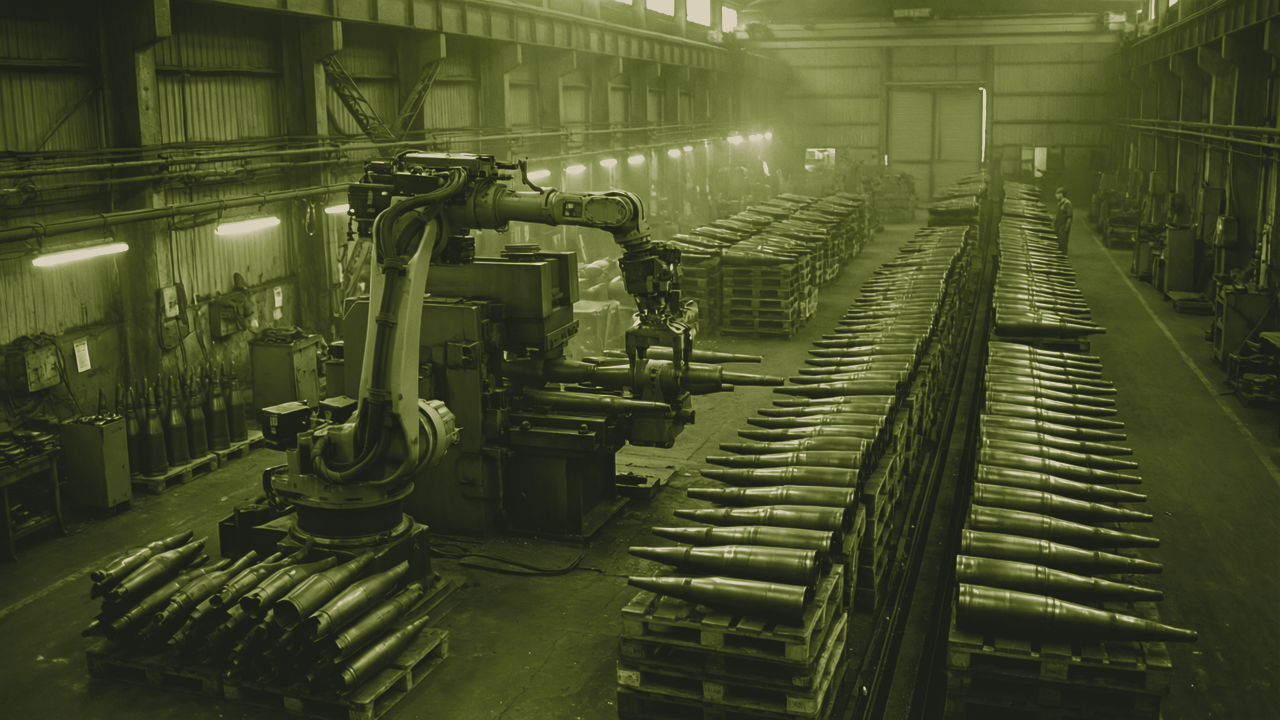
Deterrence has never held a Pentagon contract, and its first named assignment is the Mesquite line that took $533 million and produced no usable shell.
General Dynamics Ordnance and Tactical Systems and Deterrence, a manufacturing-autonomy company founded in 2023, announced a teaming agreement on June 2 to deploy AI-enabled automation across GDOTS plants. The first site is Mesquite, Texas, where GDOTS makes metal bodies for 155mm artillery shells. Neither company disclosed a contract value. The Army funded the plant.
Frequently Asked Questions
What did General Dynamics and Deterrence actually sign?
A teaming agreement announced June 2, 2026, under which Deterrence deploys AI-enabled facility optimization, intelligent automation and factory integration across GDOTS plants, starting at Mesquite, Texas. The companies disclosed no contract value.
Why does the Mesquite plant matter to the Army?
It makes metal bodies for 155mm artillery shells. The Pentagon's inspector general reported in July that without the 30,000 additional projectile metal parts expected from Mesquite, the Army cannot reach its goal of 100,000 rounds a month.
How much has the project cost?
The Army puts its spending at $533 million, per its statement to ProPublica, and says it is seeking recoupment through discounts on production orders. General Dynamics has pledged a further $200 million of its own money, Bloomberg reported.
What track record does Deterrence bring?
Limited. ProPublica reported that the company, founded in 2023, has never received a Defense Department contract, that its website gives no indication it has helped manufacture anything, and that its three founders have no prior defense experience.
When will anyone know whether this worked?
General Dynamics has told investors it expects Mesquite in production next year, and the Army told the inspector general that would amount to 20,000 shells a month, per ProPublica.
AI-generated summary, reviewed by an editor. More on our AI guidelines.
Below this point
4 more sections.
Deterrence sells a software layer that sits on an existing production line and handles facility optimization, intelligent automation and factory integration. GDOTS supplies the plant, the Army program and more than 25 sites across North America. Deterrence brings no production record. The company has never received a Defense Department contract, and its website gives no indication it has helped manufacture anything, ProPublica reported on August 12. Its three founders have no prior defense experience. A company spokesperson told Tectonic that integration work began at Mesquite at the end of May.
Mesquite opened in May 2024 as the centerpiece of the Army's push to 100,000 155mm rounds a month. It had not produced a single projectile metal part as of March 2026, the Pentagon's inspector general found in July. Without the 30,000 additional metal parts expected from the facility, the Army cannot reach that goal, the report concluded. Monthly output stood at 36,000 rounds. The Army puts its spending on the project at $533 million and says it is seeking recoupment through discounts on production orders.
General Dynamics will invest $200 million of its own money and unwind its partnership with Turkish supplier Repkon, Bloomberg reported on June 1. Repkon's equipment is to be replaced by hardware and management from Deterrence. ProPublica describes General Dynamics swapping most Repkon machines for conventional presses of the kind used in Scranton, Pennsylvania. Neither account settles how much of the line Deterrence will run. Former Mesquite workers rejected the premise. "There's nothing to learn or adapt or scale," one said. "It's all broken."
General Dynamics projects Mesquite in production next year, and the Army told the inspector general that would amount to 20,000 shells a month. That figure is the first observable test of the agreement.

Marcus Schuler
Marcus Schuler edits BattlePolicy, a daily defense-technology brief connecting the companies and capabilities behind modern war to the contest among Europe, the US, Russia, and China.