GRID-REF 37°47′N 122°25′W
DISPATCH 02/26 · 11 Jun 2026
BATTLEPOLICY
Startup to front line. Strategy to consequence.
Lexicon · Israel

Iron Beam

Israel’s first operational high-power laser air-defense system — a 100 kW directed-energy weapon designed to intercept rockets, mortar bombs and drones at a fraction of the cost of kinetic interceptors, now woven into the Iron Dome network.
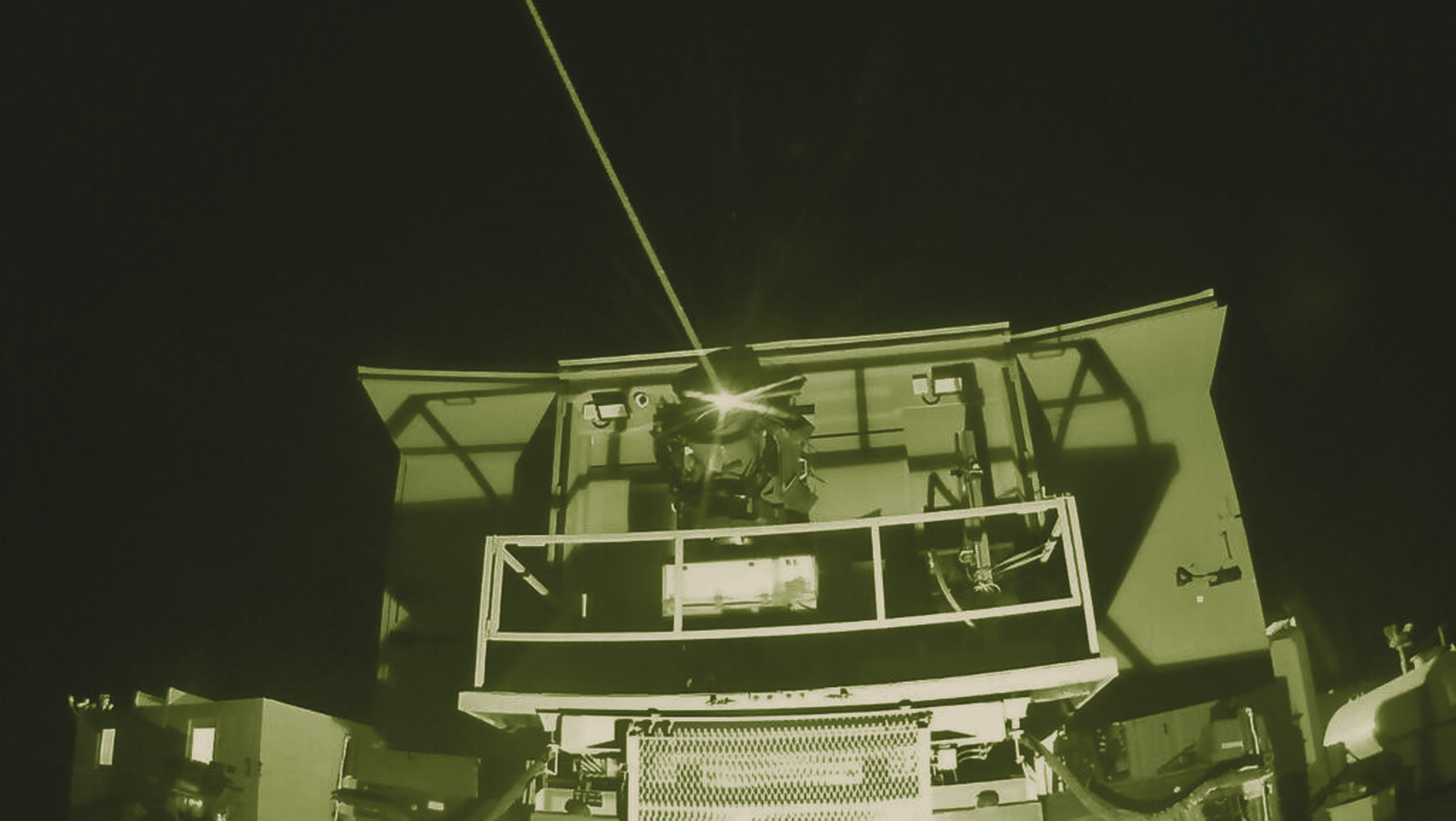
Iron Beam
FIG.01 · Israel Image - Iron Beam high-energy laser air-defense system. Photo by Rafael Advanced Defense Systems photographer, CC BY-SA 3.0, via Wikimedia Commons.
Israel’s first operational high-power laser air-defense system — a 100 kW directed-energy weapon designed to intercept rockets, mortar bombs and drones at a fraction of the cost of kinetic interceptors, now woven into the Iron Dome network.

Overview

Iron Beam (official English name: Laser Dome, Hebrew: Or Eitan) is a ground-based, high-energy laser air-defense system developed by Rafael Advanced Defense Systems with Elbit Systems as the laser source and Lockheed Martin on a US-market derivative. Designed to burn through cheap, massed aerial threats — rockets, mortar shells, one-way attack drones and, per manufacturer claims, some missile types — out to approximately ten kilometres, the system’s selling point is economics: each engagement costs single-digit dollars in electricity, compared with the $50,000-plus per Tamir missile fired by the co-located Iron Dome. The Israel Ministry of Defense declared Iron Beam operational in September 2025 and delivered the first full-production battery to the Israeli Air Force in December 2025, making it the world’s first fielded high-power laser air-defense system, according to Rafael and Wikipedia.

Development

Israel’s combat-laser lineage traces back to the US–Israel Tactical High Energy Laser (THEL) of the late 1990s, which shot down 28 Katyushas in testing but was abandoned as too bulky and expensive. Rafael resurrected the concept in solid-state form, unveiling the Iron Beam at the Singapore Airshow in February 2014. A breakthrough live-fire campaign at the White Sands test range in April 2022 destroyed drones, rockets, mortars and an anti-tank missile, with then-Prime Minister Naftali Bennett broadcasting a $3.50-per-shot figure, as reported by The Times of Israel.

Following the October 2023 Hamas attack and the multi-front war that ensued, Israel put interim, scaled-down lasers into the field as a crash program. On 28 May 2025 the Defense Ministry, IDF and Rafael disclosed that prototypes — assessed by Israeli media as Lite Beam and Iron Beam-M class, with no full Iron Beam components — had been intercepting Hezbollah drones since October 2024, including some 35–40 one-way attack drones. The ministry called the interceptions “the world’s first operational use of high-power lasers for air defense,” according to Breaking Defense. The definitive 100 kW Iron Beam completed its final qualification campaign in the summer of 2025 and was declared operational on 17 September 2025. Rafael handed over the first production system to the Israeli Air Force on 28 December 2025, with a nationwide battery rollout ordered within days and Knesset budget covering “as many batteries as needed,” detailed in The Jerusalem Post.

Design & capabilities

A standard Iron Beam battery combines a dedicated air-defence radar, a command-and-control unit and two laser effectors, each built around a fiber/solid-state laser generating about 100 kilowatts of beam power and a 450 mm-aperture telescope with Rafael-developed adaptive optics that correct for atmospheric distortion, as described by Wikipedia. The system is integrated into the Iron Dome battle-management architecture; the engagement algorithm chooses between a laser engagement and a Tamir missile intercept on a cost-and-effectiveness basis. Beam-on-target dwell time is measured in seconds — Rafael has not publicly quantified the exact figure — and the laser can re-attack immediately after a miss.

Engagement range is “up to about ten kilometres” for the full-size effector, sufficient to cover a city-size area, while the mobile Iron Beam-M is rated for five to seven kilometres and the Lite Beam for two to three. The laser’s effectiveness is constrained by cloud, rain, smoke and dust, which attenuate or disrupt the beam, a limitation that the Defense Ministry has openly acknowledged as the system’s principal weakness, according to The Times of Israel. The weapon has effectively unlimited magazine depth as long as electrical power is available, and its speed-of-light fly-out eliminates the warning-and-intercept delay typical of kinetic interceptors.

Variants

Iron Beam has spawned a family of laser effectors tailored to different scales of protection:

  • Iron Beam (baseline): 100 kW, 450 mm aperture; emplaced/relocatable, delivered to the IAF in December 2025.
  • Iron Beam 450: higher power and faster engagement cycle; unveiled at the Paris Air Show and DSEI in 2025, aiming for greater range and a quicker kill chain, reported by Defense News.
  • Iron Beam-M: 30–50 kW truck-mounted mobile effector, 250 mm aperture; reportedly capable of firing on the move, already used in “active scenarios” by Israel.
  • Lite Beam: a 10 kW system vehicle-mounted on light armoured vehicles, operational from June 2025 for point protection and counter-drone missions.
  • Naval Iron Beam: a 100 kW containerised/superstructure-integrated version for warships; preparations for sea trials on Reshef-class corvettes were reported in 2025.
  • US variant: Rafael and Lockheed Martin, under a partnership since December 2022, are working on a system targeting a combined beam of approximately 300 kW for the US “Golden Dome” architecture, noted by Wikipedia.

Combat record / operational use

Interim laser prototypes began operational shoots in October 2024, downing “scores” of one-way attack drones launched by Hezbollah. The May 2025 disclosure confirmed that those prototypes — not yet full Iron Beam systems — had intercepted roughly 35–40 drones in what the Defense Ministry termed “the world’s first operational high-power laser interceptions,” reported by The War Zone. Rafael CEO Yoav Tourgeman told FlightGlobal in February 2026 that Iron Beam achieved operational status “following battlefield deployment against Iranian missile and drone attacks” in 2025, with intercepts “of a variety of targets, very easily, from very long ranges” — claims that lack independent verification of specific Iron Beam combat kills. At the AUSA annual meeting in October 2025, Rafael stated that an Iron Beam prototype had intercepted “many dozens of targets … in real battle” and that those lessons were fed into the production configuration, as covered by National Defense Magazine.

Once the nationwide battery rollout commenced in late 2025, Iron Beam assumed a standing role inside the Iron Dome network, with the battle-management logic dynamically selecting laser or Tamir engagements based on the threat’s flight profile and cost.

Advantages

  • Near-zero marginal cost per intercept: electricity cost per shot estimated at single-digit dollars by Rafael, compared with $50,000-plus for a Tamir missile; the often-cited $3.50 figure originates from then-PM Bennett in 2022 and has been repeated by advocates, though fully-loaded overhead estimates rise to ~$2,000 per firing, per Wikipedia.
  • Effectively unlimited magazine: as long as electrical power is supplied, a battery can keep engaging threat streams without depleting interceptor stocks — a decisive advantage against massed cheap rockets and drones that previously strained Israel’s kinetic missile inventories.
  • Combat-proven before formal fielding: prototype-class lasers demonstrated real-world kills against Hezbollah drones from October 2024, accelerating confidence in the technology.
  • Instant hit, instant assessment: speed-of-light fly-out and AI-assisted aimpoint selection allow kills early in a threat’s flight, often before sirens, and enable immediate battle-damage assessment without interceptor debris over defended areas, as claimed by Rafael.
  • Reduced collateral risk: no warhead, no debris and precise dwell point limit secondary damage.

Drawbacks / limitations

  • Weather-dependent: heavy cloud, rain, smoke and dust can degrade or block the beam; the Defense Ministry has repeatedly cited this as the principal shortcoming, according to The Times of Israel.
  • Dwell-time physics: the beam must stay locked on a moving or spinning target for several seconds, making dense salvos hard to service; a battery can only engage one threat per effector at a time, though multiple effectors can be cued simultaneously.
  • Point-defence only: an effective radius of ~10 km means many batteries are needed for wide-area coverage; the full-size effector is emplaced and cannot fire while moving.
  • High acquisition cost: each system costs tens of millions of dollars (est.), so the cheap per-shot economics are only realised after a large number of interceptions; thermal management also imposes a sustained-shot-rate limit, a general high-energy laser constraint noted by analysts.
  • Countermeasure risk: hardened or reflective target skins could extend the required dwell time, potentially reducing effective engagement rates, as cautioned by open-source assessments on Wikipedia.

Counterparts

  • Iron Dome (Israel) – the kinetic layer that Iron Beam supplements, forming a layered short-range defence.
  • Flakpanzer Gepard (Germany) – a radar-directed gun system that, like Iron Beam, provides very short-range point defence against drones and low-flying threats; a conceptually older but operationally proven counterpart.

Outlook

With the first production system delivered and serial manufacturing underway, the near-term focus is scaling the battery fleet to cover the entire country while pushing the higher-power Iron Beam 450 and shipboard Naval Iron Beam into service. Rafael has said Iron Beam is “already available” for export at a “massive scale” pending Israeli government approval and is actively pitching the system for the US Golden Dome architecture, according to Defense News. Meanwhile, rival high-energy laser efforts in the US, UK, Germany and China remain in test or prototype stages. The key question for Iron Beam is no longer whether laser defence works, but how many of Israel’s threat engagements it can absorb and how quickly the economics and the architecture scale to make the laser tier the first line of the nation’s aerial shield.

Key specifications

Spec Value
Type Ground-based high-energy laser (fiber/solid-state, ~100 kW class) air-defence system; battery comprises radar, C2 and two laser effectors
Engagement range up to ~10 km (full-size Iron Beam); ~5–7 km (Iron Beam-M); ~2–3 km (Lite Beam)
Engagement altitude not publicly established
Target set rockets, mortar bombs, UAVs/drones, and some missile types (Rafael/MoD claims)
Interceptor(s) Iron Beam (100 kW, 450 mm); Iron Beam 450; Iron Beam-M (30–50 kW); Lite Beam (10 kW); Naval Iron Beam (100 kW)
Radar / fire control dedicated air-defence radar + C2 with electro-optical tracking; integrated with Iron Dome battle-management system
Reaction time beam-on-target in milliseconds; seconds of dwell required per kill (exact time not publicly established)
Simultaneous engagements one beam per effector engages one target at a time; battery can service barrages by cueing multiple effectors (Israeli official claims)
Mobility emplaced/relocatable (baseline); Iron Beam-M is truck-mobile and reportedly can fire while moving; Lite Beam mounts on light armoured vehicles

Sources

  1. Wikipedia – Iron Beam – https://en.wikipedia.org/wiki/Iron_Beam
  2. Rafael Advanced Defense Systems – Rafael Delivers 1st Operational High-Power Laser System – Iron Beam to the IDF – https://www.rafael.co.il/news/rafael-delivers-1st-operational-high-power-laser-system-iron-beam-to-the-idf/
  3. The War Zone (TWZ) – Israel’s Iron Beam Laser Air Defense System Has Downed Enemy Drones – https://www.twz.com/news-features/israels-iron-beam-laser-air-defense-system-has-downed-enemy-drones
  4. Breaking Defense – Israel has used ‘high-power lasers’ to down ‘scores’ of threats to homeland – https://breakingdefense.com/2025/05/israel-has-used-high-power-lasers-to-down-scores-of-threats-to-homeland/
  5. The Times of Israel – Laser-based ‘Iron Beam’ interception system declared operational – https://www.timesofisrael.com/laser-based-iron-beam-interception-system-declared-operational/
  6. The Times of Israel – Rafael unveils new laser interception systems, will showcase them at Paris Air Show – https://www.timesofisrael.com/rafael-unveils-new-laser-interception-systems-will-showcase-them-at-paris-air-show/
  7. National Defense Magazine – AUSA NEWS: Israel’s Iron Beam On Track for Deployment This Year – https://www.nationaldefensemagazine.org/articles/2025/10/13/iron-beam-on-track-for-deployment-this-year
  8. The Jerusalem Post – Defense Ministry rolls out Iron Beam laser air defense system across Israel – https://www.jpost.com/defense-and-tech/article-881595
  9. Defense News – Israel’s Rafael touts Iron Beam antimissile lasers at DSEI fair – https://www.defensenews.com/global/europe/2025/09/09/israels-rafael-touts-iron-beam-antimissile-lasers-at-dsei-fair/
  10. FlightGlobal – Rafael’s Iron Beam laser air defence system enters operational service in Israel – https://www.flightglobal.com/military-uavs/rafaels-iron-beam-laser-air-defence-system-enters-operational-service-in-israel/166193.article
FIELD DISPATCH · WEEKLY

BattlePolicy Weekly — free.

Defense tech, startups, and security — weekly. No paywall.

Related
Israel · missiles · precision-guided · mortar · 120mm · elbit-systems · iron-stingPro

Iron Sting

Israel's 120 mm precision-guided mortar munition, the Iron Sting, transforms any standard smoothbore tube into a room-level, dual-mode (GPS/laser) strike asset — combat-proven since October 2023 in Gaza and Lebanon.

Israel · missiles · precision-guided · mortar · 120mm · elbit-systems · iron-sting
Israel · missiles · cruise-missile · loitering-munition · standoff-strike · man-in-the-loopPro

Delilah

Israel's air-launched turbojet loitering cruise missile — man-in-the-loop precision and multi-platform flexibility from F-16s to PULS MLRS. Combat-proven since the 2006 Lebanon War, and used to suppress Iranian air defences in the 2026 Iran campaign.

Israel · missiles · cruise-missile · loitering-munition · standoff-strike · man-in-the-loop
Israel · drones · uas · tactical-uas · isr · istar · vtol · orbiter · aeronautics · RafaelPro

Orbiter 4

Israel's Aeronautics Orbiter 4 is a Group 3 tactical UAS that packs 12 kg dual-payload ISR capability — EO/IR, SAR, SIGINT — into a 50 kg airframe with a 24-hour endurance and field-switchable VTOL option, already combat-proven in Gaza as the IAF's Nitzoz.

Israel · drones · uas · tactical-uas · isr · istar · vtol · orbiter · aeronautics · Rafael