Iron Dome
Israel's battle-proven mobile system for intercepting short-range rockets, artillery shells, and drones — the bottom tier of a multi-layered air defense network, now also fielded by the US Marine Corps as MRIC.
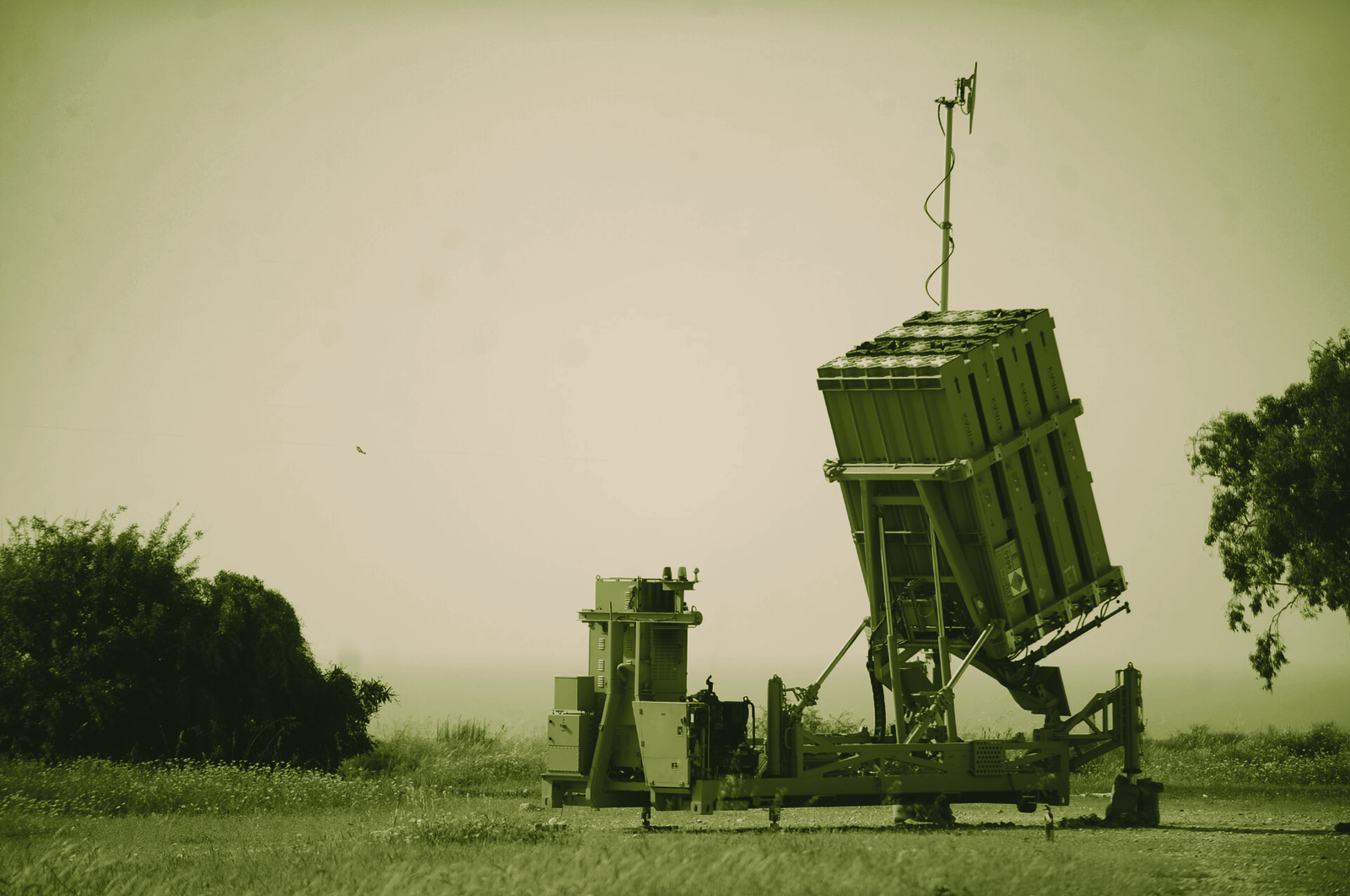
Israel's battle-proven mobile system that intercepts short-range rockets, artillery shells, mortar bombs and drones — the bottom tier of a multi-layered air defense network and now a growing US capability.
Overview
Iron Dome (Hebrew: Kippat Barzel) is a mobile all-weather short-range air defense (SHORAD) and counter-rocket, artillery and mortar (C-RAM) system developed by Rafael Advanced Defense Systems with Israel Aerospace Industries/ELTA and mPrest Systems. A single battery comprises three to four launchers, each holding 20 Tamir interceptors, a battle management center and an ELM-2084 fire-control radar, and can defend an area of roughly 150 km² against saturation rocket barrages. The system operates as the lowest layer of Israel’s integrated missile-defense architecture, beneath David’s Sling, Arrow-2/Arrow-3 and, in coalition operations, US THAAD and Aegis. Since becoming operational in 2011 it has clocked thousands of combat intercepts and has been exported to the United States (Army and Marine Corps), Azerbaijan, Romania and Cyprus.
Development
Rafael launched the Iron Dome program in 2007 after the 2006 Lebanon War, during which Hezbollah fired roughly 4,000 rockets into northern Israel, killing 44 civilians and exposing a total absence of counter-rocket defense. The system moved from a clean sheet to final testing in 2010 and was declared operational on 27 March 2011; the first combat intercept — a Grad rocket over Ashkelon — occurred barely a week later, on 7 April 2011. The United States co-funded the programme from 2011, appropriating approximately $1.3 billion between FY2011 and FY2015 and another $1 billion in 2022, and signed a co-production agreement in 2014, according to Wikipedia. Raytheon and Rafael established the R2S joint venture in August 2020 to manufacture Tamir interceptors in the US, breaking ground on a plant in East Camden, Arkansas in February 2024 and opening the facility in November 2025 alongside a $1.25 billion Tamir order for Israeli stocks.
Design & capabilities
Each Iron Dome battery is built around the ELM-2084 S-band 3D AESA multi-mission radar, which the manufacturer claims can track up to 1,100 targets simultaneously, per CSIS Missile Threat. The battle-management and weapon-control software, developed by mPrest, applies a threat-discrimination logic: it calculates the impact point of every incoming projectile and launches only against those assessed to threaten populated or strategic areas, ignoring rounds that will fall in open terrain. This conserves interceptors during mass rocket attacks. The interceptor is the Tamir — a 3 m-long, 160 mm-diameter missile weighing roughly 90 kg with a launch speed of about Mach 2.2. It carries an active radar seeker, a two-way datalink for mid-course updates, and a proximity-fuzed blast-fragmentation warhead. In US service the same missile is designated SkyHunter. The battery’s engagement envelope spans roughly 4–70 km, covering the short-range rocket and mortar threat band. In the US Marine Corps’ MRIC (Medium-Range Intercept Capability) configuration the Tamir launcher is paired instead with the AN/TPS-80 G/ATOR radar and the CAC2S command system, while the US Army’s two interim batteries retain the ELM-2084.
Variants
- Baseline Iron Dome battery: palletised/truck-emplaced launchers (20 missiles each), ELM-2084 radar and battle-management center.
- C-Dome: naval variant with vertical launch, integrated on Israeli Navy Sa’ar 6 corvettes; declared operational in 2017 for 360-degree fleet defense.
- I-Dome: single-truck configuration packing a 10-round launcher, radar and BMC on a 6×6 chassis, offering rapid relocation.
- US Army IFPC-Iron Dome: two batteries procured under a FY2019 mandate, using US trucks and the ELM-2084; fielding was capped at two batteries after integration difficulties with the Integrated Battle Command System.
- US Marine Corps MRIC: expeditionary variant with a trailer-mounted launcher, AN/TPS-80 G/ATOR radar and CAC2S command; three batteries and 1,840 Tamirs planned by end-2028.
- SkyHunter: the US-manufactured Tamir, built at the Arkansas R2S plant, interchangeable with Israeli-built rounds.
Combat record / operational use
Iron Dome logged its first intercept on 7 April 2011 and has since anchored Israel’s bottom-tier defense in every major confrontation. During Operation Pillar of Defense (November 2012) Israeli officials claimed an 85 % success rate against ∼400 threatening rockets. In Operation Protective Edge (July–August 2014) the rate was put at ∼90 % (735 intercepts out of roughly 800 engagements). The May 2021 Gaza war saw the system engage nearly 1,000 rockets in early salvos with a claimed ∼90–95 % kill rate, and it recorded its first confirmed drone kills in the same operation. After the 7 October 2023 Hamas assault Iron Dome has operated continuously against rocket, drone and missile fire from Gaza, Lebanon, Yemen and Iran.
In the June 2025 “12-Day War” Iran launched some 530–550 medium-range ballistic missiles; Israel’s layered defenses — Arrow, David’s Sling and US batteries — were credited with a 90 % interception rate, though at least 31 missiles struck military or populated areas, per Forbes. Iron Dome’s role in that campaign was officially the short-range tier, yet video collected on the ground and analysed by FDD showed Tamirs maneuvering to hit ballistic-missile bodies or warhead fragments — a capability well outside the system’s original specification. Similar footage appeared again during the 2026 Iran conflict. In May 2026 the US ambassador to Israel confirmed that Israeli-owned Iron Dome batteries and crews had been deployed to the UAE — the first known operational defense of an Arab state by the system.
On the US side, the Marine Corps’ MRIC, validated in three live-fire series in 2022, began fielding in 2025 and received its first batch of Tamir interceptors on 30 April 2026, standing up the Corps’ first medium-range air-defense unit since the HAWK was retired in the 1990s. The US Army’s two batteries, purchased between 2019 and 2021, remain an interim, non-integrated capability after the service halted expansion, citing compatibility and cybersecurity concerns.
Advantages
- Extensive combat pedigree: thousands of intercepts since 2011 with claimed success rates routinely above 85 %, making Iron Dome the most battle-proven C-RAM system in service.
- Selective engagement logic: batteries expend interceptors only against threats that endanger defended areas, stretching magazine depth against mass cheap-rocket fire.
- Expanding target set: originally a pure C-RAM system, Iron Dome has progressively added counter-drone, cruise-missile and precision-guided-munition capability, and has demonstrated an observed (if unintended) ability to engage ballistic-missile debris and leakers.
- Cost-effective interceptor: Tamir unit cost is estimated at $40,000–$100,000 — a fraction of the price of an Arrow-3 or PAC-3 round, delivering a more favourable cost-exchange against guided threats.
- Dual-continent production depth: roughly 75 % of Tamir components are US-sourced, and the R2S Arkansas plant, opened in 2025, provides surge capacity for both US and Israeli inventories.
Drawbacks / limitations
- Cost-asymmetry at the magazine level: even a cheap Tamir costs orders of magnitude more than a Qassam rocket or mortar bomb, and sustained barrages can strain stockpiles — a stress documented by FDD across the 2023–26 wars.
- Not a ballistic-missile defense system: the architecture is not designed for ballistic-missile interception; in June 2025 the primary BMD burden fell on Arrow and US systems, and 31 Iranian missiles still reached target areas.
- Saturation and coverage gaps: a single battery defends ∼150 km² and holds 60–80 ready rounds; multi-front, high-salvo attacks can locally overwhelm or exhaust a battery.
- US Army integration failure: incompatibility with the IBCS network, together with source-code and cybersecurity concerns, limited the Army buy to two batteries, which remain an interim, standalone asset.
- Adaptive threat tactics: Iranian cluster-warhead strikes in 2026 forced defenders to choose between ignoring submunitions or expending large numbers of interceptors.
Counterparts
- Pantsir-S1 (Russia)
- HQ-17 (China)
Outlook
Iron Dome’s near-term trajectory focuses on volume and integration: rebuilding Tamir stocks from two production bases, fielding the third USMC MRIC battery by 2028, and pairing kinetic intercept with the operational Iron Beam laser to cheapen the cost-exchange. The observed anti-ballistic role — though unplanned — has prompted calls from analysts at FDD for expanded US–Israeli production investment, treating the cheap bottom tier as a meaningful backstop for scarce Arrow interceptors. Politically, the brand has gone global: the US “Golden Dome for America” program explicitly borrows the name and the layered-defense concept, though the homeland threat — ICBMs and hypersonic glide vehicles — is a different class from the short-range rockets Iron Dome was built to defeat.
Key specifications
| Spec | Value |
|---|---|
| Type | Mobile all-weather SHORAD / C-RAM interceptor system |
| Engagement range | ~4–70 km |
| Engagement altitude | not publicly established (low-tier layer) |
| Target set | rockets, 155 mm artillery shells, mortar bombs, UAVs, cruise missiles, PGMs; observed anti-ballistic debris capability |
| Interceptor(s) | Tamir (SkyHunter in US) — active radar, proximity-fuzed blast-fragmentation |
| Radar / fire control | ELM-2084 S-band AESA (Israel/US Army); AN/TPS-80 G/ATOR (USMC MRIC) |
| Reaction time | not publicly established |
| Simultaneous engagements | multiple simultaneous threats (manufacturer claim); salvo engagements demonstrated |
| Mobility | relocatable truck-emplaced launchers; I-Dome on single 6×6 truck; C-Dome naval vertical launch |
Sources
- CSIS Missile Threat — Iron Dome (Israel). https://missilethreat.csis.org/defsys/iron-dome/
- Wikipedia — Iron Dome. https://en.wikipedia.org/wiki/Iron_Dome
- FDD — Iron Dome Steps Up on Ballistic Missiles (Brobst, Bowman, Leopold-Cohen). https://www.fdd.org/analysis/2026/03/25/iron-dome-steps-up-on-ballistic-missiles/
- The War Zone (TWZ) — USMC Buying Nearly 2,000 Tamir Interceptors For Its Iron Dome Systems. https://www.twz.com/usmc-buying-nearly-2000-tamir-interceptors-for-its-iron-dome-systems
- Breaking Defense — Israel delivers Tamir interceptors to US Marine Corps for MRIC program. https://breakingdefense.com/2026/05/israel-delivers-tamir-interceptors-to-us-marine-corps-for-mric-program/
- The Defense Post — US Marines Receive First Tamir Interceptors for Iron Dome-Based MRIC System. https://thedefensepost.com/2026/05/04/us-marines-tamir-interceptors/
- Forbes (Sebastien Roblin) — How Did Israel’s Air Defenses Fair Against Iran’s Ballistic Missiles? https://www.forbes.com/sites/sebastienroblin/2025/06/30/how-did-israels-air-defenses-fair-against-irans-ballistic-missiles/
- The Defense Post — Israel Sent Iron Dome Batteries, Personnel to UAE: US Ambassador to Israel. https://thedefensepost.com/2026/05/12/israel-iron-dome-uae/
- AP News — Trump’s ‘Golden Dome’ missile defense plan was inspired by Israel’s multitiered defenses. https://apnews.com/article/trump-golden-dome-israel-missile-defense-iron-da9f728b6849ebba968b4b456adb26ce
- Times of Israel — US Marines plan to procure 3 Iron Dome batteries, nearly 2,000 interceptor missiles. https://www.timesofisrael.com/us-marines-plan-to-procure-3-iron-dome-batteries-nearly-2000-interceptor-missiles/