GRID-REF 37°47′N 122°25′W
DISPATCH 02/26 · 11 Jun 2026
BATTLEPOLICY
Startup to front line. Strategy to consequence.
Lexicon · Iran

Khorramshahr

Iran's heaviest liquid-fuel medium-range ballistic missile family, derived from the North Korean Musudan, carrying large conventional warheads or submunitions out to ~2,000 km and assessed capable of 3,000 km with a lighter payload — a centrepiece of IRGC strategic strike and the subject of.
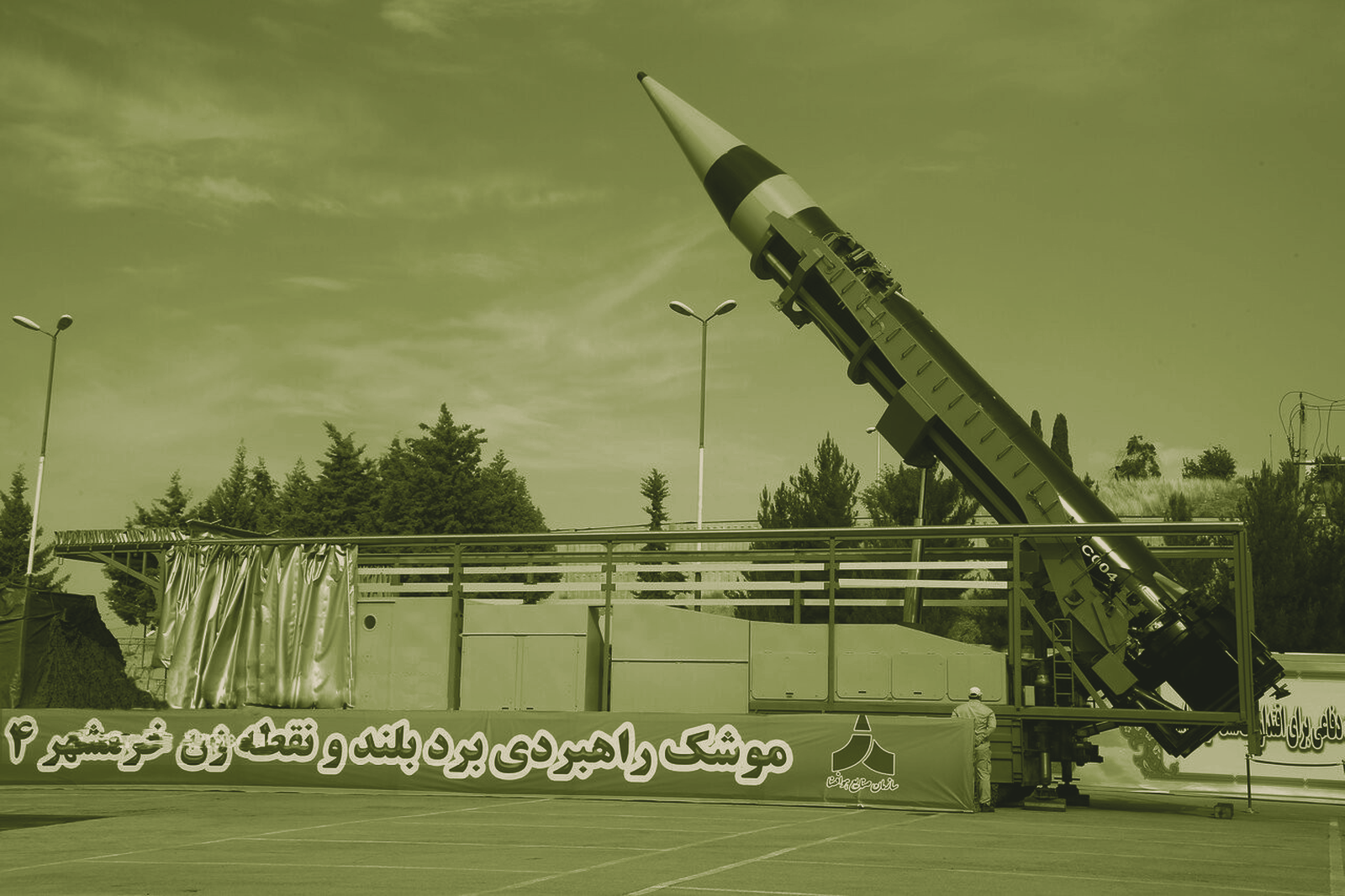
Khorramshahr
FIG.01 · Iran Image - Khorramshahr ballistic missile. Photo by Ehsan Naderipour, CC BY 4.0, via Wikimedia Commons.jpg).
Iran's heaviest liquid-fuel medium-range ballistic missile family, derived from the North Korean Musudan, capable of carrying large conventional warheads or submunitions to ranges of ~2,000 km and, with a lighter payload, potentially up to 3,000 km — a key strategic deterrent and the subject of repeated combat claims in the 2025–2026 Iran–Israel wars.

Overview

The Khorramshahr is a road-mobile, liquid-propellant medium-range ballistic missile (MRBM) operated solely by the IRGC Aerospace Force. Three main variants have been displayed since 2017, culminating in the Khorramshahr-4 (operationally named “Kheibar”), which incorporates a storable hypergolic engine, a manoeuvring reentry vehicle and a claimed 1,500 kg warhead. Western assessments consistently judge that a light-warhead configuration would allow the Musudan-derived airframe to reach 2,500–3,000 km, giving Iran an intermediate-range ballistic missile (IRBM) option it has so far kept in reserve. While Iran frames Khorramshahr as a conventional deterrent, its heavy payload class matches theoretical nuclear-delivery thresholds and has made the programme a central proliferation concern.

Development

The Khorramshahr programme is the clearest demonstration of North Korea–Iran missile cooperation. Iran reportedly acquired about 18 BM-25/Musudan missiles — themselves a land-based derivative of the Soviet R-27 submarine-launched ballistic missile — around 2005, and subsequently modified and indigenised the design, according to CSIS and Iran Watch. The first test, on 29 January 2017, failed after roughly 950 km of flight, and a broadcast “test” later that year was assessed by U.S. officials as recycled footage of the same failure. A smaller-reentry-vehicle version, Khorramshahr-2, appeared in 2019 and was flight-tested in August 2020; the March 2019 France/Germany/UK letter to the United Nations assessed that configuration could reach ~3,000 km with a ~750 kg warhead. On 25 May 2023 Iran unveiled Khorramshahr-4/Kheibar, claiming a successful test with a 2,000 km range and 1,500 kg warhead — the first variant to publicly demonstrate a storable liquid-propellant motor and a manoeuvring reentry vehicle, according to Army Recognition.

Design & capabilities

The Khorramshahr airframe is roughly 13–13.5 m long, 1.5–2.0 m in diameter, and a CSIS estimate places launch mass between 15,000 and 26,000 kg. The baseline Khorramshahr-1 and -2 use a single-stage, storable-liquid propulsion package derived from the Musudan; the Khorramshahr-4 introduces the indigenously named “Arvand” hypergolic engine, which burns a storable propellant combination that reportedly cuts the pre-launch preparation time to around 12 minutes — a drastic reduction compared with the hours-long fuelling sequences of earlier Iranian liquid-fuel missiles, according to Iranian state media Mehr News. Guidance is inertial with a claimed mid-course correction capability; the -4 adds a MaRV with eight auxiliary thrusters that Iranian sources say is immune to terminal-phase electronic warfare. Iran’s official accuracy claim is a 30 m CEP, but CSIS cautions that an older inertial-navigation system would produce a CEP closer to 1,500 m. The missile’s declared payload of 1,500–1,800 kg is Iran’s heaviest ballistic warhead; Iranian and Israeli accounts describe a cluster-warhead option that disperses around 20 submunitions (each ~2.5 kg) over a wide footprint, complicating terminal defence. Speed claims of Mach 16 exo-atmospheric and Mach 8 endo-atmospheric have not been independently verified.

Variants

  • Khorramshahr-1: Original configuration (2017), large reentry vehicle; first test failed.
  • Khorramshahr-2: Smaller, finned Emad-style reentry vehicle (2019-2020); assessed by the E3 as capable of ~3,000 km with a ~750 kg warhead.
  • Khorramshahr-4 “Kheibar”: Unveiled May 2023; hypergolic Arvand engine, storable liquid propellant, MaRV with thrust-vectoring, composite airframe with reduced radar cross-section, claimed 2,000 km range and 1,500 kg warhead.
  • Unverified “Khorramshahr-5” speculation: Appears only in regional media with outlandish claims of 5,000–12,000 km range and solid fuel; no test or official acknowledgement exists.

Combat record / operational use

No confirmed combat use predates 2025. During Iran’s June 2025 “True Promise-3” barrages — the Twelve-Day War — IRGC-linked media circulated Khorramshahr-4 launch footage on 19 June, the same day a cluster-warhead ballistic missile scattered ~20 submunitions over central Israel. However, The War Zone established that the video was recycled 2023 test footage and found no explicit Iranian claim of use; the IDF merely said it was investigating whether a Khorramshahr-4 was among the missiles, while Israel Hayom noted the technology is cluster-dispersal, not true MIRV. Attribution remains unproven.

The first explicit employment claim came during the 2026 Iran–Israel/US war. On 5 March 2026, the IRGC stated it had launched Khorramshahr-4 missiles with 1,000 kg warheads at central Tel Aviv, Ben Gurion Airport and an air base during the 19th wave of “True Promise,” with submunition impact patterns consistent with the type observed across central Israel, according to Türkiye Today. The IDF disputed the claim, asserting all overnight ballistic missiles were intercepted. Earlier, on 5 February 2026, Press TV had announced the Khorramshahr-4’s deployment in an IRGC underground “missile city,” presenting it as a second-strike capability. Throughout the 2026 war, Iranian missile attack volumes reportedly fell about 90 per cent as Israeli and U.S. strikes destroyed launchers, the same Turkish source reported.

Advantages

  • Heaviest payload in Iran’s missile inventory: a 1,500–1,800 kg warhead class that exceeds normal MRBM payloads and matches theoretical nuclear-delivery thresholds.
  • Inherent range growth: with a lighter warhead the airframe is assessed by Iran Watch as “almost certainly” capable of 2,500–3,000 km, giving Iran a latent IRBM option.
  • Khorramshahr-4’s storable hypergolic propellant cuts launch preparation to ~12 minutes (Iranian claim), greatly reducing the window for pre-emptive strike.
  • Cluster-warhead option disperses submunitions over a large footprint, complicating terminal-phase intercept and extending the lethal area (IDF-assessed ~20 bomblets across ~16-km diameter in the June 2025 pattern).
  • Claimed penetration-aid package on the -4 — MaRV with thruster-controlled manoeuvre, reduced radar cross-section, and mid-course-only guidance intended to evade terminal jamming.

Drawbacks / limitations

  • Liquid propulsion remains operationally inferior to Iran’s solid-fuel missiles (Fattah, Kheibar Shekan); even with 12-minute fuelling, it is less combat-responsive than solid-propellant systems, a key reason Iran’s doctrinal emphasis has shifted to solid fuel.
  • Thin and troubled test record: the January 2017 debut failed, and a subsequent “test” was assessed as a replay.
  • Accuracy is unproven: the Iranian-claimed 30 m CEP sits far from CSIS’s estimate of up to 1,500 m for an older inertial-navigation configuration; no independent strike data confirms precision.
  • The information environment is heavily claims-driven — range, Mach 16 speed, “MIRV” and even the “Khorramshahr-5” variant rest largely on IRGC-aligned media; Western trackers still list the system only as “possibly deployed.”
  • Large missile size (~13 m, 20–30 t) and liquid-fuel infrastructure proved vulnerable in 2025–2026: Israeli and U.S. strikes destroyed launchers and drove launch rates down dramatically.

Counterparts

  • Fattah-1 (Iran) — solid-fuel MRBM with a hypersonic glide vehicle, representing Iran’s most modern strike asset.
  • DF-26 (China) — intermediate-range ballistic missile with comparable payload and range class, fielded in conventional and nuclear roles.

Outlook

Khorramshahr sits at the intersection of Iran’s two post-war priorities: rebuilding a missile force degraded by the 2025–2026 campaigns, and preserving a breakout path to IRBM-class reach should the self-imposed 2,000 km cap be abandoned — which Iran Watch notes Tehran could do “at any time.” The restoration of UN Resolution 1929’s prohibition on nuclear-capable ballistic missile activity (snapback, September 2025) makes the heavy-payload Khorramshahr a central proliferation concern. Unverified “Khorramshahr-5” ICBM talk functions mainly as deterrence messaging, while analysts expect the family’s future to hinge on whether any U.S.–Iran deal addresses missiles at all — a prospect Tehran has consistently rejected.

Key specifications

Spec Value
Type Road-mobile liquid-fuel medium-range ballistic missile (MRBM)
Range ~2,000 km (claimed, 1,500 kg warhead); assessed 2,500–3,000 km with a lighter (~750 kg) RV
Speed (Mach / km·s⁻¹) Mach 16 exo-atmospheric / Mach 8 endo-atmospheric (Iranian claim for Khorramshahr-4)
Warhead (type & weight) Conventional HE or submunitions; 1,500–1,800 kg claimed (Khorramshahr-4: ~1,500 kg)
Guidance Inertial with claimed mid-course correction; Khorramshahr-4 features a MaRV with eight auxiliary thrusters
Accuracy (CEP) ~30 m (Iranian claim); up to ~1,500 m possible for older INS configuration
Launch platform(s) Road-mobile transporter-erector-launcher (TEL); also claimed deployed in underground “missile city” complexes
Propulsion Single-stage storable liquid propellant; Khorramshahr-4 uses the “Arvand” hypergolic engine
Length / diameter / launch weight ~13–13.5 m × 1.5–2.0 m; launch weight estimates 15,000–26,000 kg

Sources

  1. CSIS Missile Threat — Khorramshahr at a Glance. https://missilethreat.csis.org/missile/khorramshahr/
  2. Iran Watch (Wisconsin Project) — Table of Iran’s Missile Arsenal. https://www.iranwatch.org/our-publications/weapon-program-background-report/table-irans-missile-arsenal
  3. The Times of Israel — “Iran says it test-launched new missile with 2,000-km range, capable of hitting Israel.” https://www.timesofisrael.com/iran-unveils-new-missile-with-2000-kilometer-range-capable-of-hitting-israel/
  4. Wikipedia — “Khorramshahr (missile).” https://en.wikipedia.org/wiki/Khorramshahr_%28missile%29
  5. The War Zone — “Iran Just Used Ballistic Missiles With Cluster Warheads To Strike Israel.” https://www.twz.com/land/iran-just-used-ballistic-missiles-with-cluster-warheads-to-strike-israel
  6. The Jerusalem Post (Reuters) — “Iranian Khorramshahr 4 missile deployed in IRGC ‘missile city’.” https://www.jpost.com/middle-east/iran-news/article-885796
  7. Army Recognition — “Iran Khorramshahr-4 Is the Most Advanced Long-Range Missile Able to Counter Modern Air Defenses.” https://www.armyrecognition.com/news/army-news/2026/iran-khorramshahr-4-is-the-most-advanced-long-range-missile-able-to-counter-modern-air-defenses
  8. Türkiye Today — “Iran fires Khorramshahr-4 missiles at Tel Aviv, causing chaos.” https://www.turkiyetoday.com/region/iran-fires-khorramshahr-4-missiles-at-tel-aviv-causing-chaos-3215688
  9. Mehr News Agency — “How does Iran’s Khorramshahr-4 missile change war equation?” https://en.mehrnews.com/news/241491/How-does-Iran-s-Khorramshahr-4-missile-change-war-equation
  10. Israel Hayom — “Did Iranian missile scatter 80 mini warheads across Israeli cities?” https://www.israelhayom.com/2025/06/19/did-iranian-missile-scatter-80-mini-warheads-across-israeli-cities/
FIELD DISPATCH · WEEKLY

BattlePolicy Weekly — free.

Defense tech, startups, and security — weekly. No paywall.

Related
Iran · Russia · missiles · loitering-munition · one-way-attack · iran-drone · shahed · jet-dronePro

Shahed-238

Iran's jet-turbine loitering munition — a faster, costlier successor to the Shahed-136, fielded by Russia as the Geran-3 and by Iran itself in the Gulf.

Iran · Russia · missiles · loitering-munition · one-way-attack · iran-drone · shahed · jet-drone
Iran · Russia · drones · uav · mohajer · istarus · strike · surveillancePro

Mohajer-6

Iran's twin-boom multirole ISTAR/strike UAV — a runway-operated, 12-hour endurance platform armed with precision glide bombs and Almas missiles, exported to Russia, Venezuela, Sudan and others, and seeing combat from Ukraine to the Caribbean.

Iran · Russia · drones · uav · mohajer · istarus · strike · surveillance