Paveh
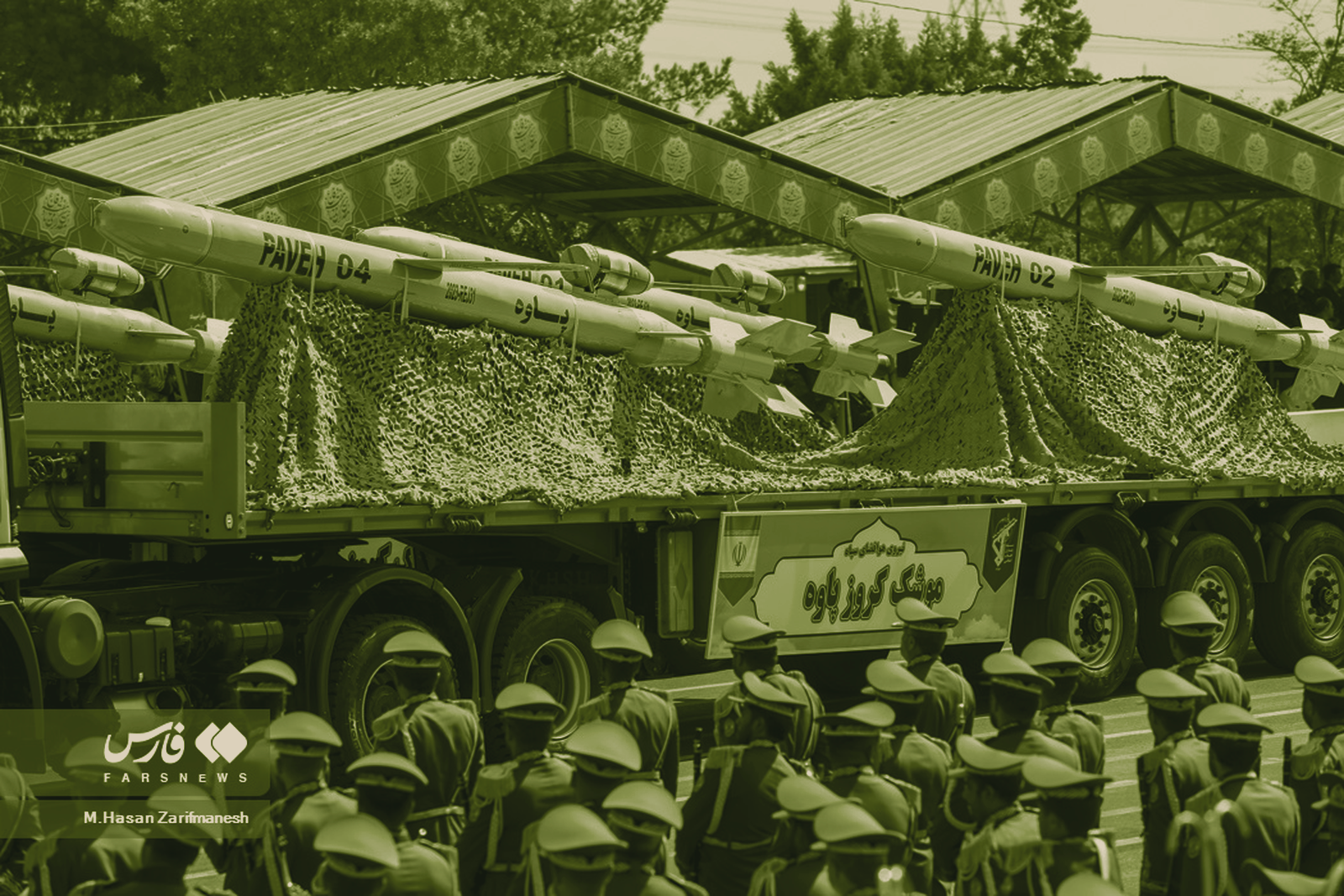
The Paveh is Iran's 1,650 km-claimed cruise missile — the IRGC's Project 351, identical to the Houthis' Quds that hit Saudi Aramco in 2019. Used against Israel in April 2024 (0 of ~30 got through), exported to three proxy arsenals, and absent from the missile-dominated 2025–26 wars.
.jpg)
The cruise missile with three names — Iran's Paveh is the IRGC's Project 351: a cheap, terrain-hugging land-attack missile with a claimed 1,650-kilometer range that exists in the Houthi arsenal as the Quds, in Iraqi militia hands as al-Arqab, and reportedly in Hezbollah's tunnels via the now-severed Syrian corridor. Its family drew first blood at Saudi Aramco's Abqaiq in 2019 and flew against Israel in April 2024 — where, by Israel's count, none of roughly thirty got through. In the ballistic-missile-dominated wars of 2025 and 2026, Iran's cruise missiles stayed conspicuously quiet.
Overview
The Paveh — named for a Kermanshah-province town, and known to Western analysts as "351" — is the current apex of Iran's land-attack cruise missile line and its most successfully proliferated strike weapon. Iran Watch's assessment is unambiguous: the Paveh and the Houthis' Quds "by all appearances… are identical," and the US Defense Intelligence Agency typed Iraqi militias' al-Arqab as Paveh-class — one design, three arsenals. Unveiled by IRGC Aerospace Force commander Amirali Hajizadeh in February 2023 with a claimed 1,650 km range (never independently verified), the Paveh is a small, ground-launched, subsonic missile: pop-out wings, a distinctive dorsal-mounted turbojet derived — per UN Panel of Experts debris analysis of the Quds — from the reverse-engineered Czech PBS TJ-100, and a terrain-hugging profile that takes roughly 2–2.5 hours to reach Israel. Iranian media add claims of route variation, 360-degree attack geometry and networked salvos with a "leader" missile — all unverified state-adjacent messaging. Its combat ledger is instructive in both directions: the family's debut at Abqaiq–Khurais (2019) blinded half of Saudi oil processing and embarrassed US-supplied defenses, while the April 2024 True Promise strike saw all ~30 cruise missiles fail to reach Israeli territory. In the June 2025 and 2026 wars — more than 1,800 ballistic missiles and thousands of drones — no Paveh use has been publicly attributed: the flagship finding of this file is that Iran's own doctrine has moved past its cruise missiles for peer-level salvos, while the design's real career is proliferation.
🔒 The full Paveh file is for BattlePolicy Pro members. Below the line: development history, design and capabilities, variants, the combat record, advantages and limitations, comparable systems, outlook, the full specifications table, our sourcing, and the analyst assessment — procurement, suppliers and the BattlePolicy verdict. Unlock the full file with BattlePolicy Pro →
Below this point
- Development
- Design & capabilities
- Variants
- Combat record / operational use
- Advantages
- Drawbacks / limitations
- Counterparts
- Outlook
- Key specifications
- Sources
- Analyst Section
- Procurement & contracts
- Suppliers & related companies
- Comparable systems — analyst view
- Analyst note