PULS
Israel’s multi-caliber precision rocket launcher — a wheeled, pod-based system that spans 12 km to 300 km with a single vehicle and has become Europe’s leading non-US alternative to HIMARS.
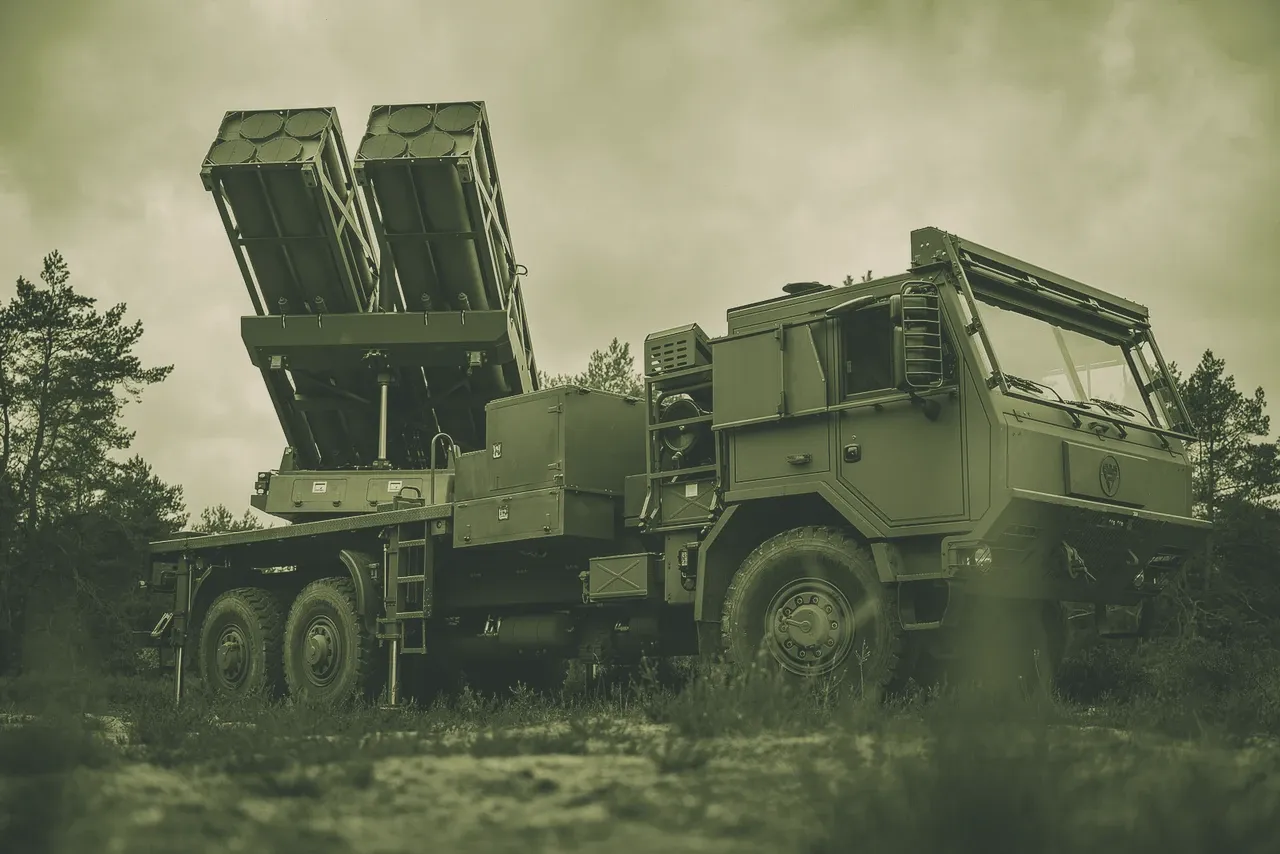
Israel’s multi-caliber, pod-based wheeled rocket launcher — a system that merges short-range saturation rockets, 300 km tactical ballistic missiles, and loitering munitions in a single vehicle, and has emerged as Europe’s primary non-US alternative to HIMARS.
Overview
The PULS (Precise & Universal Launching System) is a wheeled, pod-fed multiple rocket launcher developed by Elbit Systems. It traces its lineage to the Israeli Military Industries (IMI) Lynx MRL, and today fields a dual-pod architecture that accepts sealed launch pods for calibers from 122 mm to 370 mm — including unguided rockets, precision-guided EXTRA and Predator Hawk rounds, Delilah cruise missiles, and SkyStriker loitering munitions. Elbit’s product documentation stresses the “mix-and-match” capability: two independent pods on the same launcher can fire a different weapon type each, enabling a single vehicle to cover area suppression, deep precision strike, and organic battle-damage assessment without re-configuration. The system has been adopted by the IDF under the Lahav name, and since 2023 has secured major export contracts in Europe, Asia, and Latin America.
Development
The original IMI Lynx was unveiled at MSPO in 2013 as a multi-calibre launcher, and small batches were exported to Kazakhstan, Rwanda, and Azerbaijan before Elbit Systems acquired IMI in 2018. Wikipedia’s PULS article records those early deliveries and notes that the system was re-branded as PULS after the acquisition. The IDF first fielded the PULS — designated Lahav — in 2020, but the programme’s transformational moment came after Russia’s 2022 full-scale invasion of Ukraine, when European states urgently sought precision rocket artillery free of US export-chain dependence. Denmark became the launch export customer in March 2023 (8 units on Tatra T815 chassis), and the Netherlands followed in May 2023 with a 20-launcher order on a mix of Tatra and Scania Gryphus 8×8 platforms. Elbit’s Netherlands contract announcement values the deal at $305 million. The September 2023 teaming agreement between Elbit and KNDS Deutschland created the EuroPULS variant, later designated MARS III for the Bundeswehr. Germany ordered an initial five EuroPULS units in February 2025, with a subsequent framework agreement for up to 500 systems — roughly half for the Bundeswehr and the remainder open to European partners — disclosed in March 2026. Meta-Defense reports that parliamentary finalization is expected in H2 2026. Parallel licence-production deals have followed: India’s NIBE Limited signed a technology-collaboration agreement in July 2025, leading to an Indian Army emergency-procurement order for the Suryastra system in January 2026, and Thailand’s Defence Technology Institute continues testing the D-11A variant.
Design & capabilities
Variants
- Lynx MRL: The original IMI product (2013), available on 6×6 or 8×8 chassis. Exported to Azerbaijan, Kazakhstan, and Rwanda.
- PULS (standard): Elbit’s post-2018 production version; twin-pod architecture on multiple chassis. The IDF’s Lahav variant sits on a HEMTT 8×8.
- EuroPULS / MARS III: Co-developed with KNDS Deutschland, tailored for European chassis (Iveco Trakker, Rheinmetall HX) and intended to integrate additional NATO-standard munitions. Adopted by Germany and Greece.
- D-11A: Thai variant produced by the Defence Technology Institute on a Tatra 815-7 6×6 chassis, with a claimed 300 km range.
- Surya / Suryastra: Indian licence-manufactured variant by NIBE Limited under Elbit technology transfer; fires 150 km and 300 km rockets plus loitering munitions.
Combat record / operational use
The predecessor Lynx saw its first major combat during the Second Nagorno-Karabakh War (September–November 2020), when Azerbaijani forces employed six Lynx systems armed with EXTRA 306 mm guided rockets against Armenian defensive positions. Post-conflict open-source analyses attribute a significant tactical impact to the Lynx-EXTRA combination operating alongside drone reconnaissance. In Israeli service, the Lahav (PULS) was first used operationally in February 2024 during the Gaza war; Army Recognition reported that the system had been deployed against Hamas infrastructure and positions. Separately, a Russian-language report from Topwar notes the Lahav’s combat debut in the same period. Denmark conducted its first live-fire exercise with PULS in July 2024. To date, no PULS systems have been used in Ukraine; the German and Dutch MARS II/M270 launchers sent to Kyiv were replaced by PULS orders fulfilled within NATO countries, keeping the system itself away from direct Ukrainian employment.
Advantages
- Munitions-agnostic, dual-pod architecture: A single launcher can carry one pod of unguided rockets and one pod of 300 km tactical ballistic missiles simultaneously — a flexibility unmatched by single-pod systems like HIMARS.
- Integrated loitering munitions: PULS is the only operational MLRS confirmed to launch SkyStriker loitering munitions (up to 12 per vehicle) directly from sealed pods, merging rocket-artillery and man-in-the-loop precision strike.
- Non-US ammunition supply chain: All PULS rockets are Israeli-made, freeing European operators from US export-licence dependencies — a key consideration driving recent orders.
- High precision at stand-off range: GPS/INS-guided EXTRA and Predator Hawk achieve CEP ≤10 m at 150 km and 300 km, respectively; Accular-122 offers similar accuracy at 35 km.
- Rapid shoot-and-scoot: Full pod reload under 10 minutes, road speeds up to 90 km/h, and >750 km operational range enable fast displacement and high survivability.
Drawbacks / limitations
- High guided-munition cost: EXTRA rockets are estimated well above $100,000 each, and Predator Hawk rounds cost considerably more, making high-volume unguided barrages the affordable option but sacrificing the system’s precision advantage.
- GPS-guidance vulnerability: A Danish Army officer reported in November 2024 that the delivered PULS lacked military-grade GPS, raising jamming concerns. Elbit denied the claim, but The Defense Post notes no independent verification has been published, leaving a credibility risk.
- GMLRS incompatibility: Lockheed Martin refused to authorize integration of its GMLRS and other HIMARS-standard missiles on EuroPULS, limiting interoperable ammunition sharing with NATO allies that operate HIMARS or M270.
- Political supply-chain risk: Precision munitions are manufactured in Israel; Spain canceled a €576.5 million order in September 2025 due to the Gaza war, highlighting potential export-licence exposure for other buyers.
- Cost-per-launcher: At an estimated $10–16 million per unit, the PULS sits in the same price bracket as a HIMARS launcher but without access to the large existing NATO GMLRS stockpile.
Counterparts
- M142 HIMARS (NATO)
- BM-30 Smerch (Russia)
- M270 MLRS (NATO, tracked)
- K239 Chunmoo (South Korea)
- Pinaka Mk-II/Guided Pinaka (India)
Outlook
PULS has secured a leading position in the non-US European MLRS market, with cumulative publicly announced contracts exceeding $2 billion by mid-2026. The German framework agreement for up to 500 launchers, if fully executed, could standardize a large portion of NATO’s land-based rocket artillery outside the American ecosystem. Headwinds include the unresolved GMLRS interoperability gap, political supply-chain concerns tied to Israeli production, and competition from the US-backed GMARS (Rheinmetall HX + HIMARS launcher). The system’s unique loitering-munition integration, however, provides a capability that no current Western competitor replicates, and the domestic Indian production line opens a secondary export channel into South Asia and Africa. Near-term milestones to watch are the German parliamentary decision on the framework contract and the pace of the Greek delivery schedule.
Key specifications
| Spec | Value |
|---|---|
| Crew | 2–3 |
| Combat weight | ~38 t (est., configuration-dependent) |
| Length / width / height | ~10.5 m / 2.55 m / 3.4 m (8×8 chassis approx.) |
| Main armament | Dual interchangeable sealed launch pods; 36 × 122 mm unguided, 26 × 160 mm, 8 × 306 mm EXTRA, 4 × 330 mm Delilah, 4 × 370 mm Predator Hawk, or 12 × SkyStriker loitering munitions (6 per pod) |
| Secondary armament | None integral; typically networked with Hermes-series UAVs for target designation |
| Armor & protection | Varies by chassis (Scania Gryphus for Netherlands features armoured cab; others standard cab) |
| Engine & power | Chassis-dependent (not publicly specified per variant) |
| Power-to-weight | Not publicly established |
| Road / cross-country speed | Up to 90 km/h (road, est.); cross-country not publicly established |
| Operational range | >750 km (road, est.) |
Sources
- Elbit Systems — PULS product page. https://www.elbitsystems.com/land/weapons-systems-and-munitions/launchers/puls
- Wikipedia — PULS (multiple rocket launcher). https://en.wikipedia.org/wiki/PULS_(multiple_rocket_launcher)
- Army Recognition — Israeli Army deploys new Lahav multi-caliber MLRS against Hamas militants in Gaza Strip. https://armyrecognition.com/hamas_gaza_-_israel_war_2023/israeli_army_deploys_new_lahav_multi-caliber_mlrs_against_hamas_militants_in_gaza_strip.html
- Topwar — IDF uses Lahav multi-caliber MLRS. https://en.topwar.ru/238199-aoi-jekspluatiruet-i-primenjaet-multikalibernye-rszo-lahav.html
- Army Technology — Elbit Systems to supply PULS rocket launcher to German forces. https://www.army-technology.com/news/elbit-systems-puls-rocket-germany/
- Janes — Denmark funds more missiles and support equipment for PULS MRLs. https://www.janes.com/defence-intelligence-insights/defence-news/weapons/denmark-funds-more-missiles-and-support-equipment-for-puls-mrls
- Elbit Systems press release — $305 M contract to supply PULS to the Royal Netherlands Army. https://www.elbitsystems.com/news/elbit-systems-awarded-305-million-contract-supply-puls-rocket-artillery-systems-royal
- Army Recognition — Dutch Army receive first PULS rocket launcher systems. https://www.armyrecognition.com/archives/archives-land-defense/land-defense-2024/dutch-army-receive-first-puls-rocket-launcher-systems-from-elbit-systems
- Army Recognition — Serbia acquires Elbit Systems’ PULS Artillery Rocket System. https://armyrecognition.com/news/army-news/2025/serbia-acquires-elbit-systems-puls-artillery-rocket-system-amid-tensions-with-croatia
- Defense Magazine — Serbia acquires PULS rocket launchers on Tatra chassis. https://www.defensemagazine.com/article/serbia-acquires-puls-rocket-launchers-on-tatra-force-chassis
- OvertDefense — Germany joins European buyers of Elbit’s PULS Rocket Launcher System. https://www.overtdefense.com/2025/02/19/germany-joins-european-buyers-of-elbits-puls-rocket-launcher-system/
- Meta-Defense — The PULS rocket launcher at the heart of a German agreement for up to 500 systems. https://meta-defense.fr/en/2026/03/11/puls-accord-cadre-allemand-jusqua-500-lance-roquettes/
- Defense Mirror — Denmark secures funding for full PULS deployment worth $235M. https://defensemirror.com/news/40176/Denmark_Secures_Funding_for_Full_PULS_Deployment_Worth__235M
- Elbit Systems press release — $750 M to supply PULS to the Hellenic Armed Forces. https://www.elbitsystems.com/news/elbit-systems-awarded-750-million-supply-puls-rocket-artillery-systems-hellenic-armed-forces
- Times of Israel — Israel, Greece finalize NIS 2.3 billion purchase of Israeli artillery system. https://www.timesofisrael.com/liveblog_entry/israel-greece-finalize-nis-2-3-billion-purchase-of-israeli-artillery-system/
- Economic Times India — Nibe Limited signs agreement with Elbit to manufacture Advanced Universal Rocket Launcher. https://economictimes.indiatimes.com/news/defence/nibe-limited-signs-agreement-with-with-israels-elbit-systems-to-manufacture-advanced-universal-rocket-launcher/articleshow/122937137.cms
- The Hindu — Army signs deal to procure long-range rocket launchers Suryastra. https://www.thehindu.com/news/national/army-to-procure-long-range-rocket-launchers-in-major-deal-backed-by-israeli-technology/article70468168.ece
- Army Recognition — Peru selects Israeli PULS rocket launcher. https://www.armyrecognition.com/news/army-news/2025/peru-selects-israeli-puls-rocket-launcher-to-modernize-artillery-with-tech-transfer-and-joint-production
- Times of Israel — Spain cancels major arms deal with Israel amid Gaza backlash. https://www.timesofisrael.com/spain-cancels-major-arms-deal-with-israel-amid-gaza-backlash/
- Elbit Systems press release — $150 M contract to supply PULS to an international customer. https://elbitsystems.com/pr-new/elbit-systems-awarded-150-million-contract-to-supply-puls-rocket-artillery-systems-to-an-international-customer/
- Elbit Systems press release — ~$270 M contract to supply rocket artillery for an international customer. https://elbitsystems.com/pr-new/elbit-systems-awarded-approximately-270-million-contract-to-supply-rocket-artillery-for-an-international-customer/
- Elbit Systems press release — $130 M contract to supply PULS advanced rocket munitions to a European customer. https://www.elbitsystems.com/news/elbit-systems-secures-130-million-contract-supply-puls-advanced-rocket-munitions-european
- Defense News — Citing missile mismatch, Lockheed snarls at HIMARS challenge in Europe. https://www.defensenews.com/global/europe/2024/06/18/citing-missile-mismatch-lockheed-snarls-at-himars-challenge-in-europe/
- Business Insider — A European rival to HIMARS takes shape. https://www.businessinsider.com/new-european-europuls-rocket-launcher-could-rival-himars-2024-7
- The Defense Post — Denmark bought weapon systems from Elbit without military GPS. https://thedefensepost.com/2025/01/20/elbit-weapon-systems-denmark/