Rassvet Opens Two Daily Communications Windows Over Ukraine
Bureau 1440's first Rassvet formation can support hour-long links over Ukraine twice a day, according to Militarnyi, but terminals and launch cadence will decide its combat value.
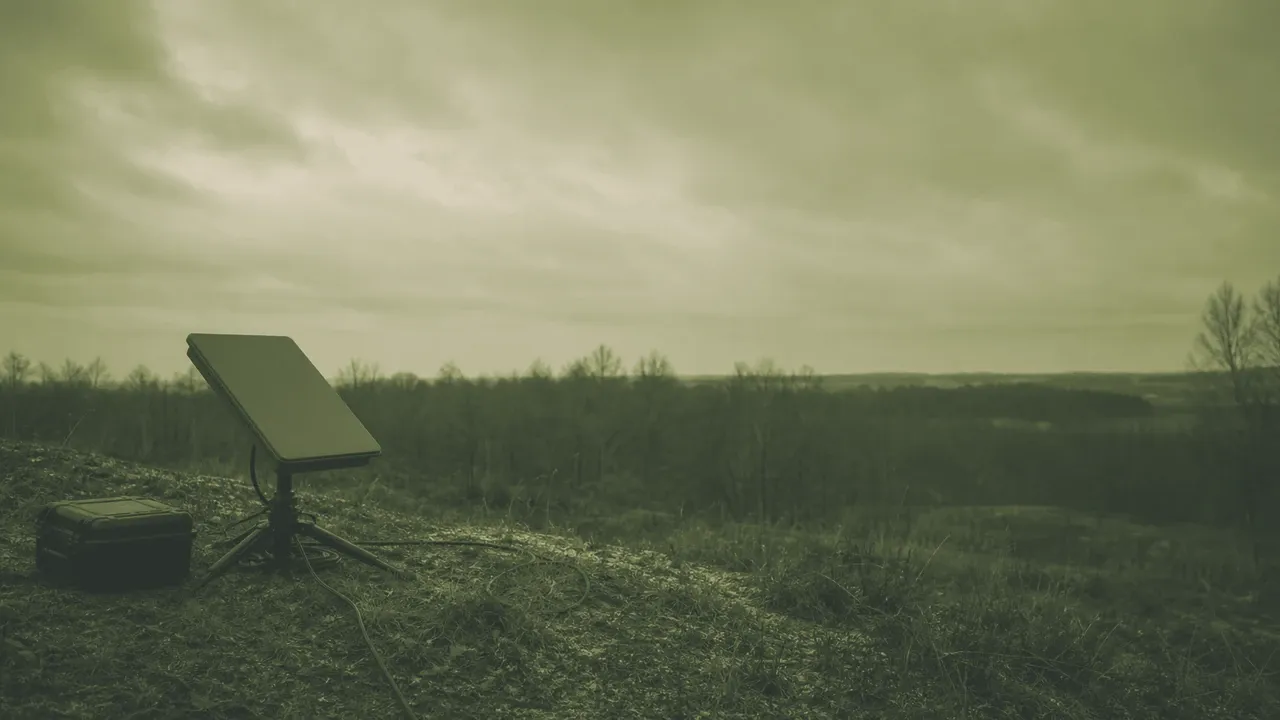
Bureau 1440's first Rassvet formation can support hour-long links over Ukraine twice a day, according to Militarnyi, but terminals and launch cadence will decide its combat value.
Russia's Rassvet network has crossed its first operational threshold over Ukraine: Bureau 1440's initial production batch now forms an orbital chain that creates at least two communications windows a day, each lasting more than an hour, satellite communications expert Volodymyr Stepanets told Militarnyi on July 31. The finding comes from public trajectory data. It does not establish that Russian forces have used the links in combat.
Twelve of the 16 satellites launched on March 23 had reached an operating altitude near 550 kilometers by July 31, according to Stepanets. Three were still climbing and one had reentered the atmosphere. He calculated that the formation passes within line of sight of Ukraine four times a day, but rises high enough for a stable link on only two or three passes. Each useful passage lasts roughly 60 to 90 minutes.
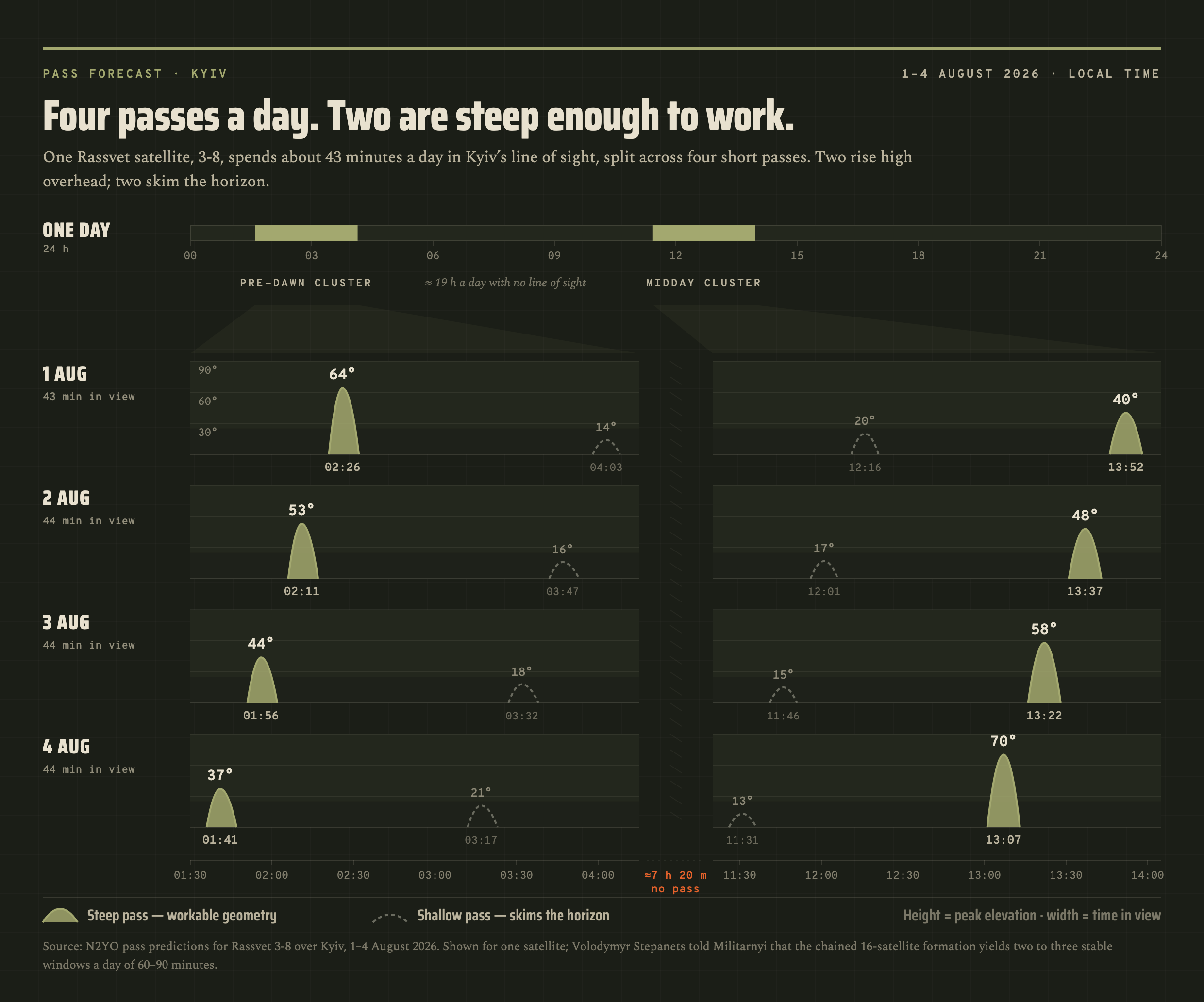
Bureau 1440 launched a second production group on July 19. TASS, citing the company, said the spacecraft separated from their carrier and entered commissioning before a transfer to their target orbits. Those satellites cannot yet extend the windows described by Stepanets. Their deployment will show whether Rassvet can add coverage at the pace its operator promises.
16 satellites and a scheduled link
Rassvet's immediate military value lies in predictable access during scheduled passes. A force that knows when a satellite chain will rise can schedule data transfers, maritime-drone control or long-range reconnaissance around the pass. Militarnyi assessed that the same channel could support heavier Geran-series strike drones. The outlet framed those uses as possibilities, and no source in the reviewed archive documented a Rassvet terminal on a Russian weapon or at a command post.
That distinction sets the current threat level. Serhiy Beskrestnov, an adviser to Ukraine's president on defense technology, told the Kyiv Post after the July launch that Russia would need several hundred satellites for effective military command, control and communications. His estimate addresses persistent service across a theatre. Stepanets's finding identifies an earlier threshold: a smaller constellation can already produce useful blocks of time over one area.
The geometry also narrows the countermeasure problem. Four daily passes do not equal four reliable links, because a satellite close to the horizon offers poorer geometry for a ground terminal than one passing higher overhead. Stepanets counted two or three stable opportunities from the first batch. If the second group forms a comparable chain by October or November, he estimated that it could add two windows. That projection depends on the new spacecraft reaching and holding their assigned orbits.
The first batch supplies a caution. RussianSpaceWeb tracked the March group from its initial orbit and found that the spacecraft raised their altitude at different rates. One vehicle, catalogued as 2026-061D, never maneuvered and reentered around June 6. Meduza later wrote that Bureau 1440 confirmed the loss to Kommersant.
A terminal under 15 kilograms
The terminal will decide whether orbital availability becomes battlefield capacity. Militarnyi described Bureau 1440's base unit as a flat active phased-array antenna measuring no more than 60 centimeters on each side, weighing under 15 kilograms and carrying a claimed throughput of as much as 1 gigabit per second. The design is meant to track moving satellites without manual pointing. Bureau 1440 has said it is preparing the base model for serial production.
Those dimensions fit vehicles, ships and fixed command posts more readily than small tactical drones. Vitalij Egorov, a Russian space expert interviewed by WIRED, said Rassvet's terminals are larger and heavier than Starlink hardware. Militarnyi nevertheless assessed that Russia could adapt them for Geran-class long-range drones or develop smaller variants. Until a terminal appears on a fielded platform, that remains a warning about integration potential rather than evidence of deployment.
The communications architecture matters because Russia cannot control access to Starlink. The Kyiv Post linked Rassvet's urgency to SpaceX's February action against unauthorized Russian terminals. Russian forces had obtained Starlink hardware through illicit channels, according to the outlet, but the service owner retained the ability to disable access. Bureau 1440 offers the Kremlin a network whose service policy, ground segment and user authorization sit under Russian control.
The system's disclosed design combines 5G non-terrestrial networking with inter-satellite laser links. TASS said the July spacecraft carry upgraded power systems, laser terminals and plasma propulsion. Bureau 1440 claimed a 10-gigabit-per-second laser test between experimental satellites in 2024, while Militarnyi recorded 14 test sessions over distances of 30 to 220 kilometers. These are company results, not measurements of a loaded operational network.
Two launches against a 250-satellite plan
Bureau 1440's constraint is serial production and launch capacity. The operator has completed two 16-satellite production launches in four months. Militarnyi calculated that its public plan requires roughly 16 satellites a month to reach 250 spacecraft and begin commercial operations in 2027. A continuation of the current interval would leave the network far below that target.
The March launch had already slipped from late 2025. SatNews attributed the delay to incomplete assembly and production failures, citing a Bureau 1440 report from January. The second batch proves that the line can deliver another group. It does not yet show a monthly rhythm. Stepanets calculated that, at one group every four months, a fourth batch would not fly until March 2027 and continuous coverage over Ukraine would arrive no earlier than the middle of that year.
Stated public and private funding totals 431.8 billion rubles. The Moscow Times, drawing on Kommersant, put federal support at 102.8 billion rubles and Bureau 1440's planned investment through 2030 at 329 billion rubles. WIRED quoted Egorov saying the company would need to produce one or two satellites a week to approach a 300-spacecraft network in the next few years, a rate he said Russian industry has not sustained.
This turns the Rassvet story into an industrial test with a military customer. The relevant threshold sits far below Starlink's global scale. It requires enough spacecraft in the right planes, terminals on suitable platforms and launch resilience to replace losses. The first communication windows reduce the number of assumptions in that chain by one. The production line and terminal fleet still carry the rest.
The first formation's visible timetable
The small fleet keeps Rassvet's growth observable. Stepanets derived the daily windows from public trajectories, while RussianSpaceWeb followed individual spacecraft after launch. Analysts can compare Bureau 1440's announcements with altitude, spacing and survival, while fixing the hours when a Rassvet-linked platform could use the first formation.
The scheduled windows create a timetable for watching the threat develop. A change in Russian drone behavior during a known pass would carry more weight than a general military-use claim. Analysts could then check a photographed terminal against the antenna dimensions and phased-array design Militarnyi published.
This monitoring interval will narrow as Bureau 1440 adds orbital planes. More satellites increase the frequency of useful passes. Stepanets's mid-2027 projection for continuous coverage assumes two more launches at the current four-month interval. A faster schedule would bring that date forward.
Four indicators through mid-2027
Four observable developments will show how quickly Rassvet moves from scheduled access to sustained military utility.
- The second group's orbit. Bureau 1440 said the July spacecraft would move from their support orbit after checks and commissioning. A formation comparable to the March group would allow analysts to calculate whether daily windows over Ukraine increase before the end of 2026.
- Terminal evidence. A verified Rassvet antenna on a command vehicle, ship or long-range drone would establish a military user segment. No such integration was documented in the archive reviewed for this analysis.
- Launch interval. The gap from March 23 to July 19 was almost four months. A third batch within weeks would support Bureau 1440's production claims; another multi-month gap would push the 2027 service plan further out.
- Orbital attrition. One of the first 16 production satellites failed within roughly 75 days, according to RussianSpaceWeb and Bureau 1440's confirmation to Kommersant. Repeated losses would consume launch capacity that the program needs for expansion.
The next hard measurement is the July group's deployment. Its altitude, spacing and survival rate will determine whether Russia adds another pair of scheduled links over Ukraine this autumn or remains with the windows Stepanets identified on July 31.
Frequently Asked Questions
Does Rassvet provide continuous coverage over Ukraine?
No. Volodymyr Stepanets told Militarnyi that the first production formation provides at least two stable windows a day, each lasting more than an hour.
How many Rassvet satellites has Bureau 1440 launched?
Bureau 1440 launched two production groups of 16 satellites in March and July 2026, according to Militarnyi and TASS. One satellite from the March group was lost.
Has Russia used Rassvet in combat?
No combat use was documented in the sources reviewed for this analysis. Militarnyi assessed that the network could support command links and larger drones, but described those roles as potential applications.
What can a Rassvet terminal do?
Militarnyi described the base terminal as an active phased-array unit under 15 kilograms, with claimed throughput of up to 1 gigabit per second. Bureau 1440 says it is preparing serial production.
What limits Rassvet's expansion?
The launch interval and satellite output remain the clearest limits. The first two production launches were almost four months apart, while Militarnyi calculated that the 2027 plan requires about 16 satellites a month.
AI-generated summary, reviewed by an editor. More on our AI guidelines.

Marcus Schuler
Marcus Schuler edits BattlePolicy, a daily defense-technology brief connecting the companies and capabilities behind modern war to the contest among Europe, the US, Russia, and China.